

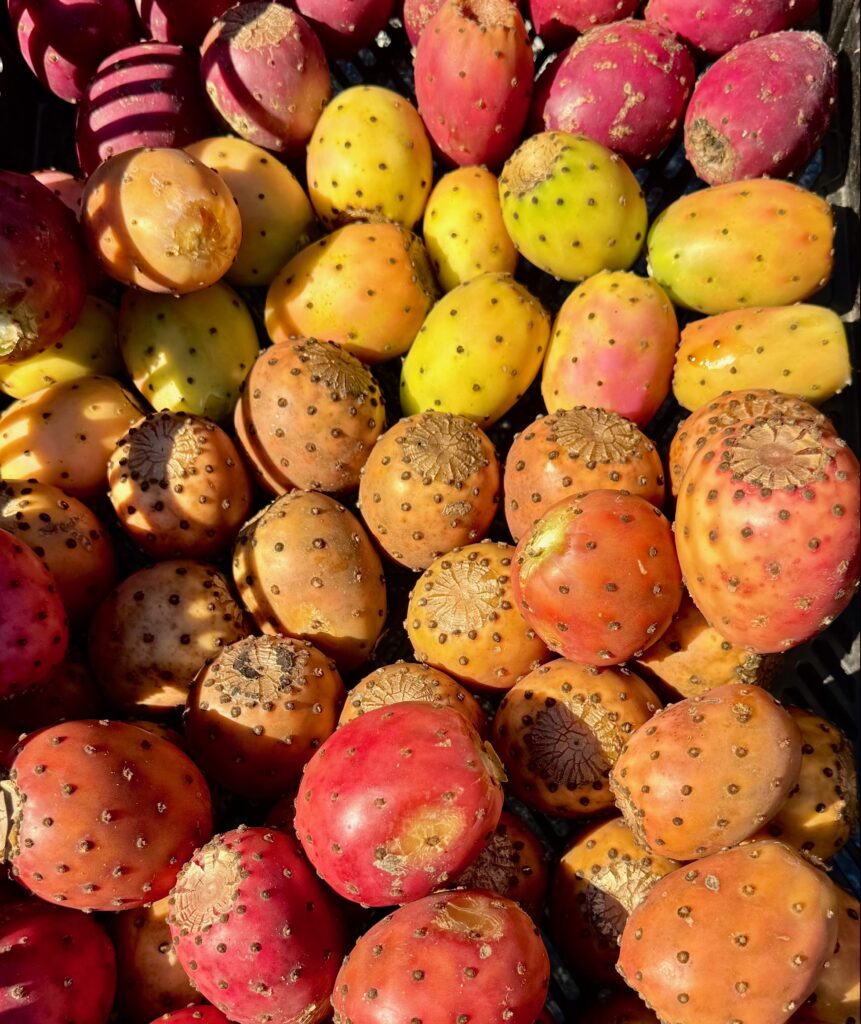
Hey; look what’s in season!
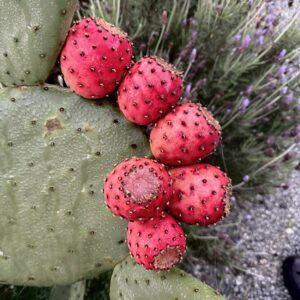
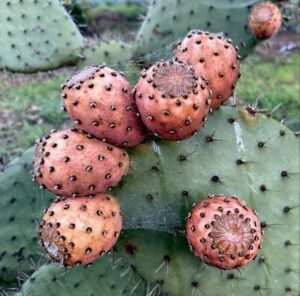
The flesh of these tunas is a bright, tangerine orange. I knew it was time to harvest because I saw the birds moving in.
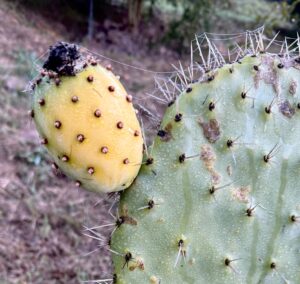
The white tunas are the biggest, and may be the sweetest, but they also have the fiercest spines.
 Hi Folks: When I was in my late 20s I had an opportunity to travel to Bolivia. Having never been there before I had no expectations, so I decided to expect the unexpected. I didn’t have to wait long for satisfaction.
The plane flight from Callao in Peru landed in La Paz around midnight. I’d been in the air or stewing in an airport waiting room for a couple of days so I had all kinds of jet lag and I was too tired to sleep well. I decided to walk around the downtown financial district and look for a cup of coffee. The eastern sky was just beginning to welcome the dawn. There still wasn’t any traffic to speak of, so when a series of small Japanese pickup trucks began rolling down the boulevards they were hard to miss. I was interested to see each of them stop at a different street corner. In each case the drivers dropped off an Afro-Bolivian woman dressed in colorful Aymara clothing topped off with the traditional Bowler hat. Then the driver would help his passenger unfold a large blanket and spread it out over the sidewalk. The two of them would then unload the pickup truck’s cargo of prickly pear cactus fruits and make a big pile in the middle of the blanket. There were purple cactus fruits, red ones, orange ones, yellow ones, and even some that were so pale as to be described as “blanca,” or white. Once his passenger was situated on her stool next to the cactus fruits the driver would zip off into the growing stream of traffic and the woman would begin to call attention to her wares. “Tasty cactus fruits,” she would sing out. “Mine are the sweetest! A rainbow of flavor! Mine are the freshest! So nutritious!”
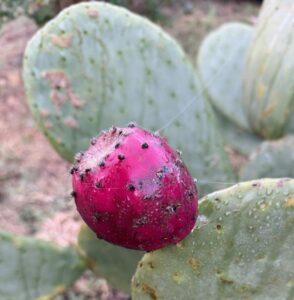
I was familiar with the red or purple prickly pears, or “tunas.” We have them here in California and they were a favorite fresh fruit snack with the Mexicans I worked with on farms but I hadn’t realized that tunas came in so many colors. I approached a vendor and pointed to an orange prickly pear. She speared the fruit with a wooden popsicle stick, deftly peeled it with a small paring knife and handed it to me. I’d watched her earlier customers walk off eating their fruit on the stick and spitting the seeds into the gutter so I did the same. I stopped at the next vendor and bought a yellow cactus fruit. A block later I bought a pink cactus fruit. By the time I got to my hotel I was out of change, but I’d eaten my way through a rainbow. In my private life, when I’m not busy being a farmer, I enjoy studying and growing cacti. Any vacation I can take inevitably ends up with me snuggling up to a cactus. I’d traveled to Bolivia to visit the vast, arid, southeast of the country which hosts some of the most spectacular stands of cacti in the world. I took it as a good omen that my first moments in Bolivia would be so cactus-centric.
When we think “desert” we think “cactus.” When I finally did get to the deserts of southern Bolivia I saw plenty of species of cacti in habitat, including some of the Opuntia varieties of cactus which yield prickly pear fruits. But the fruits I saw displayed on the street corners of La Paz were more “dessert” than “desert.” Over the millennia the Native Americans from Nebraska to Tierra Del Fuego had selected the best tasting, best yielding cactus varieties from the wild plants they encountered. They improved the crops that they chose to cultivate to the point where modern, garden variety cacti ought be considered as hardy, drought-tolerant, fruit trees more than any sort of desert plant.
Once I was back in California, I was inspired to plant some prickly pear cactus in my yard. For a long time I only had the red fruited form that is so common here, but a few years ago at a friend’s holiday party I was introduced to a fellow who was a member of the local chapter of the Rare Fruit Growers Association. He, in turn, passed my number on to a friend of his who had traveled widely across Mexico collecting every garden variety of prickly pear he could find. I was invited to visit his orchard in Morgan Hill and he gifted me one cactus pad each of 14 different kinds of prickly pear cactus.
All you have to do to propagate a prickly pear cactus plant is lay a pad on the ground. Cactus pads are not big, thick leaves, even though that is what they look like, but rather the succulent stems of the plant. Any leaves that a cactus plant will have are tiny, almost unnoticeably so, and they fall off the pad as the spines develop. The cactus leaves, and later the spines, grow out of a bud structure on the stem called the “areola.” Every areola is a bud capable of producing a root, a leaf, a flower, or a new branch. If you lay the cactus pad on the ground and wait, sooner or later it will take root and start to grow. new stems. I “planted” the 14 pads of cactus I received several years ago and now my new plants are mature enough to begin giving me my first harvests.
One of the nice things about having so many different varieties of cactus is that they don’t all mature at the same time; different varieties have different seasons when they ripen. Over time, as all the varieties mature, I’ll have fruit more often. Also. cactus plants flower on the older pads, so next year, with much bigger plants to pick from, I can expect much more fruit, but it’s fun to be able to offer some now. This morning, I ate several “tunas” for breakfast and I enjoyed my memory of the Black women in their colorful outfits hawking their colorful fruit with their colorful speech as much as I enjoyed the sweet fruit. And what do prickly pears taste like? “Tropical,” I’d say, “But not too sweet.” Starr said the yellow one she had for breakfast tasted a bit like melon. Each variety has its own nuances of flavor. Tunas are like Pokemon; ya gotta “catch ’em all.”
CAVEAT EMPTOR; Cactus fruits, Fiche d’India, Tunas, Prickly Pears, Indian Figs, whatever you want to call them, THEY ALL have spines; tiny, hair-like spines called glochids, which can be irritating if you get them on you. When I harvest the crop I wear glasses and gloves. I brush the tiny spines off each fruit with a brush before I make the cut and harvest the fruit. Once I’m back in the packing shed I wipe each fruit down with a damp rag. But there could always be a spine or two left over, despite my best efforts and intentions. They’re worth it. Thanks.
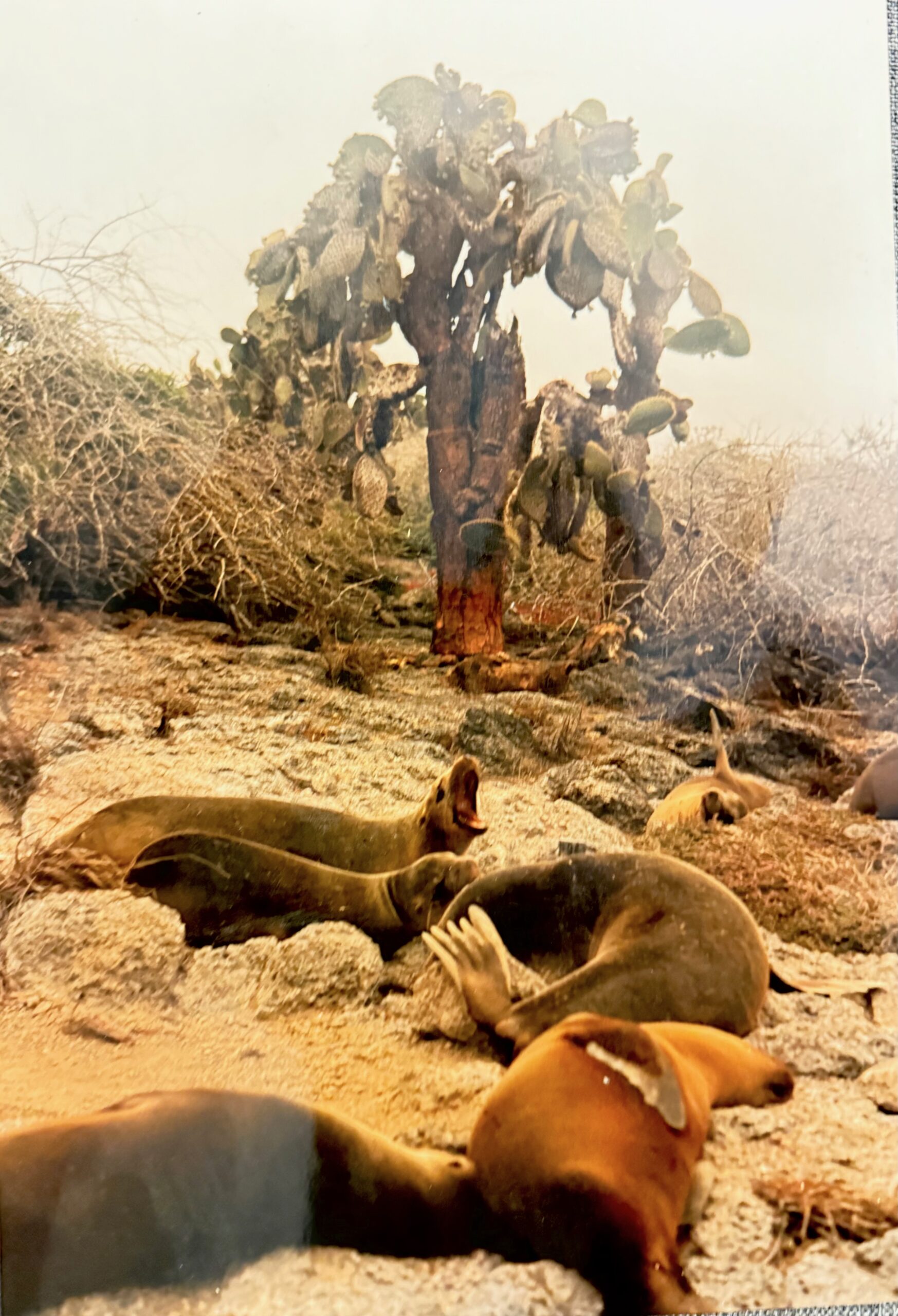
Here’s a wild prickly pear species, Opuntia galapageia, in habitat. I was standing at the water’s edge to capture this shot of the sea lions and the cactus tree in the same frame. The sea lion with his mouth open is complaining about having to say “Cheese.” As the “tunas” were not in season at the time of my visit I wasn’t able to try them. I’m sure they taste good; the huge Galapagos tortoises have the patience to wait until the fruit falls, and then they slowly eat it, relishing every moment.
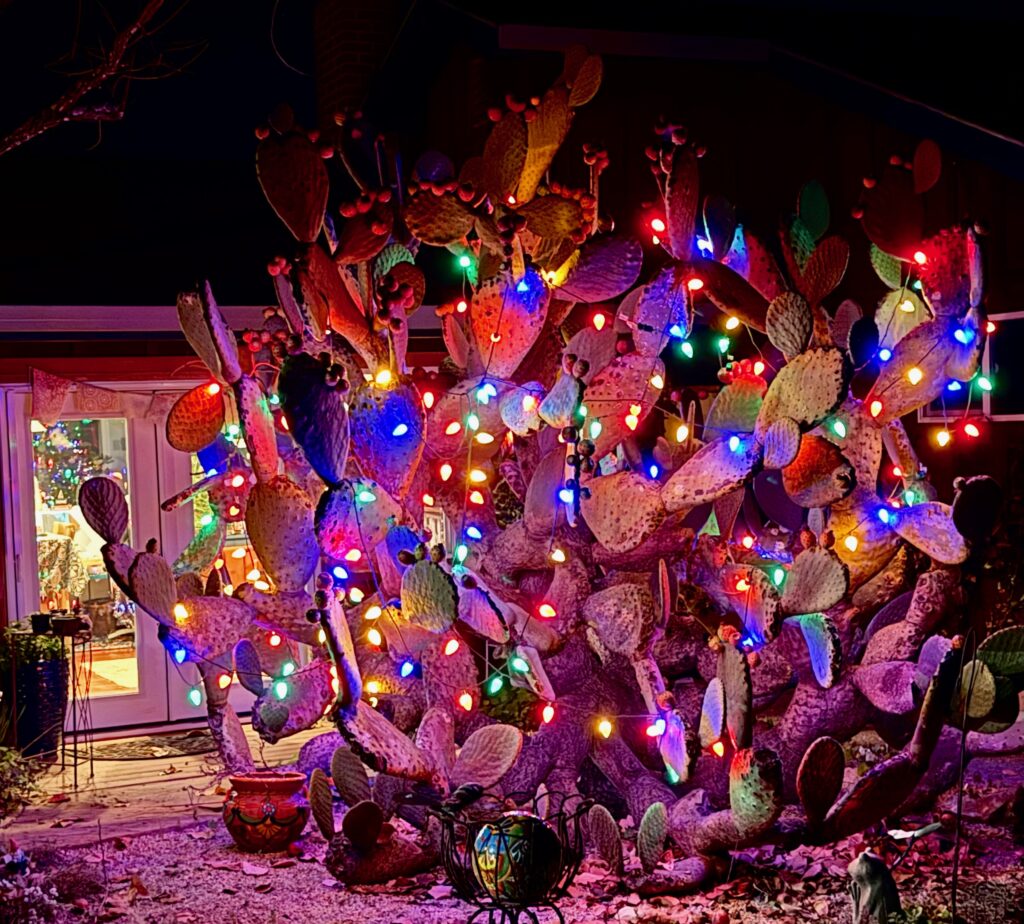
Here’s our front yard “Christmas Tree;” an Opuntia ficus-indica that I planted the day I moved to the farm 38 years ago. We wish you a merry holiday season and a happy New Year.

.
|

 Copyright © 2023 Mariquita Farm. All Right Reserved.