

Sunday In Berkeley
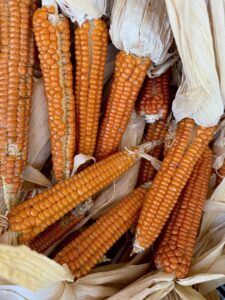
“Otto File” polenta corn, an Italian heirloom that my friend, Annabelle, originally gifted me the seeds of. Thanks, Annabelle.
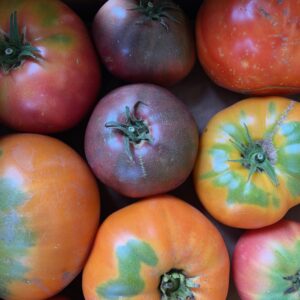
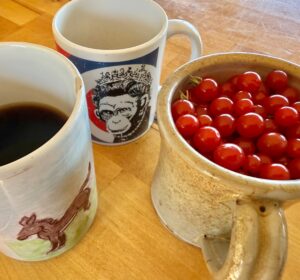
We grow these tiny “wild” tomatoes for the LA Flower market. The little tomatoes taste great, but it would take all day to fill a basket. We harvest the entire plant and ship it south to be used as a graceful and fragrant foliage green in large bouquets.
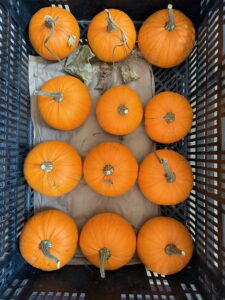
Baby Bear Pumpkins are in. They are real pie pumpkins and veritable ornamental edibles.
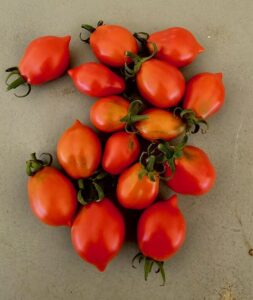
Dry-Farmed Piennolo tomatoes are so good. They taste great and if you don’t use them all at once they hang out in splendid shape for a long time. They make great dried tomatoes but they’re excellent fresh too, and I love them in sauces.
Hi Folks: Business first! We will be in Berkeley this coming Sunday with dry-farmed Early Girl tomatoes as well as dry-farmed Piennolos, San Marzanos, Cherry tomatoes and heirlooms. Red & Gold sweet & hot peppers are in season now, as are fresh Shishitos. We’ve got ornamental gourds, edible and ornamental pumpkins, cucuzzi greens and a rainbow of fresh flowers! If you already know what you want to get just drop us an email to mariquitachef@gmail.com. We’ll confirm the order and you can pay when you pick up. As always, we appreciate cash, but we accept Venmo at pick ups too. We will be popping up on Sunday, September 21st, in West Berkeley on 9th Street at Willow’s House between Virgina and Cedar Streets, from 9-11. This is a day later than previously announced but we needed to make the change to work some kinks out of life and get some homework done. Thanks, Willow, Thanks, Willow, for generously sharing your space and your enthusiasm for preserving heirloom vegetables and traditional foodways.
For those of you who don’t know Sunday’s pop-up hostess, Willow has long been active in the East Bay Slow Food Convivium. If you want to learn about the efforts the Slow Food Movement is making to preserve, promote and popularize the open pollinated crops that our ancestors have left for us you might want to check into Slow Food. Here’s a link to their “Ark of Taste.” https://slowfoodusa.org/ark-of-taste/
We will be bringing a number of heirloom crops to Sunday’s West Berkeley pop-up, including Tromba d’Albenga squash, Chilacayotes, Otto File corn, Galeaux d’Eysines pumpkins, Tennerumi di Cucuzzi, Tusta peppers, and tomatillo de Milpa. None of these crops are produced by the big growers here in California or sold in any regular supermarket but they all make sense in the context of a little farm like ours serving a public like you. I learned about each crop and how to grow it from a different person, so besides taking delight in their varied colors, shapes and flavors, every harvest reminds me of a friend I’ve made. Here’s my “origin story” for one of these crops, the Tomatillo de Milpa:
“We live in a Paradise, Andres,” Ramiro said. “But there’s something missing.”
“Oh yeah?” I responded. “What would that be?”
It was 1992 or 1993. The date doesn’t matter much now since it seems like another lifetime before marriage, kids, or the trials, triumphs or tribulations of being a small business owner. Ramiro and I both worked on an organic farm together, and I shared my home with him and his family. The two of us were sitting around a campfire in the yard, waiting for the coals to develop that we’d be cooking over. No hurry, no worry. It was early evening on a quiet Sunday. The women were in the house hanging out, the children were playing in the dirt behind us with their dolls and toy trucks and the cat was keeping an eye on them. There were no flies or mosquitos to annoy anyone, a little ribbon of smoke rose straight into the skies and not into the eyes and a tasty dinner was about to take shape around the fire. Maybe it wasn’t paradise but it beat sitting around on a cloud with Jimmy Swaggart, Pat Robertson and Jerry Falwell while the angelic hosts twanged out “Onward Christian Soldiers” on their harps for ETERNITY.
“Look around you.” Ramiro made a grand gesture. “We’ve got all the space we could want, with a garden, a pear tree, two persimmon trees and a lemon tree. There are goats in the corral, tunas on the nopales, plenty of firewood in the shed and there’s water in the well! But….”
“But what?”
“There are no tomatillos in the milpa!”
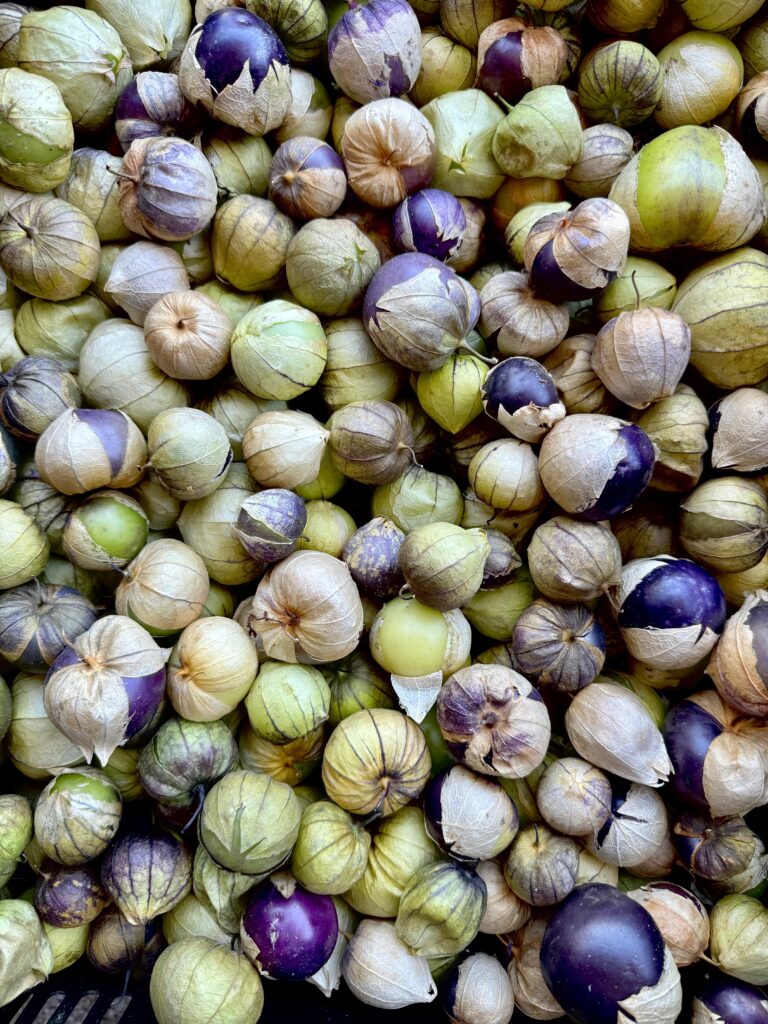
Tomatillo de Milpa
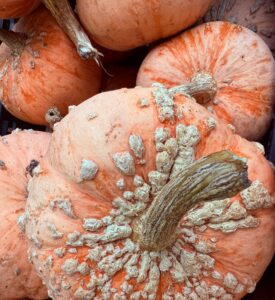
Galeaux d’Eysines, a sweet, heirloom, French cooking pumpkin that can serve as an ornament until it’s made into dinner.
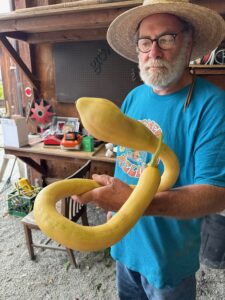
Here I’m posing with an heirloom Italian Butternut squash cousin called “Tromba d’Albenga”
I knew what a milpa was. The traditional Pre-Columbian Mexican farming style was based around a Holy Trinity; corn, squash, and beans. The logic of the milpa is as follows; the corn stalks grow tall and provide the beans with a sturdy cane to climb up for support. The squashes grow out horizontally and their broad leaves choke out the weeds. Taken together, the corn, squash and beans work together to create a balanced diet for the farmer. Also, the beans work to capture atmospheric nitrogen and convert it into a soluble form that plants can take up as natural fertilizer. It’s almost magic. And when you consider that two of the worst pests in corn, the corn earworm and the corn fungus were both traditionally “controlled” by being appreciated as delicacies and consumed with alacrity, the milpa reveals itself as a remarkably sustainable food system. But of course there are weeds….
“We can get tomatillos in the market,” I said.
“Sure,” Ramiro replied. “But you have to pay for them. Besides, the best tomatillos with the most authentic flavor are the milperos. Luckily, my sister is arriving tomorrow and I asked her to bring me some tomatillos de milpa from home.”
By “home” Ramilro meant a ranch in the hills outside of La Barca, Jalisco, not far from Lake Chapala. His sister did, indeed, bring a handful of small, purple tomatillos from their milpa back home. Ramiro and I had a project together, unrelated to the farm where we both worked. In the field below the house we planted a patch of garbanzos and we sold huge bundles of the fresh plants heavy with fat, full little bean pods out of the back of my pick-up in the streets of Pajaro. Ramiro scattered the purple tomatillos along the edges of the garbanzo field and when we worked the ground up the following spring the tomatillos all sprouted. Ramiro and I worked together at Frogland Farm, and then at Riverside Farm. By the time I started Mariquita Farm Ramiro had returned to La Barca where he bought his own ranch and began raising dairy goats. That was almost thirty years ago now, but Ramiro’s tomatillos are still with me. They germinate like clockwork every spring, and they’ve spread to every corner of the ground that I cultivate.
I could get mad and say that Ramiro was a vector spreading a noxious weed, but it’s not like that at all. The tomatillo de milpa really is a good tasting crop and it is beautiful. They are so decorative that we have actually been harvesting big, tall tomatillo de milpa plants and selling them into the LA Flower Market where they are appreciated for their airy grace and durability as a “cut flower.” And we sell the colorful tomatillo fruits to people who want to make a flavorful salsa verde. (Note; if you want to make salsa verde the way Ramiro does you will roast the tomatillos around the fire until they’re soft enough to mash into sauce in a molcajete. It’s nice to add some roasted onion too, with a little roasted jalapeno pepper, a pinch of salt and a squeeze of lemon.
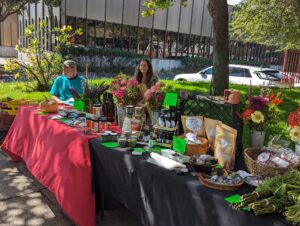
Here’s looking out across our pop-up in Dogpatch. A super pleasant scene. Thanks, SF.
Back to business; On Saturday September 27th, we plan to be back in San Francisco’s Dogpatch, from 9-12, in front of Piccino Restaurant. Then, on Sunday, October 5th, we’ll be back in Palo Alto. On Saturday, October 11th, it’s back to Berkeley and on Sunday, October 11th, we’ll be in our own home city of Corralitos.
Past these dates I don’t want to tempt fate by offending the weather gods with my hubris. People ask me, “How long will the tomato season last?” Truly, if I could honestly and correctly answer that question my talents would be better employed at a weather bureau. Generally speaking, September is a great month for tomatoes and October can be great but it’s hard to predict how the season will progress. It’s worth noting that we produce a lot more than tomatoes and when we can do a pop-up that showcases our other crops and products we look forward to doing so. Also, as our sacramental marigold crop comes into focus we will announce a series of U-Pick Marigold events. Keep an eye on the newsletter for announcements as all dates are tentative by nature. (That’s a pun, LOL, because Mother Nature ALWAYS calls the shots.)Thanks, Starr & Andy
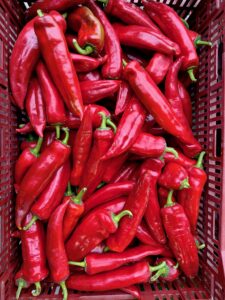
Red Anaheim peppers mix the sweet with the heat.
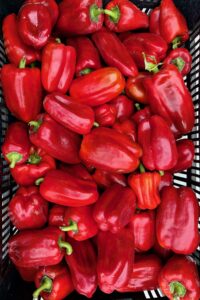
Red Bell peppers
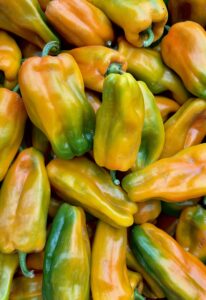
Sweet Golden Bull Horn peppers aka “Corno di Toro”
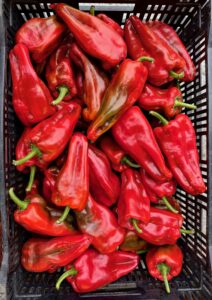
Red Bull Horn Peppers; all sweet, no heat

Starr is drying these sunflower plants for florists to use in their larger dried arrangements.
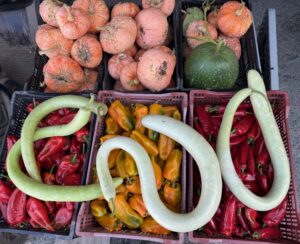
The cucuzzi gourds will naturally curl if they are not grown on a trellis to hang down from.
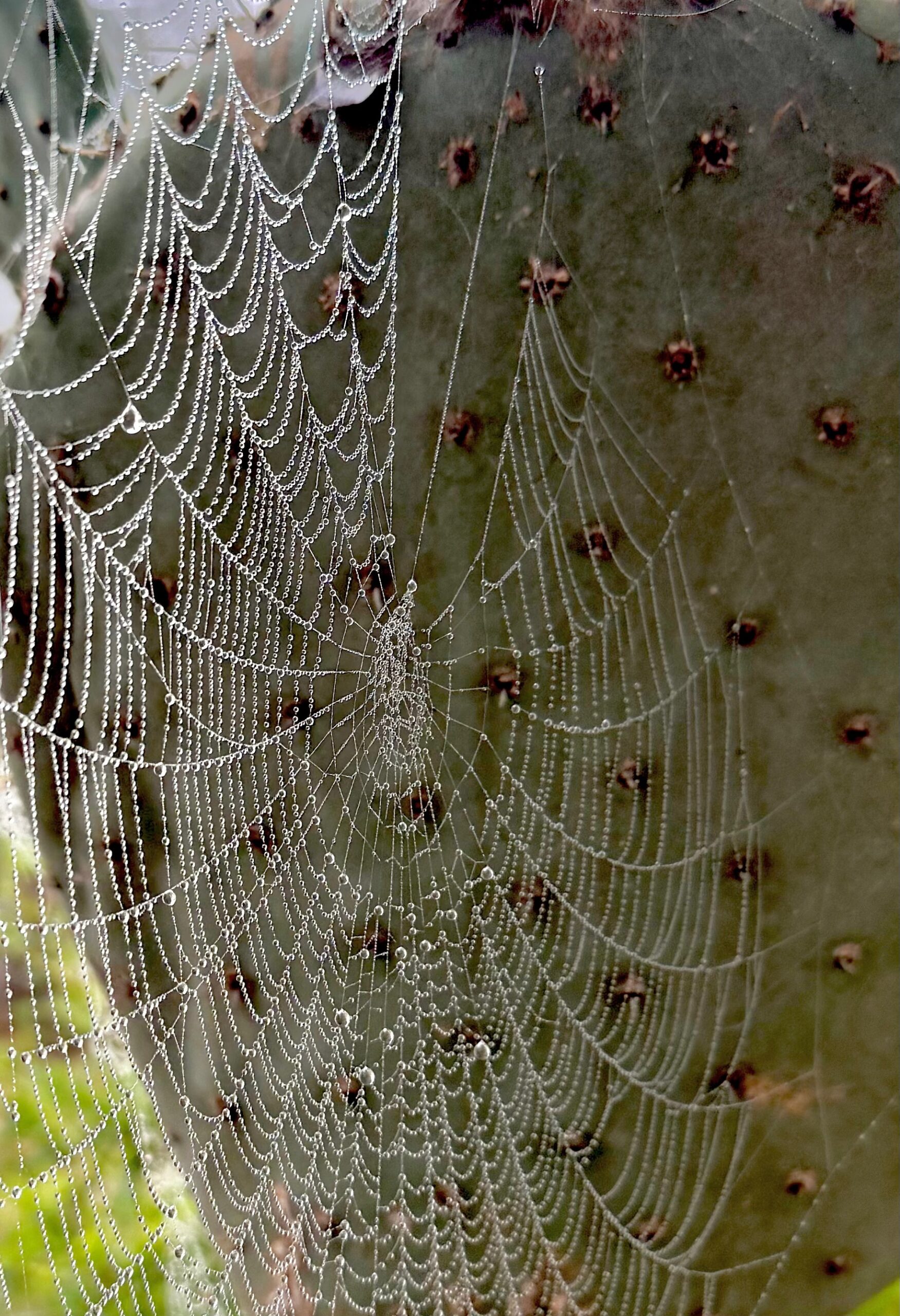
Who needs diamonds when you have fog an a spiderweb?

.
|

 Copyright © 2023 Mariquita Farm. All Right Reserved.