

Ladybug Postcard
Sunday In Berkeley
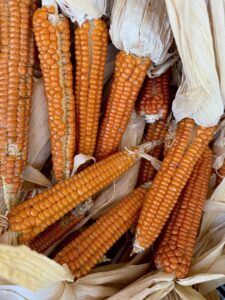
“Otto File” polenta corn, an Italian heirloom that my friend, Annabelle, originally gifted me the seeds of. Thanks, Annabelle.
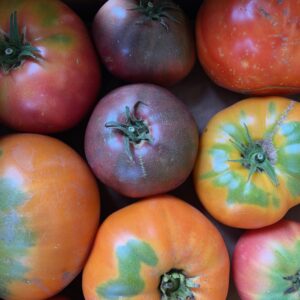
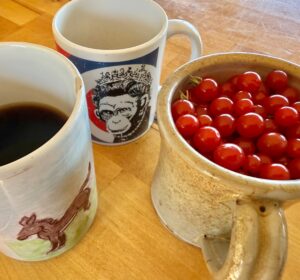
We grow these tiny “wild” tomatoes for the LA Flower market. The little tomatoes taste great, but it would take all day to fill a basket. We harvest the entire plant and ship it south to be used as a graceful and fragrant foliage green in large bouquets.
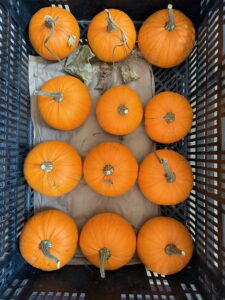
Baby Bear Pumpkins are in. They are real pie pumpkins and veritable ornamental edibles.
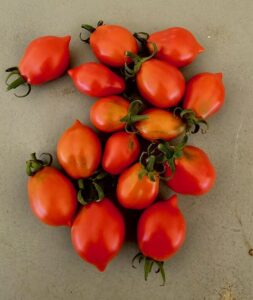
Dry-Farmed Piennolo tomatoes are so good. They taste great and if you don’t use them all at once they hang out in splendid shape for a long time. They make great dried tomatoes but they’re excellent fresh too, and I love them in sauces.
Hi Folks: Business first! We will be in Berkeley this coming Sunday with dry-farmed Early Girl tomatoes as well as dry-farmed Piennolos, San Marzanos, Cherry tomatoes and heirlooms. Red & Gold sweet & hot peppers are in season now, as are fresh Shishitos. We’ve got ornamental gourds, edible and ornamental pumpkins, cucuzzi greens and a rainbow of fresh flowers! If you already know what you want to get just drop us an email to mariquitachef@gmail.com. We’ll confirm the order and you can pay when you pick up. As always, we appreciate cash, but we accept Venmo at pick ups too. We will be popping up on Sunday, September 21st, in West Berkeley on 9th Street at Willow’s House between Virgina and Cedar Streets, from 9-11. This is a day later than previously announced but we needed to make the change to work some kinks out of life and get some homework done. Thanks, Willow, Thanks, Willow, for generously sharing your space and your enthusiasm for preserving heirloom vegetables and traditional foodways.
For those of you who don’t know Sunday’s pop-up hostess, Willow has long been active in the East Bay Slow Food Convivium. If you want to learn about the efforts the Slow Food Movement is making to preserve, promote and popularize the open pollinated crops that our ancestors have left for us you might want to check into Slow Food. Here’s a link to their “Ark of Taste.” https://slowfoodusa.org/ark-of-taste/
We will be bringing a number of heirloom crops to Sunday’s West Berkeley pop-up, including Tromba d’Albenga squash, Chilacayotes, Otto File corn, Galeaux d’Eysines pumpkins, Tennerumi di Cucuzzi, Tusta peppers, and tomatillo de Milpa. None of these crops are produced by the big growers here in California or sold in any regular supermarket but they all make sense in the context of a little farm like ours serving a public like you. I learned about each crop and how to grow it from a different person, so besides taking delight in their varied colors, shapes and flavors, every harvest reminds me of a friend I’ve made. Here’s my “origin story” for one of these crops, the Tomatillo de Milpa:
“We live in a Paradise, Andres,” Ramiro said. “But there’s something missing.”
“Oh yeah?” I responded. “What would that be?”
It was 1992 or 1993. The date doesn’t matter much now since it seems like another lifetime before marriage, kids, or the trials, triumphs or tribulations of being a small business owner. Ramiro and I both worked on an organic farm together, and I shared my home with him and his family. The two of us were sitting around a campfire in the yard, waiting for the coals to develop that we’d be cooking over. No hurry, no worry. It was early evening on a quiet Sunday. The women were in the house hanging out, the children were playing in the dirt behind us with their dolls and toy trucks and the cat was keeping an eye on them. There were no flies or mosquitos to annoy anyone, a little ribbon of smoke rose straight into the skies and not into the eyes and a tasty dinner was about to take shape around the fire. Maybe it wasn’t paradise but it beat sitting around on a cloud with Jimmy Swaggart, Pat Robertson and Jerry Falwell while the angelic hosts twanged out “Onward Christian Soldiers” on their harps for ETERNITY.
“Look around you.” Ramiro made a grand gesture. “We’ve got all the space we could want, with a garden, a pear tree, two persimmon trees and a lemon tree. There are goats in the corral, tunas on the nopales, plenty of firewood in the shed and there’s water in the well! But….”
“But what?”
“There are no tomatillos in the milpa!”
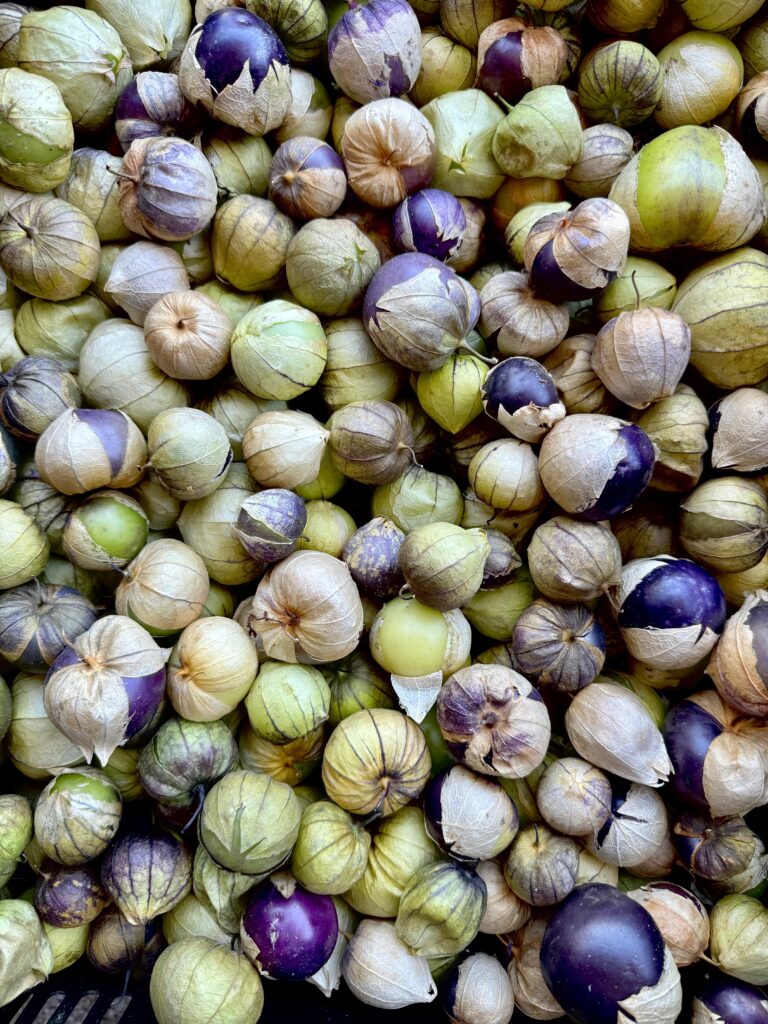
Tomatillo de Milpa
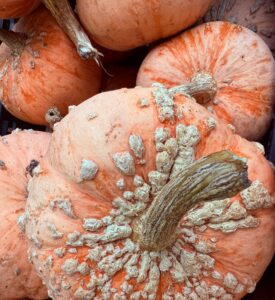
Galeaux d’Eysines, a sweet, heirloom, French cooking pumpkin that can serve as an ornament until it’s made into dinner.
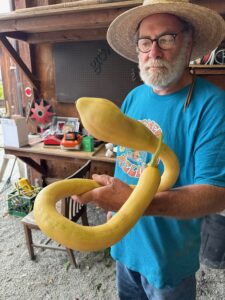
Here I’m posing with an heirloom Italian Butternut squash cousin called “Tromba d’Albenga”
I knew what a milpa was. The traditional Pre-Columbian Mexican farming style was based around a Holy Trinity; corn, squash, and beans. The logic of the milpa is as follows; the corn stalks grow tall and provide the beans with a sturdy cane to climb up for support. The squashes grow out horizontally and their broad leaves choke out the weeds. Taken together, the corn, squash and beans work together to create a balanced diet for the farmer. Also, the beans work to capture atmospheric nitrogen and convert it into a soluble form that plants can take up as natural fertilizer. It’s almost magic. And when you consider that two of the worst pests in corn, the corn earworm and the corn fungus were both traditionally “controlled” by being appreciated as delicacies and consumed with alacrity, the milpa reveals itself as a remarkably sustainable food system. But of course there are weeds….
“We can get tomatillos in the market,” I said.
“Sure,” Ramiro replied. “But you have to pay for them. Besides, the best tomatillos with the most authentic flavor are the milperos. Luckily, my sister is arriving tomorrow and I asked her to bring me some tomatillos de milpa from home.”
By “home” Ramilro meant a ranch in the hills outside of La Barca, Jalisco, not far from Lake Chapala. His sister did, indeed, bring a handful of small, purple tomatillos from their milpa back home. Ramiro and I had a project together, unrelated to the farm where we both worked. In the field below the house we planted a patch of garbanzos and we sold huge bundles of the fresh plants heavy with fat, full little bean pods out of the back of my pick-up in the streets of Pajaro. Ramiro scattered the purple tomatillos along the edges of the garbanzo field and when we worked the ground up the following spring the tomatillos all sprouted. Ramiro and I worked together at Frogland Farm, and then at Riverside Farm. By the time I started Mariquita Farm Ramiro had returned to La Barca where he bought his own ranch and began raising dairy goats. That was almost thirty years ago now, but Ramiro’s tomatillos are still with me. They germinate like clockwork every spring, and they’ve spread to every corner of the ground that I cultivate.
I could get mad and say that Ramiro was a vector spreading a noxious weed, but it’s not like that at all. The tomatillo de milpa really is a good tasting crop and it is beautiful. They are so decorative that we have actually been harvesting big, tall tomatillo de milpa plants and selling them into the LA Flower Market where they are appreciated for their airy grace and durability as a “cut flower.” And we sell the colorful tomatillo fruits to people who want to make a flavorful salsa verde. (Note; if you want to make salsa verde the way Ramiro does you will roast the tomatillos around the fire until they’re soft enough to mash into sauce in a molcajete. It’s nice to add some roasted onion too, with a little roasted jalapeno pepper, a pinch of salt and a squeeze of lemon.
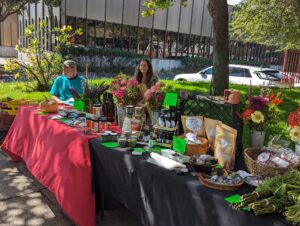
Here’s looking out across our pop-up in Dogpatch. A super pleasant scene. Thanks, SF.
Back to business; On Saturday September 27th, we plan to be back in San Francisco’s Dogpatch, from 9-12, in front of Piccino Restaurant. Then, on Sunday, October 5th, we’ll be back in Palo Alto. On Saturday, October 11th, it’s back to Berkeley and on Sunday, October 11th, we’ll be in our own home city of Corralitos.
Past these dates I don’t want to tempt fate by offending the weather gods with my hubris. People ask me, “How long will the tomato season last?” Truly, if I could honestly and correctly answer that question my talents would be better employed at a weather bureau. Generally speaking, September is a great month for tomatoes and October can be great but it’s hard to predict how the season will progress. It’s worth noting that we produce a lot more than tomatoes and when we can do a pop-up that showcases our other crops and products we look forward to doing so. Also, as our sacramental marigold crop comes into focus we will announce a series of U-Pick Marigold events. Keep an eye on the newsletter for announcements as all dates are tentative by nature. (That’s a pun, LOL, because Mother Nature ALWAYS calls the shots.)Thanks, Starr & Andy
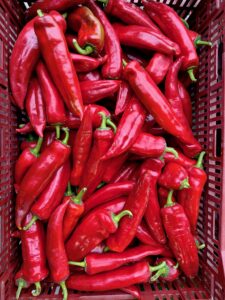
Red Anaheim peppers mix the sweet with the heat.
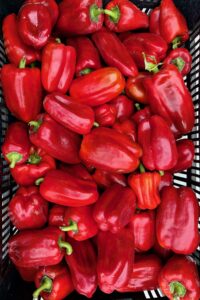
Red Bell peppers
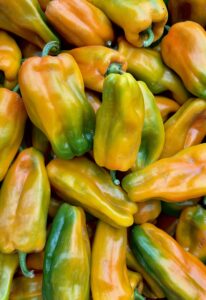
Sweet Golden Bull Horn peppers aka “Corno di Toro”
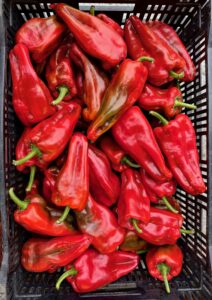
Red Bull Horn Peppers; all sweet, no heat

Starr is drying these sunflower plants for florists to use in their larger dried arrangements.
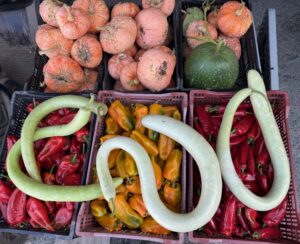
The cucuzzi gourds will naturally curl if they are not grown on a trellis to hang down from.
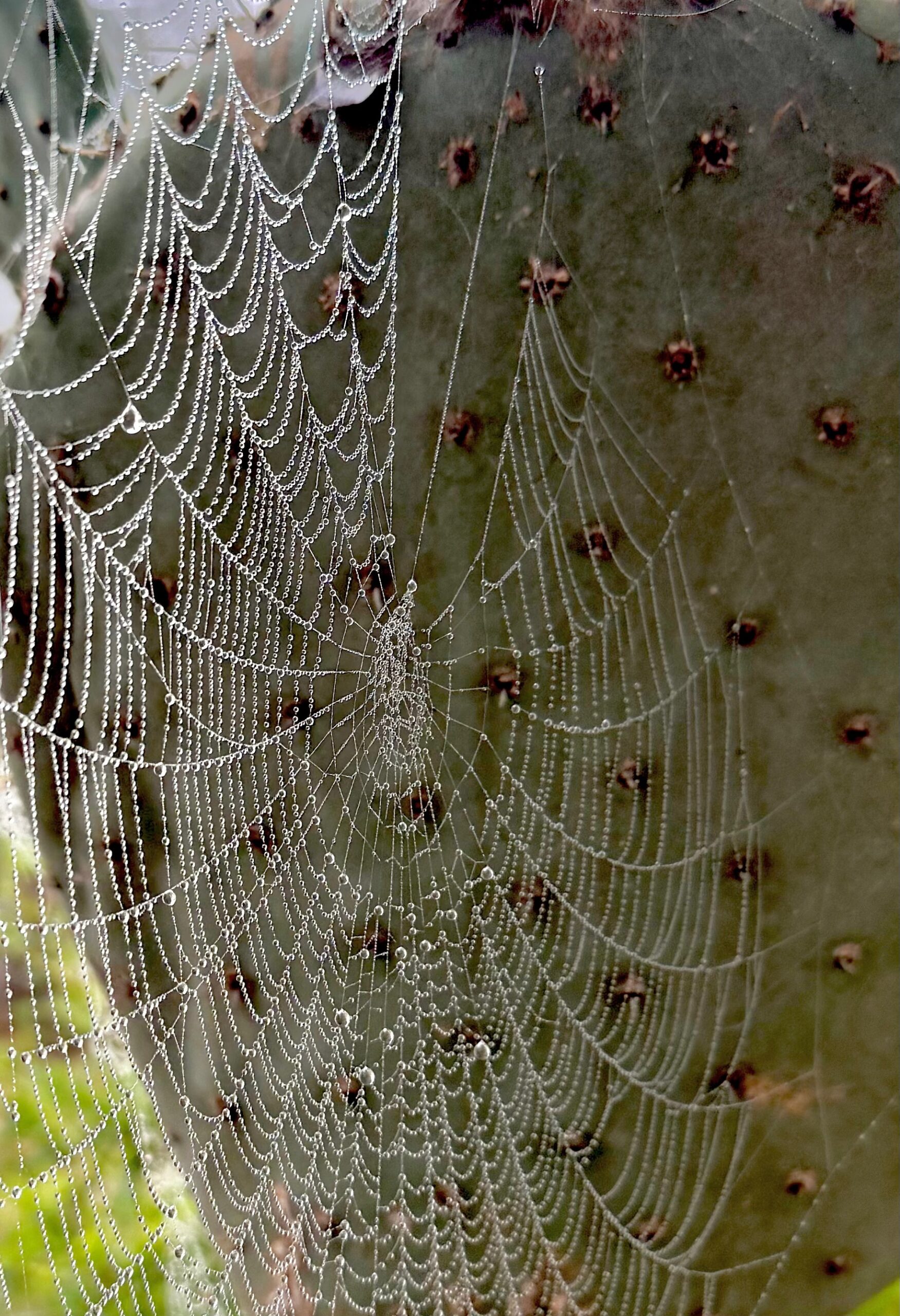
Who needs diamonds when you have fog an a spiderweb?

.
|
Fall Colors/You backed a winner!
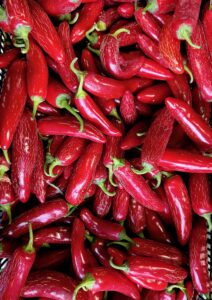
The jalapeno pepper crop is turning red; perfect for sriracha, chipotle, or for jazzing up a salsa. They make a great jelly too.
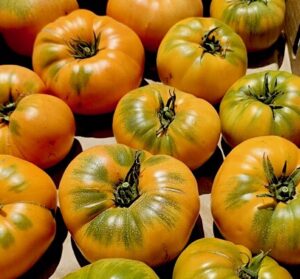
Amana Orange Heirloom tomatoes are starting up this weekend. Other colors, shapes, flavors, and sizes are ripening too.
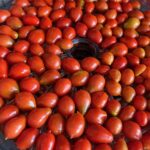
Piennolo tomatoes getting ready for a ride through the dehydrator. We can’t sundry these the way they do in Italy because no matter how much sun we have inj the day to dehydrate we always have fog in the night to rehydrate. But the dehydrator works perfectly.
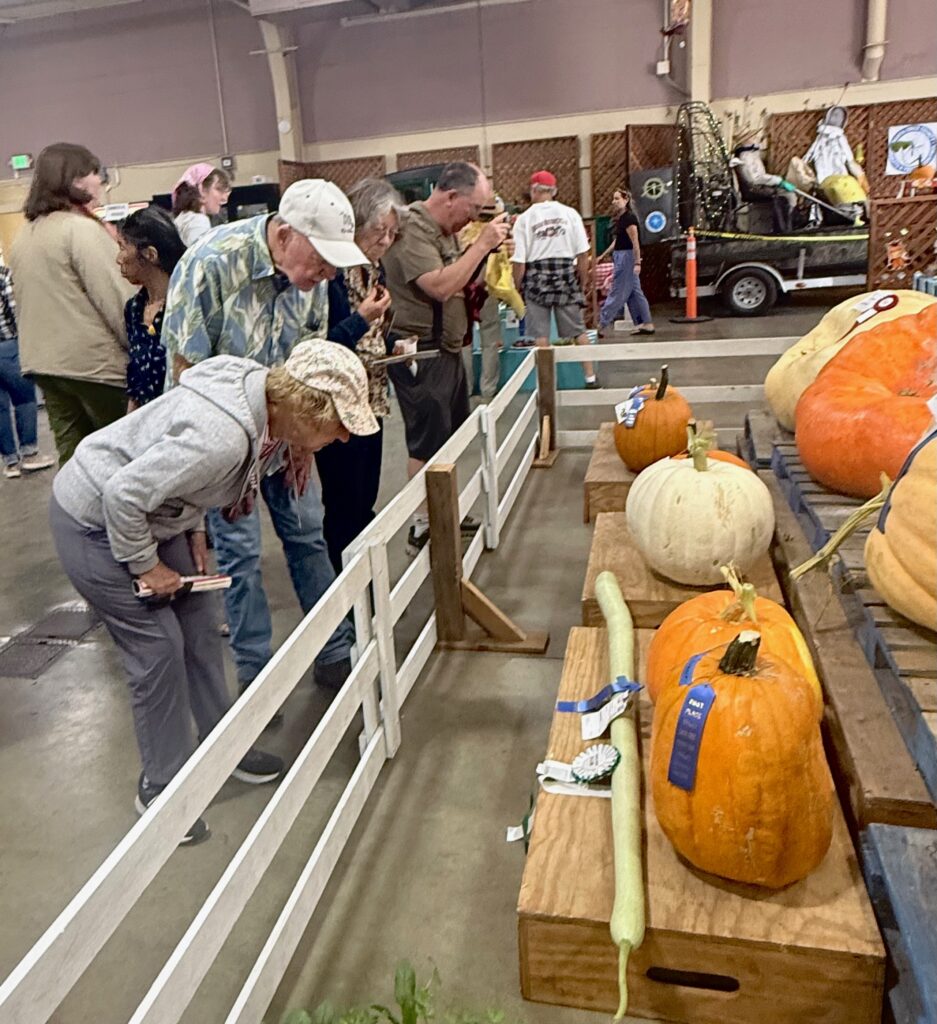
The citizens of Santa Cruz County were blown away by our prize winning cucuzza gourd. It not only won 1st place, it also won best of class.
Baby Bear Pumpkins are in. They are real pie pumpkins and veritable ornamental edibles.
Dry-Farmed Piennolo tomatoes are so good. They taste great and if you don’t use them all at once they hang out in splendid shape for a long time. They make great dried tomatoes but they’re excellent fresh too, and I love them in sauces.
Hi Folks: Fall colors are here! The fields are full and the harvest is happening seven days a week now. We’ve got Dry-farmed tomatoes of all sorts plus sweet & hot peppers, ornamental gourds, pumpkins and flowers! On Saturday, September 13th, from 9 to 11, we will be popping up at The Pumpkin House in Santa Cruz, 827 California Street, off Walnut and directly across from the High School. Then, on Sunday, September 14th, from 10 to 1 we will be in San Francisco at Piccino in the Dogpatch, 1001 Minnesota Street. If you already know what you want to get just drop us an email to mariquitachef@gmail.com and we’ll confirm the order. As always, we appreciate cash, but we accept Venmo at pick ups too. Thanks.
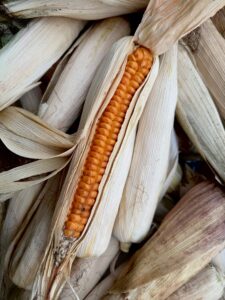
Otto File corn is an heirloom Italian corn that is considered to be the best variety for polenta. I will be bringing whole ears of it in case anybody wants to enjoy it as a seasonal ornamental before grinding it up for polenta.
Galeaux d’Eysines, a sweet, heirloom, French cooking pumpkin that can serve as an ornament until it’s made into dinner.
Here I’m posing with an heirloom Italian Butternut squash cousin called “Tromba de Albenga.”
Sunday, September 21st, will find our mobile farmstand in West Berkeley on 9th Street at Willow’s House between Virgina and Cedar Streets, from 9-11. This is a day later than previously announced but we needed to make the change to work some kinks out of life and get some home work done. Thanks, Willow, for generously sharing your space.
On Saturday September 27th, we plan to be back in San Francisco’s Dogpatch, from 9-12, in front of Piccino Restaurant. Then, on Sunday, October 5th, we’ll be back in Palo Alto. On Saturday, October 11th, it’s back to Berkeley and on Sunday, October 11th, we’ll be in our own home city of Corralitos.
Past these dates I don’t want to tempt fate by offending the weather gods with my hubris. People ask me, “How long will the tomato season last?” Truly, if I could honestly and correctly answer that question my talents would be better employed at a weather bureau. Generally speaking, September is a great month for tomatoes and October can be great but it’s hard to predict how the season will progress. It’s worth noting that we produce a lot more than tomatoes and when we can do a pop-up that showcases our other crops and products we look forward to doing so. Also, as our sacramental marigold crop comes into focus we will announce a series of U-Pick Marigold events. Keep an eye on the newsletter for announcements as all dates are tentative by nature. (That’s a pun, LOL, because Mother Nature ALWAYS calls the shots.)Thanks, Starr & Andy
Red Anaheim peppers mix the sweet with the heat.
Red Bell peppers
Sweet Golden Bull Horn peppers aka “Corno di Toro”
Red Bull Horn Peppers; all sweet, no heat
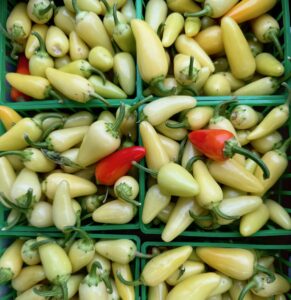
Tusta, a Oaxacan pepper with an attitude
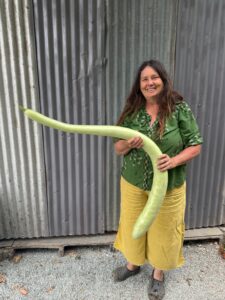
Starr shows off one of our Cuccuzi
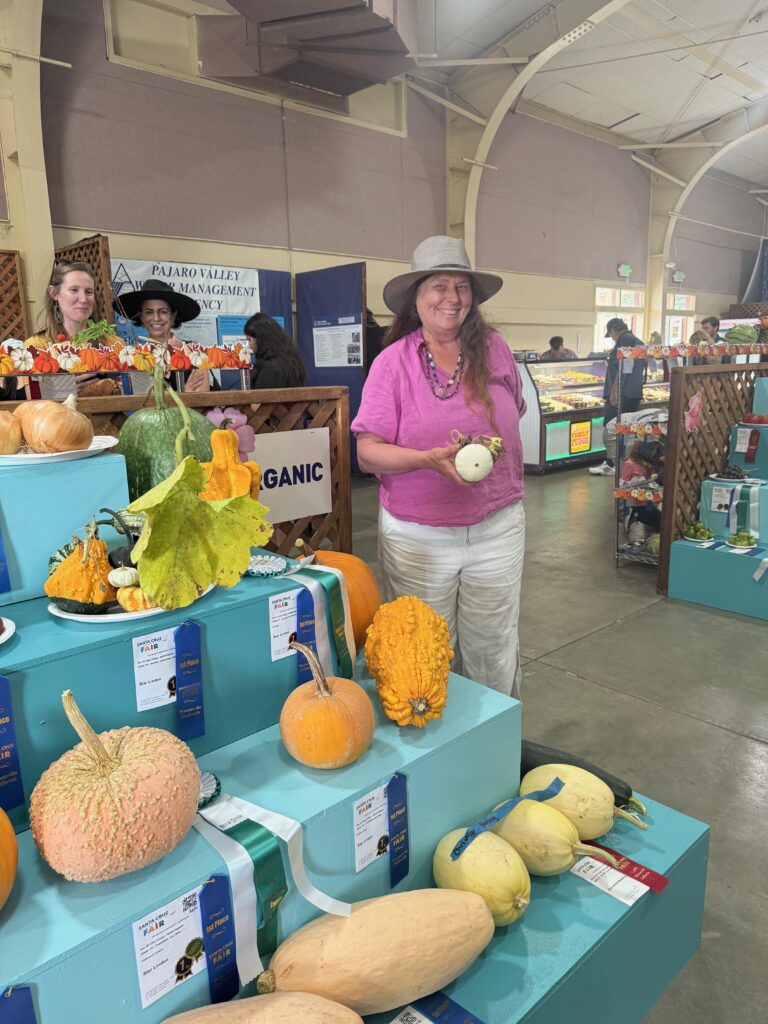
Starr at the Santa Cruz County Fair. She took first for the White pumpkin, as well as for a pie pumpkin called “Winter Luxury,” and also a selection of gourds. It was a big day for Mariquita Farm.
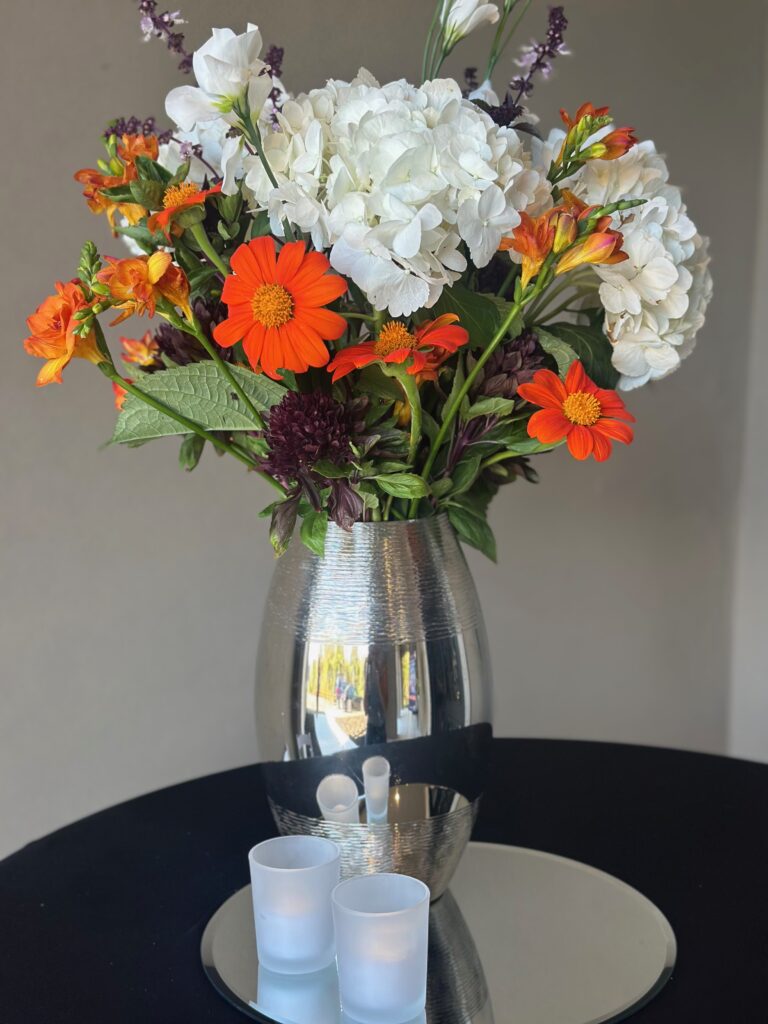
Our flowers had a night out on the town at a party in Santa Cruz. We do flowers for events.
.
|
Santa Cruz/San Francisco
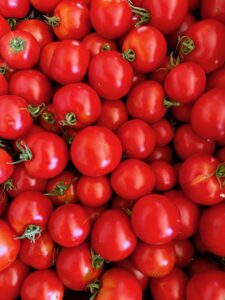
The dry-farmed Early Girl tomatoes are coming on strong and they taste great. We will be offering them by the 20# crate for $50 or by the pint basket for $3 apiece. We will be bringing around 20 cases, for sure, and maybe more.
Amana Orange Heirloom tomatoes are starting up this weekend. Other colors, shapes, flavors, and sizes are ripening too.
Piennolo tomatoes getting ready for a ride through the dehydrator. We can’t sundry these the way they do in Italy because no matter how much sun we have inj the day to dehydrate we always have fog in the night to rehydrate. But the dehydrator works perfectly.
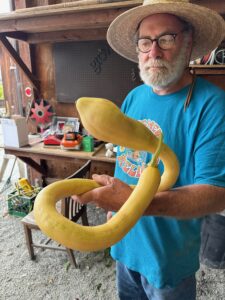
This curvy cousin of the Butternut squash tastes great and looks cool. It’s an Italian Heirloom called Tromba de Albenga.
San Marzano tomatoes are starting. We figure on picking around 20 x 20# cases to bring to Piccino. We’re asking $60/case..
Dry-Farmed Piennolo tomatoes are so good. They taste great and if you don’t use them all at once they hang out in splendid shape for a long time. They make great dried tomatoes but they’re excellent fresh too, and I love them in sauces.
Hi Folks: The fields are full and the harvest is happening seven days a week now. We’ve got Dry-farmed tomatoes of all sorts plus sweet & hot peppers, ornamental gourds, pumpkins and flowers! On Saturday, September 13th, from 9 to 11, we will be popping up at The Pumpkin House in Santa Cruz, 827 California Street, off Walnut and directly across from the High School. Then, on Sunday, September 14th, from 10 to 1 we will be in San Francisco at Piccino in the Dogpatch, 1001 Minnesota Street. If you already know what you want to get just drop us an email to mariquitachef@gmail.com and we’ll confirm the order. As always, we appreciate cash, but we accept Venmo at pick ups too. Thanks.

We grow cut flowers for sale at our pop-ups, and for events. Here’s a bouquet of our flowers that was arranged by an event coordinator for a party last week.
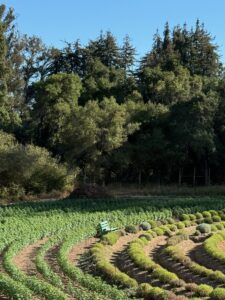
He’re the marigold patch as it is this morning. You can’t see them from this vantage point but pretty soon all the unopened flower buds will start to pop and the field will light up.
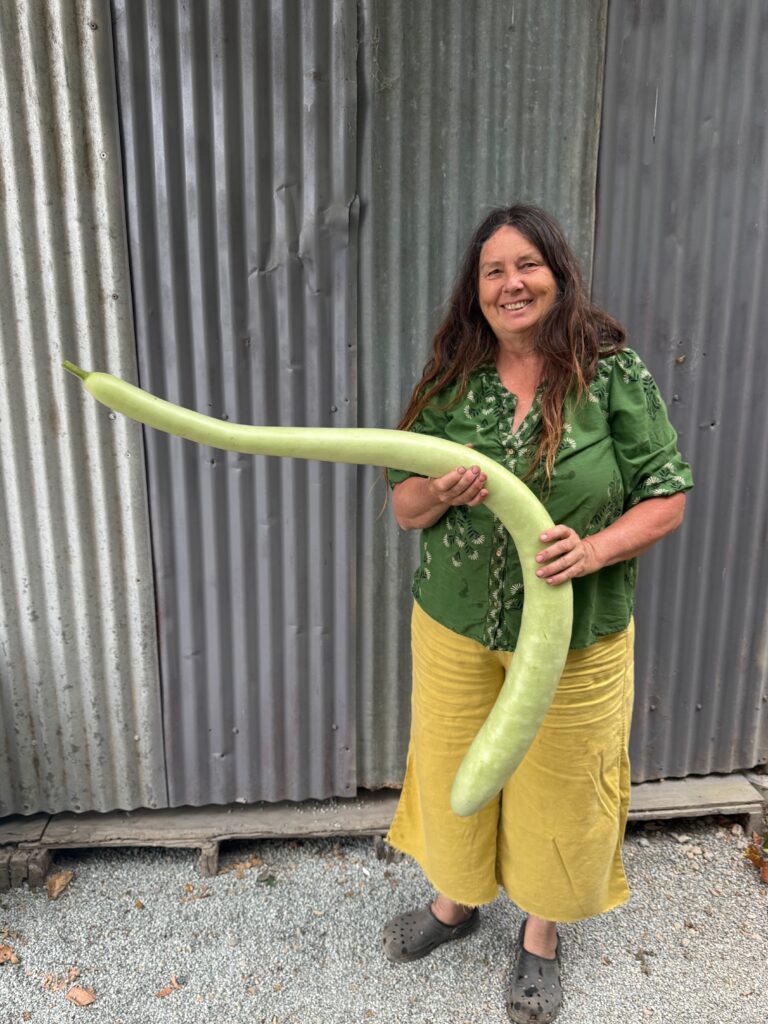
Starr is modeling an enormous cucuzza. We’ll be bringing some to our pop-ups. Let us know in advance if you want some. Thx A
Saturday, September 20th, will find our mobile farmstand in West Berkeley on 9th Street at Willow’s House between Virgina and Cedar Streets, from 9-11. Thanks, Willow.
On Saturday September 27th, we plan to be in San Francisco’s Dogpatch, from 9-12. On Sunday, October 5th, we’ll be back in Palo Alto. On Saturday, October 11th, it’s back to Berkeley and on Sunday, October 11th, we’ll be in our own home city of Corralitos.
Past these dates I don’t want to tempt fate by offending the weather gods with my hubris. People ask me, “How long will the tomato season last?” Truly, if I could honestly and correctly answer that question my talents would be better employed at a weather bureau. Generally speaking, September is a great month for tomatoes and October can be great but it’s hard to predict how the season will progress. It’s worth noting that we produce a lot more than tomatoes and when we can do a pop-up that showcases our other crops and products we look forward to doing so. Also, as our sacramental marigold crop comes into focus we will announce a series of U-Pick Marigold events. Keep an eye on the newsletter for announcements as all dates are tentative by nature. (That’s a pun, LOL, because Mother Nature ALWAYS calls the shots.)Thanks, Starr & Andy
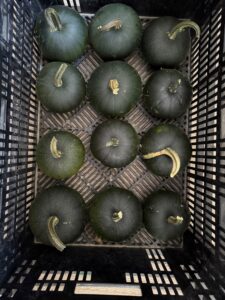
This is a small “black” pumpkin called Black Bear. I did some squash & gourd trials this year for fun.
This is an old favorite; “Baby Bear.”
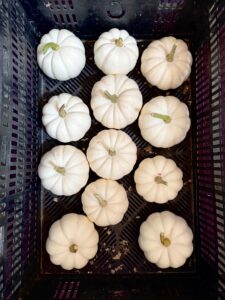
These little, white pumpkins are called “Casperita.” They do well here. I’m waiting for the plant scientists to cross one of these with a lightning bug to produce pumpkins that glow in the dark. Whoops, I shouldn’t have said that; someone will probably try…
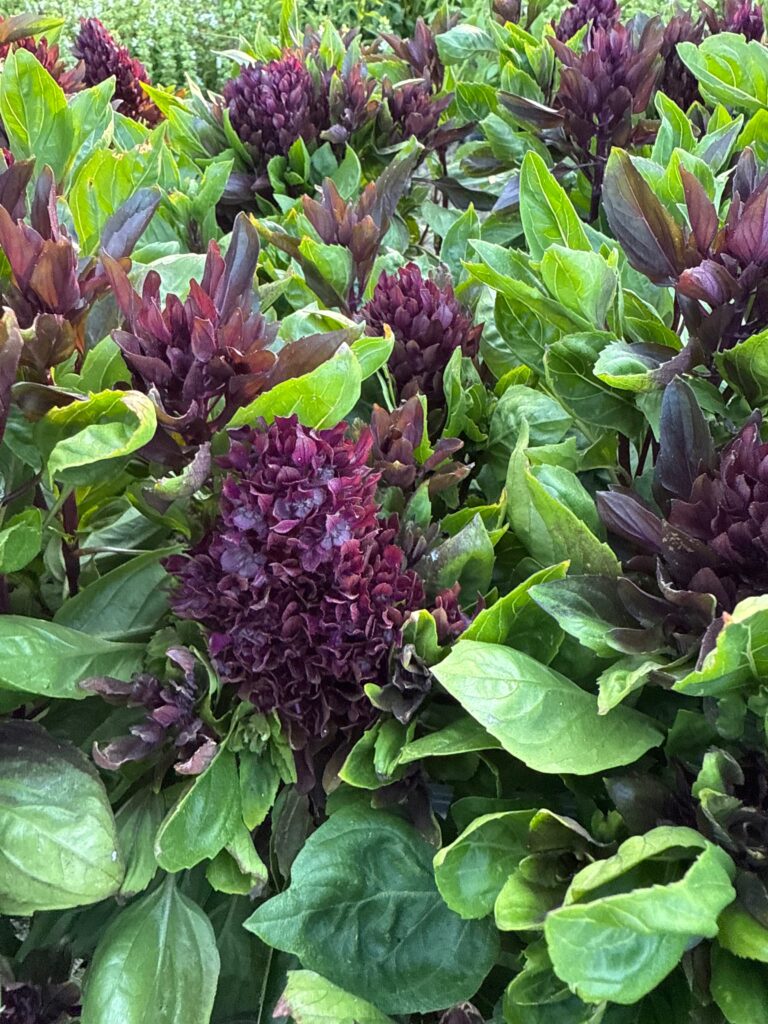
We enjoy trying new crops. This is a trial of an unusual basil called “Cardinal” that looks cool and smells great!
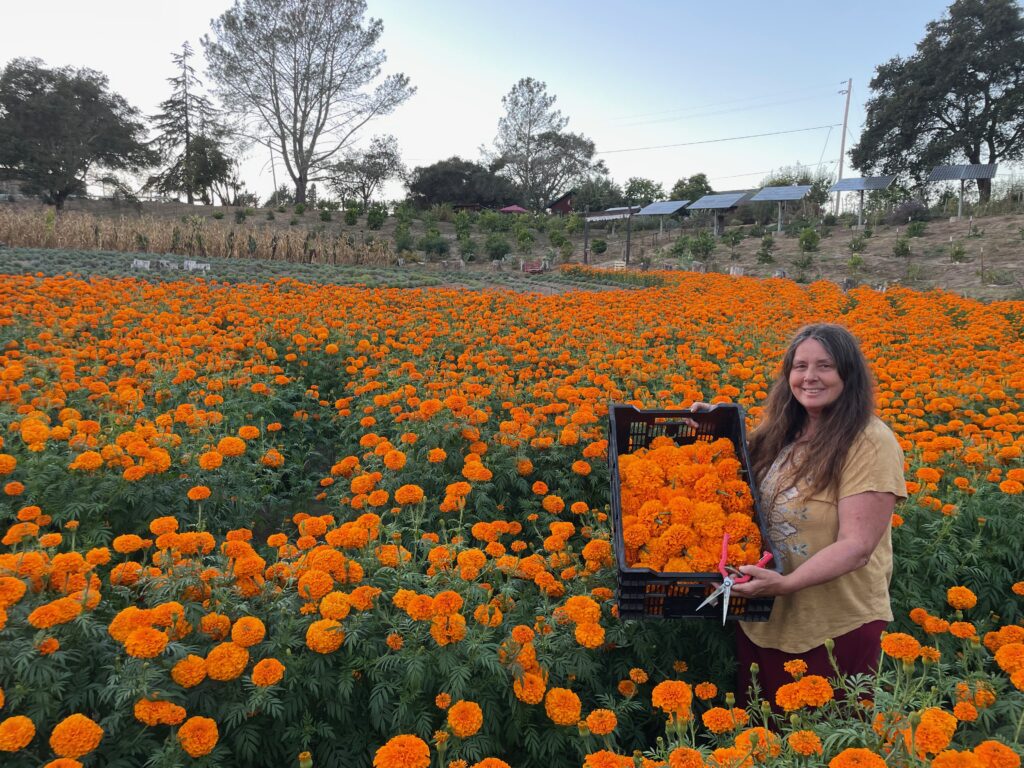
Here’s Starr picking sacramental marigolds for garlands that will decorate a Diwali shrine. We ship marigold flowers by FedEx in boxes of 100 blooms.
.
|
Palo Alto, and Beyond.
The dry-farmed Early Girl tomatoes are coming on strong and they taste great. We will be offering them by the 20# crate for $50 or by the pint basket for $3 apiece. We will be bringing around 20 cases, for sure, and maybe more.
Amana Orange Heirloom tomatoes are starting up this weekend. Other colors, shapes, flavors, and sizes are ripening too.
Piennolo tomatoes getting ready for a ride through the dehydrator. We can’t sundry these the way they do in Italy because no matter how much sun we have inj the day to dehydrate we always have fog in the night to rehydrate. But the dehydrator works perfectly.
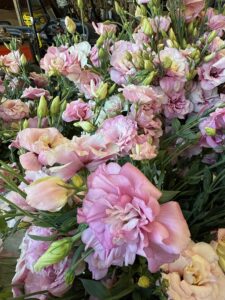
The Lisianthus look great right now. Starr does flowers for events and if you’re ever interested please give us a call.
San Marzano tomatoes are starting. We figure on picking around 20 x 20# cases to bring to Piccino. We’re asking $60/case..
Dry-Farmed Piennolo tomatoes are so good. They taste great and if you don’t use them all at once they hang out in splendid shape for a long time. They make great dried tomatoes but they’re excellent fresh too, and I love them in sauces.
Hello Everybody: The harvest season is in full swing now. This coming Saturday, September 6th, we will be popping up on Ross Road in Palo Alto, just off the Oregon Expressway, from 9 to 11 am. A big “Thanks!” to Crystal & Susan for all their support over the years. We will be bringing Dry-farmed Early Girls, San Marzanos, Heirlooms, Piennolo, Cherry Tomatoes, flowers, basils, dried herbs, decorative & ornamental squash and gourds, plus a whole lot more. As always, cash is appreciated, but we accept Venmo & PayPal as well. We will be joined by our friends from Farm Cat Marmalade as well, with their fruit preserves. Swing by and visit us; it’s a very pleasant scene. If you already know what you want to get just drop us an email to mariquitachef@gmail.com and we’ll confirm, but we’re not taking payment in advance at this time. That could change, but right now we’re taking the harvest one day at a time. It’s always tricky making promises deep into the future, but this year, besides the weather to take into account we don’t have as much help in the field as we have in the past.
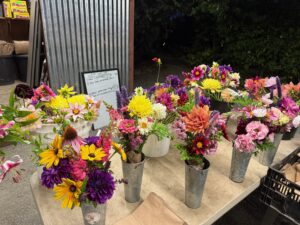
Starr has fun composing all the bouquets that she brings to the farm stand events.
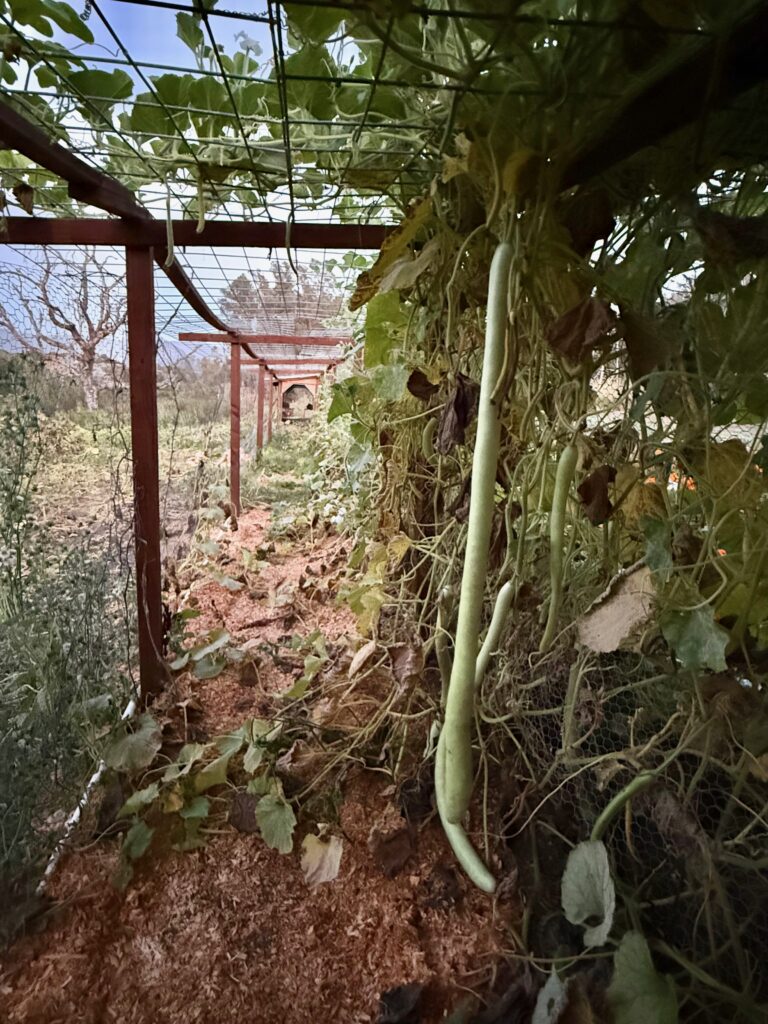
I’m planning on entering this hysterical cucuzza gourd in the Santa Cruz County Fair. It’s six feet long already, and still growing!
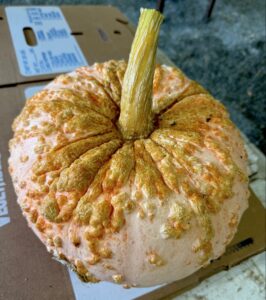
Galeaux d’Eysines, a flavorful and curious heirloom hard squash that we are harvesting right now.
Looking deeper into the crystal ball I see that on Saturday, September 14th, we’ll be in Santa Cruz, at the Pumpkin House on California Street, just off of Mission Street, from 9-11. Thank you, Jon & Susie!
Saturday, September 20th, will find our mobile farmstand in West Berkeley on 9th Street at Willow’s House between Virgina and Cedar Streets, from 9-11. Thanks, Willow.
On Saturday September 27th, we plan to be in San Francisco’s Dogpatch, from 9-12. On Sunday, October 5th, we’ll be back in Palo Alto. On Saturday, October 11th, it’s back to Berkeley and on Sunday, October 11th, we’ll be in our own home city of Corralitos.
Past these dates I don’t want to tempt fate by offending the weather gods with my hubris. People ask me, “How long will the tomato season last?” Truly, if I could honestly and correctly answer that question my talents would be better employed at a weather bureau. Generally speaking, September is a great month for tomatoes and October can be great but it’s hard to predict how the season will progress. It’s worth noting that we produce a lot more than tomatoes and when we can do a pop-up that showcases our other crops and products we look forward to doing so. Also, as our sacramental marigold crop comes into focus we will announce a series of U-Pick Marigold events. Keep an eye on the newsletter for announcements as all dates are tentative by nature. (That’s a pun, LOL, because Mother Nature ALWAYS calls the shots.)Thanks, Starr & Andy
This is a small “black” pumpkin called Black Bear. I did some squash & gourd trials this year for fun.
This is an old favorite; “Baby Bear.”
These little, white pumpkins are called “Casperita.” They do well here. I’m waiting for the plant scientists to cross one of these with a lightning bug to produce pumpkins that glow in the dark. Whoops, I shouldn’t have said that; someone will probably try…
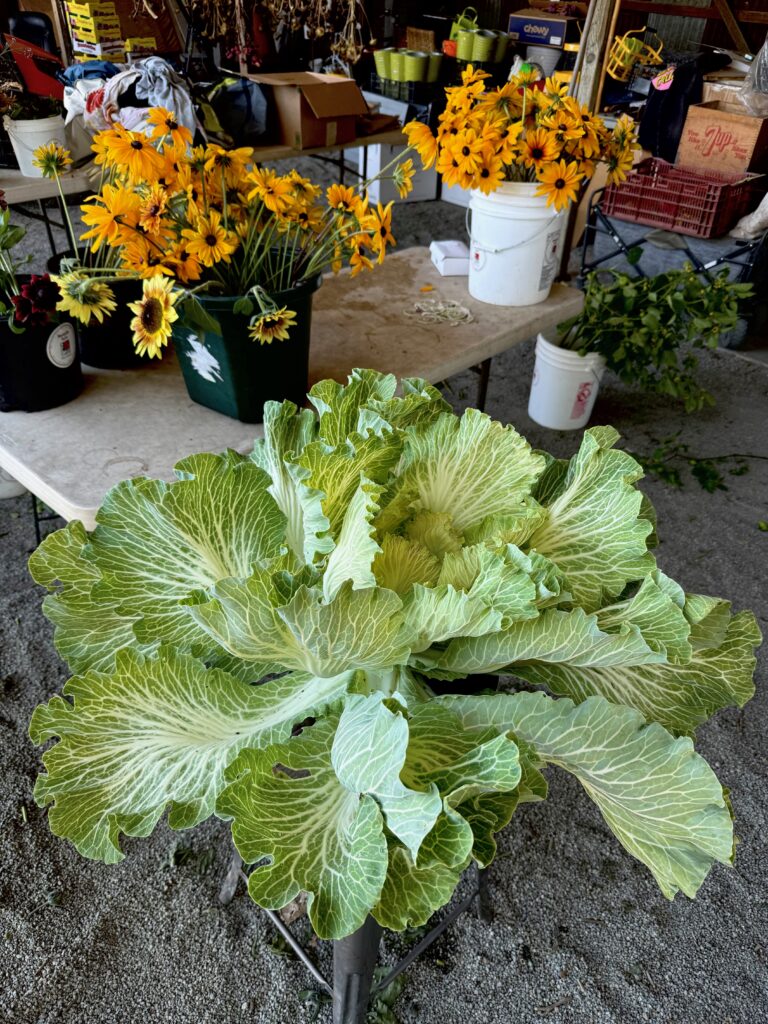
This spectacular Portuguese cabbage is going to the LA flower market. Yes, it is an heirloom and very edible cabbage, but this one is going to be a feast for the eyes.
Here’s Starr picking sacramental marigolds for garlands that will decorate a Diwali shrine. We ship marigold flowers by FedEx in boxes of 100 blooms.
.
|
Los Gatos, San Francisco, Palo Alto, and Beyond.
The dry-farmed Early Girl tomatoes are coming on strong and they taste great. We will be offering them by the 20# crate for $50 or by the pint basket for $3 apiece. We will be bringing around 20 cases, for sure, and maybe more.
Amana Orange Heirloom tomatoes are starting up this weekend. Other colors, shapes, flavors, and sizes are ripening too.
Piennolo tomatoes getting ready for a ride through the dehydrator. We can’t sundry these the way they do in Italy because no matter how much sun we have inj the day to dehydrate we always have fog in the night to rehydrate. But the dehydrator works perfectly.
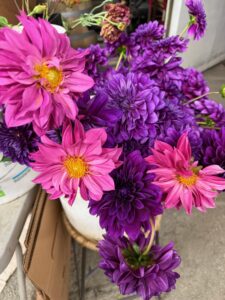
These brilliant pinks and purples are a nice counterpoint to all the oranges and browns and yellows of late summer and early fall. Starr’s dahlia beds are doing well this year.
San Marzano tomatoes are starting. We figure on picking around 20 x 20# cases to bring to Piccino. We’re asking $60/case..
Dry-Farmed Piennolo tomatoes are so good. They taste great and if you don’t use them all at once they hang out in splendid shape for a long time. They make great dried tomatoes but they’re excellent fresh too.
Hello Friends: If you live anywhere around the South Bay please drop in on us in Los Gatos, at 15819 Izorah Way. We will be there from 11 to 1 on Saturday, slinging tomatoes, flowers, herbs, and other earthly treasures. Our friends at Farm Cat Marmalade will be joining us with their preserves. Spread the word- and the marmalade! And a big “Thank you!” to Sueling and her family, for their hospitality and support. We’re in the fields picking right now and the crop looks good. Dry-Farmed Early Girls will be $50 for a 20# case, and we will have some pint baskets available for $4pint basket or 3 for $10. Cherry tomatoes and/or Piennolo tomatoes will be $4/pint basket or 3 baskets for $10 as well and whole flats for $36/case. San Marzano Tomatoes will be $60/20 lb case. Heirlooms will be $30/flat. We will also bring herbs, flowers, and other goodies from the earth. As always, cash works best, but we do Venmo & Paypal too.
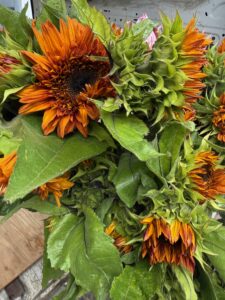
We’ve never grown this sunflower before so we’re waiting to see what it looks like when fully open.
On Sunday, August 31st, we will be popping up with Farm Cat in front of Piccino Restaurant in San Francisco, 1001 Minnesota Street, down in The Dogpatch. Besides the tomatoes, flowers, herbs, peppers and fruits that we are harvesting, Starr will be bringing the lavender oils and hydrosols from our lavender crop.
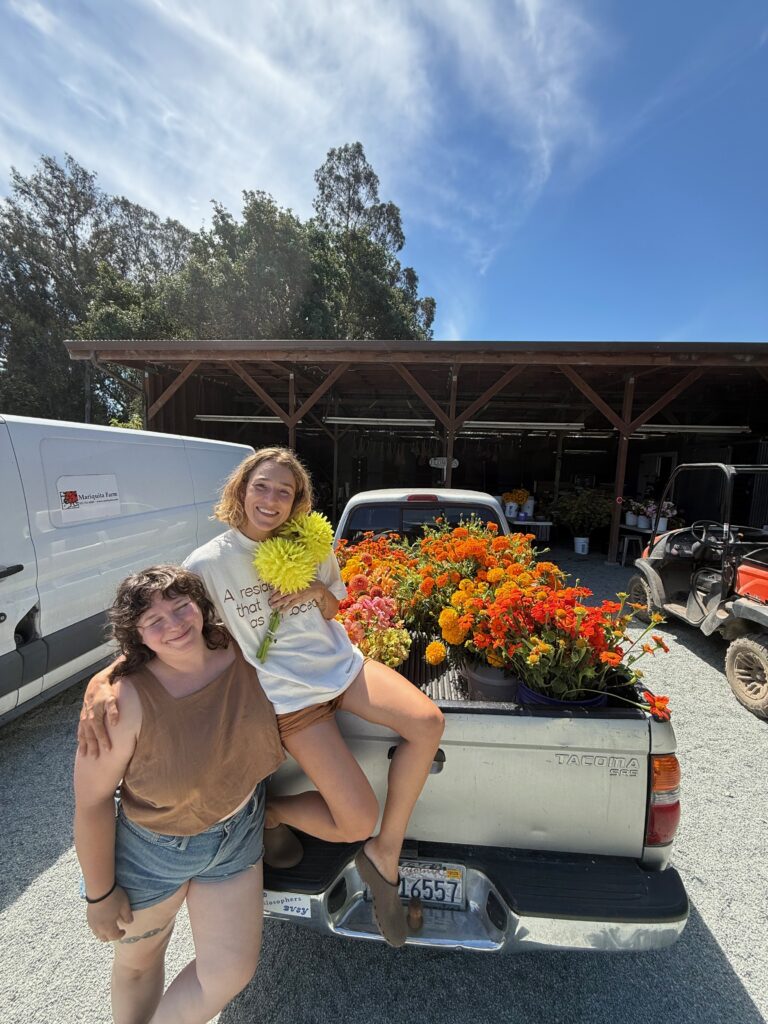
Our friends and neighbors at Eothen Floral dropped in for a truck-load of color. Katie’s flower workshop & studio are just around the corner from our house but her beautiful creations go all around the state. Thanks for your support and encouragement, Katie!
Galeaux d’Eysines, a flavorful and curious heirloom hard squash that we are harvesting right now.
More details next week, but our next stops will be in Palo Alto, Santa Cruz, and back to West Berkeley.
As our sacramental marigold crop comes into focus we will announce a series of U-Pick Marigold events. Thanks, Starr & Andy
This is a small “black” pumpkin called Black Bear. I did some squash & gourd trials this year for fun.
This is an old favorite; “Baby Bear.”
These little, white pumpkins are called “Casperita.” They do well here. I’m waiting for the plant scientists to cross one of these with a lightning bug to produce pumpkins that glow in the dark. Whoops, I shouldn’t have said that; someone will probably try…
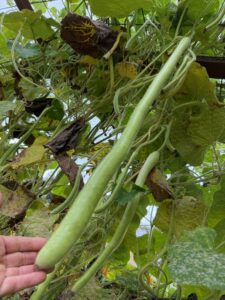
Cucuzza, Lagenaria siceraria, an African gourd popularized in Sicilian cuisine. The tendrils and shoots of the rampant vine are appreciated as greens and are cooked with tomatoes as “Tenerummi di Cucuzzi.” I will bring some Tenerummi to San Francisco.
Starr is wrestling with this gigantic cucuzza. They are fun, but hard to handle and very difficult to put in a box for transport. This one will have to ride on top of the load.
.
|
Berkeley, Los Gatos, San Francisco and Beyond.
The dry-farmed Early Girl tomatoes are coming on strong and they taste great. We will be offering them by the 20# crate for $50 or by the pint basket for $3 apiece. We will be bringing around 20 cases, for sure, and maybe more. We will see what the sun does this week.
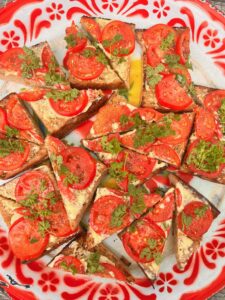
Carlo of @linger___longer and @mealkittymeow will be making tomato toasts at the Sunday Sesame Tiny Bakery pop-up.
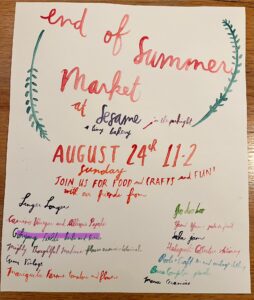
Thanks to Sesame Tiny Bakery for inviting us to their event. We’re excited to find another landing spot in the East Bay. We will have San Marzano tomatoes, cherry tomatoes, Early Girls, and Piennolo tomatoes by then. Maybe we’ll even have a few Heirlooms to offer.
San Marzano tomatoes are starting. We figure on picking around 20 x 20# cases to bring to Berkeley. We’re asking $60/case..
Dry-Farmed Piennolo tomatoes are so good. They taste great and if you don’t use them all at once they hang out in splendid shape for a long time. They make great dried tomatoes but they’re excellent fresh too.
Hello Friends: Drop by the Sesame Tiny Bakery in Berkeley tomorrow, Sunday, August 24th from 11 to 2 and visit us and the other vendors. We’re in the fields picking right now and the crop looks good. Dry-Farmed Early Girls will be $50 for a 20# case, and we will have some pint baskets available for $4pint basket or 3 for $10. Cherry tomatoes and/or Piennolo tomatoes will be $4/pint basket or 3 baskets for $10 as well and whole flats for $36/case. San Marzano Tomatoes will be $60/20 lb case. We will also bring herbs, flowers, and other goodies from the earth. As always, cash works best, but we do Venmo & Paypal too.
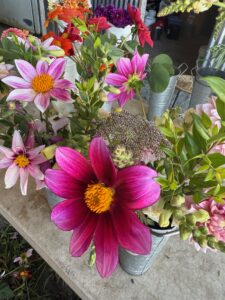
The Dahlias are looking strong on the farm these days. Starr will bring a quantity of mixed garden bouquets that I’m sure will have some cool Dahlias.
Next weekend, Saturday, August 30th, we will be in Los Gatos on Izorah Way from 11 am to 1pm. Izorah Way is a short, quiet, residential street. You won’t be able to miss us. We’ll be the only ones out on the sidewalk hustling tomatoes, basil, flowers, peppers, herbs, and lavender products. You could probably just close your eyes and sniff us down!
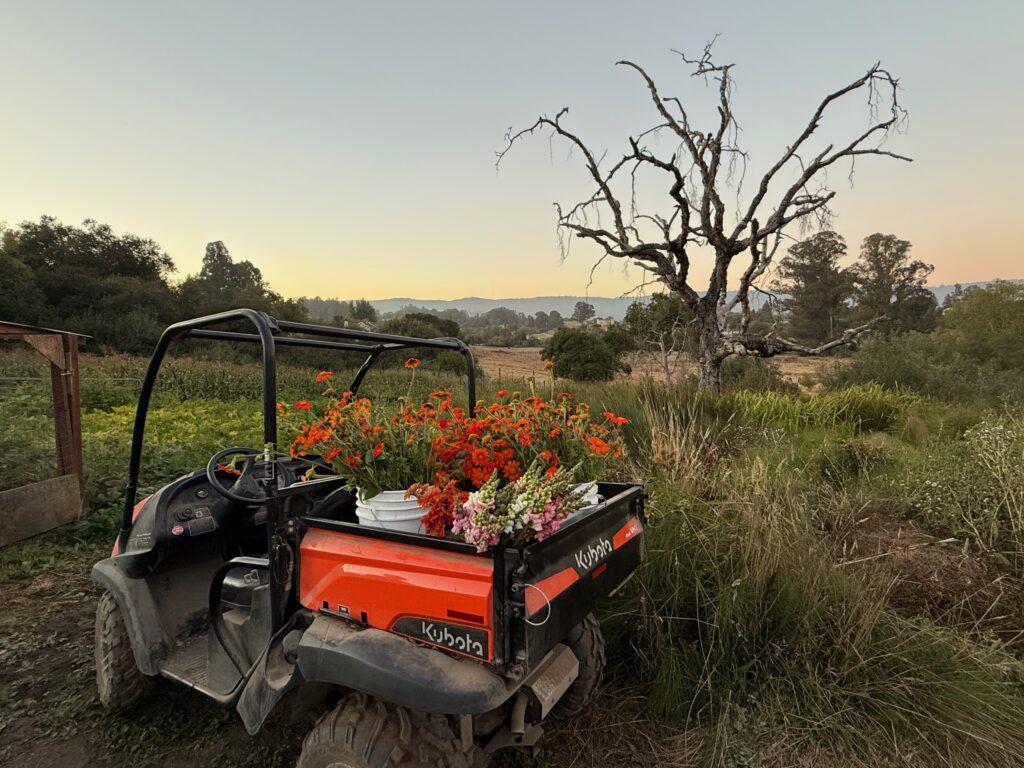
This evening shot of our little 4×4 wheel-barrow had me thinking we should be Kubota influencers! The Tithonia Starr picked goes so well with the Kubota’s colors.
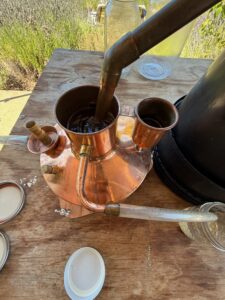
Rosie at Deer Creek Farm helped Starr distill Lavender oil from our crop of fresh lavender flowers. Here is Rosie’s still.
On Sunday, August 31st, we will be popping up in front of Piccino Restaurant in San Francisco, 1001 Minnesota Street, down in The Dogpatch.
As the season progresses we will schedule pop-up events in Palo Alto, and West Berkeley. We look forward to seeing you. As our sacramental marigold crop comes into focus we will announce a series of U-Pick Marigold events. Thanks, Starr & Andy
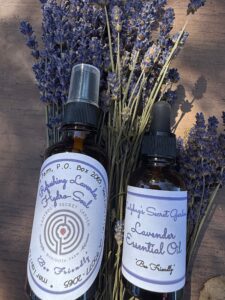
And here are some bottles of lavender oil and lavender hydrosol that Starr has bottled up. We will be bringing a quantity with us to Berkeley.
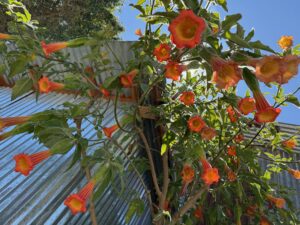
I just had to share this picture because I’m so stoked that our Brugmansia sanguinea tree is so happy.
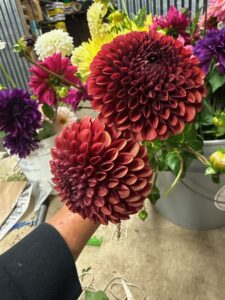
This is one of Starr’s favorite Dahlias.
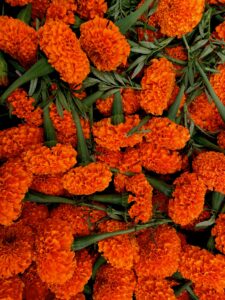
Marigold season is just around the corner; we’re making our first harvests of the year this evening.
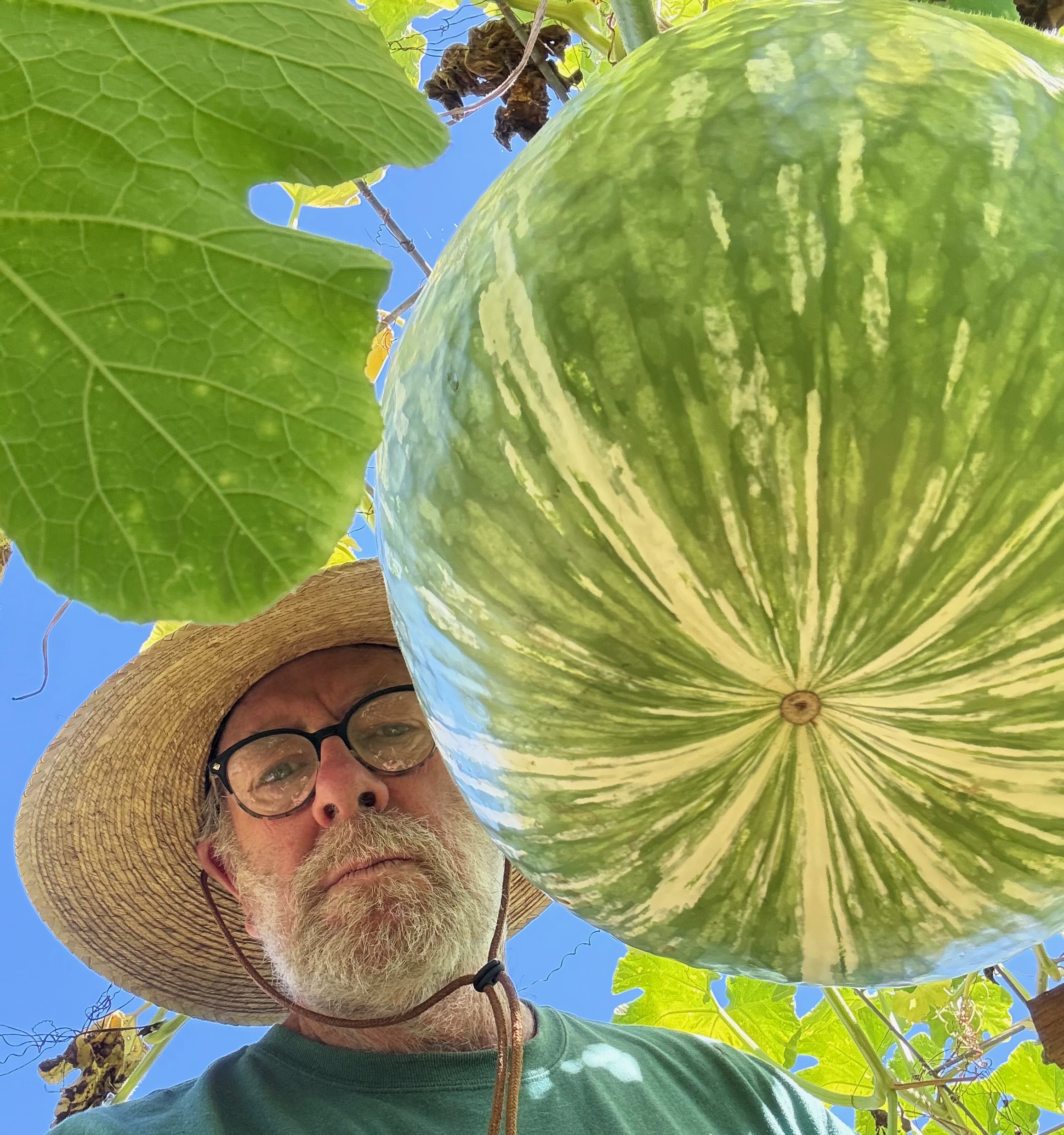
Selfi with Chilacayote. It amazes me that a gourd this big and heavy can hang from a squash plant that has decided to climb a tree.
.
|
We’re Back in Corralitos Again and heading to Berkeley And San Francisco
The dry-farmed Early Girl tomatoes are coming on strong and they taste great. We will be offering them by the 20# crate for $50 or by the pint basket for $3 apiece. We will be bringing around 20 cases, for sure, and maybe more. We will see what the sun does this week.
Carlo of @linger___longer and @mealkittymeow will be making tomato toasts at the Sunday Sesame Tiny Bakery pop-up.
Thanks to Sesame Tiny Bakery for inviting us to their event. We’re excited to find another landing spot in the East Bay. We will have San Marzano tomatoes, cherry tomatoes, Early Girls, and Piennolo tomatoes by then. Maybe we’ll even have a few Heirlooms to offer.
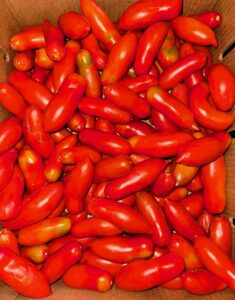
San Marzano tomatoes are starting. We figure on picking around 10 x 20# cases to bring to Berkeley. We’re asking $60/case. Dry-farmed Piennolo tomatoes kick in too; maybe 10 of those to pick as well. I’m asking $40/flat on the Piennolos.
Hello Tomato Lovers, flower people and friends we haven’t met yet: You’re invited to our first 2025 season pop-up sales events. We’re near home in Corralitos again this weekend at the Jett & Rose Boutique from 11 am until we run out of tomatoes and flowers. It was such a great event last weekend that Amy at Jett & Rose decided to do it again this weekend! Dry-Farmed Early Girls will be $50 for a 20# case, or for $3/pint basket. Cherry tomatoes will be $4/pint basket or 3 baskets for $10. San Marzano Tomatoes will be $60/20 lb case. We will also bring herbs, flowers, and other goodies from the earth.
The Dahlias are looking strong on the farm these days. Starr will bring a quantity of mixed garden bouquets that I’m sure will have some cool Dahlias.
Our second pop-up of the weekend will be at The Sesame Tiny Bakery on August 24th from 11am to 2 pm. The Bakery calls itself “A pocket sized bakery down a secret alley at 2533 Seventh Street in Berkeley.” Who doesn’t love being “in” on a secret? I’m looking forward to their pastries too. We will also be sharing this event with our friend, Chef Carlo of @linger___longer . It’s fun to be back in Berkeley and fun to work with Carlo again. He and I have worked together for many years in Santa Cruz, SF, and the East Bay! Thanks, Carlo, for being such a long time supporter of our farm, and thanks Sesame Tiny Bakery for inviting us to join you and your supporters. (Carlo will be making tomato toasts with our tomatoes this weekend at the event and I will “toast” to that!)
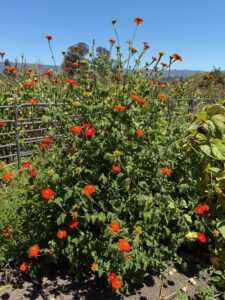
One of my favorite discoveries this year has been the Tithonia, or Red Mexican Sunflower. It seems to really feel at home on the farm.
Rosie at Deer Creek Farm helped Starr distill Lavender oil from our crop of fresh lavender flowers. Here is Rosie’s still.
On Sunday, August 31st, we will be popping up in front of Piccino Restaurant in San Francisco, 1001 Minnesota Street, down in The Dogpatch.
As the season progresses we will schedule pop-up events in Los Gatos, Palo Alto, and West Berkeley. We look forward to seeing you. As our sacramental marigold crop comes into focus we will announce a series of U-Pick Marigold events. Thanks, Starr & Andy
And here are some bottles of lavender oil and lavender hydrosol that Starr has bottled up. We will be bringing a quantity with us to Berkeley.
I just had to share this picture because I’m so stoked that our Brugmansia sanguinea tree is so happy.
This is one of Starr’s favorite Dahlias.
Marigold season is just around the corner; we’re making our first harvests of the year this evening.
Selfi with Chilacayote. It amazes me that a gourd this big and heavy can hang from a squash plant that has decided to climb a tree.
.
|
You Are Invited To Our Corralitos & Berkeley Pop-Ups
The dry-farmed Early Girl tomatoes are coming on strong and they taste great. We will be offering them by the 20# crate for $50 or by the pint basket for $3 apiece.

A big “Thanks!” to our friends and neighbors at Corralitos’s own Jet & Rose Boutique for inviting our farm to their event this coming Saturday. Tomatoes, herbs, flowers, and other goodies. Come by the stand and visit us and the other vendors.
Thanks to Sesame Tiny Bakery for inviting us to their event. We’re excited to find another landing spot in the East Bay. We will have San Marzano tomatoes, cherry tomatoes, Early Girls, and maybe some Principe Borghese & Piennolo tomatoes by then.
Hello Tomato Lovers, flower people and friends we haven’t met yet: You’re invited to our first 2025 season pop-up sales events. We’re in Corralitos this weekend at the Jet & Rose Boutique from 11 am until we run out of tomatoes and flowers. Dry-Farmed Early Girls will be $50 for a 20# case, or for $3/pint basket. Cherry tomatoes will be $4/pint basket or 3 baskets for $10. San Marzano Tomatoes will be $60/20 lb case. We will also bring herbs, flowers, and other goodies from the earth.

No, we didn’t grow these blue roses. I saw them for sale on the street in the LA Flower District and figured they’d be great if I was going for a date with Wednesday Addams, but we weren’t able to get together. She’d probably prefer black roses anyway. Or dead ones… We only grow “un-dyed” flowers lol.
Our second pop-up will be at The Sesame Tiny Bakery on August 24th from 11am to 2 pm. The Bakery calls itself “A pocket sized bakery down a secret alley at 2533 Seventh Street in Berkeley.” Who doesn’t love being “in” on a secret? I’m looking forward to their pastries too. We will also be sharing this event with our friend, Chef Carlo of @linger___longer . It’s fun to be back in Berkeley and fun to work with Carlo again. He and I have worked together for many years in Santa Cruz, SF, and the East Bay! Thanks, Carlo, for being such a long time supporter of our farm, and thanks Sesame Tiny Bakery for inviting us to join you and your supporters.
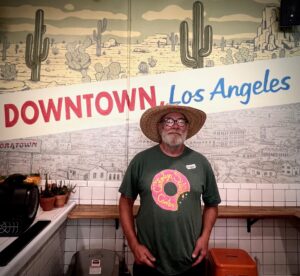
I did visit Gather Flora LA, our partner in downtown LA who represents the naturally grown, un-dyed flowers we do produce. Thanks to the crew at Gather Flora for all your help and encouragement. Starr will be bringing lots of blooms to the pop-ups for local flower people.

I always enjoy visiting the flower market and learning what I can. Inside the market it was cool and “Christmas As Usual,” but….
As the season progresses we plan on scheduling pop-up events in Los Gatos, Palo Alto, San Francisco, and West Berkeley. We look forward to seeing you. As our sacramental marigold crop comes into focus we will announce a series of U-Pick Marigold events. Thanks, Starr & Andy
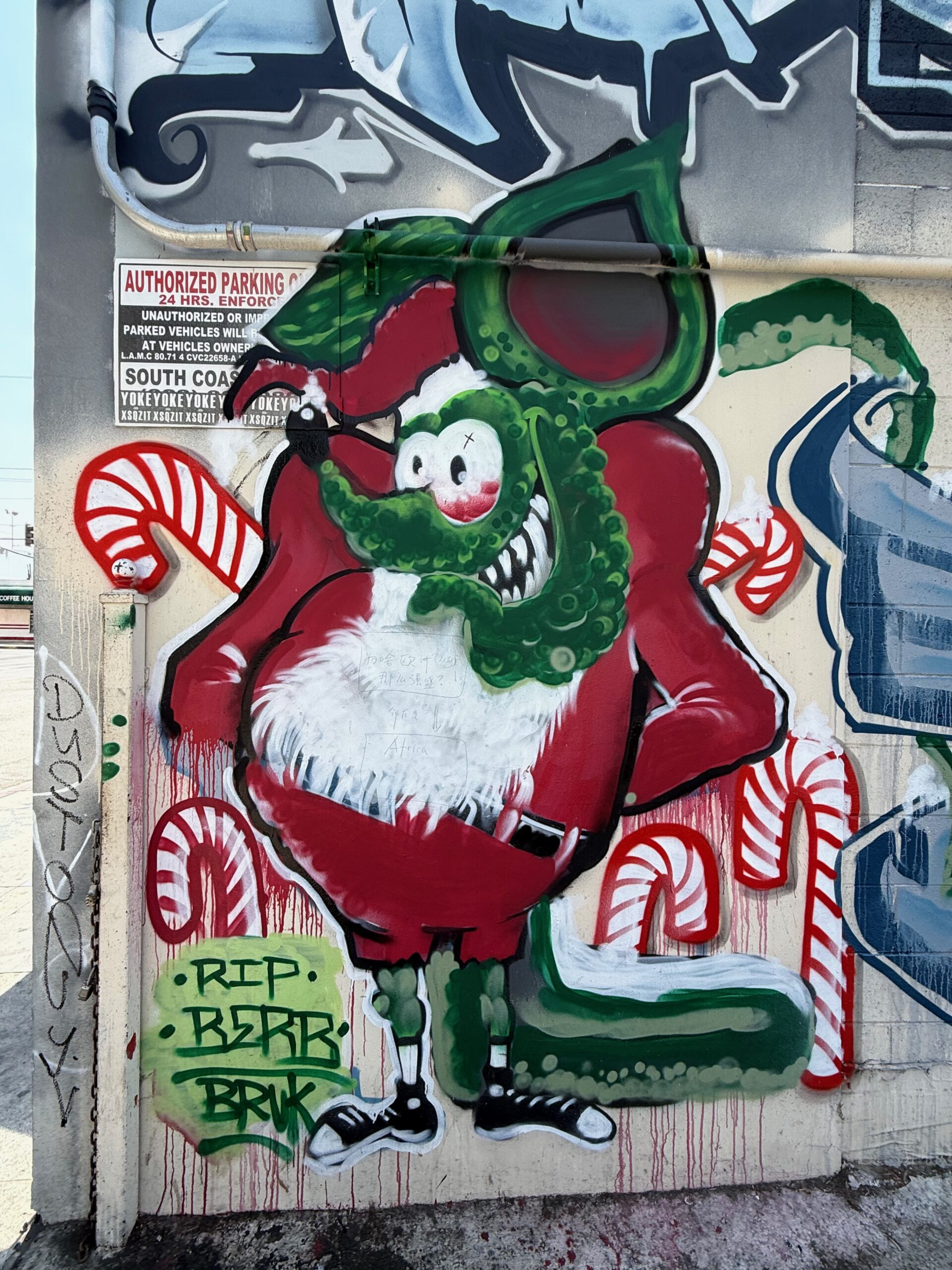
….out on the streets of downtown LA it was a perfect Rat Fink Christmas: hot and muggy with the threat of ICE hanging in the air. If you think the way that our government is treating agricultural workers- and lots of other folks- in this country is ok, fair, or even “Christian”, then please buy your tomatoes from someone else; I wouldn’t want you to choke as you swallow your own lies and ignorance.
Inside the flower market it was getting close to Christmas, but in our fields it’s still summer. We did find our first Galeaux d’Eysines pumpkin though.
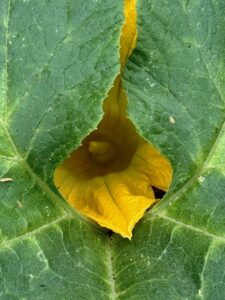
Here is a Chilacayote blooming. We will have some huge Chilacayote gourds in the fall.
This is one of Starr’s favorite Dahlias. She will bring a wide spectrum of flowers.
If you appreciate Marigolds for Diwali or Dia de los Muertos we will be opening the farm up for a series of U-Pick events.

Starr and I do find time to relax from time to time. Earlier in the month we visited a cute little labyrinth at the Grace Cathedral in San Francisco. We modeled the labyrinth we built on the farm after the Chartres Cathedral Labyrinth, which is the same one that Grace was inspired by.
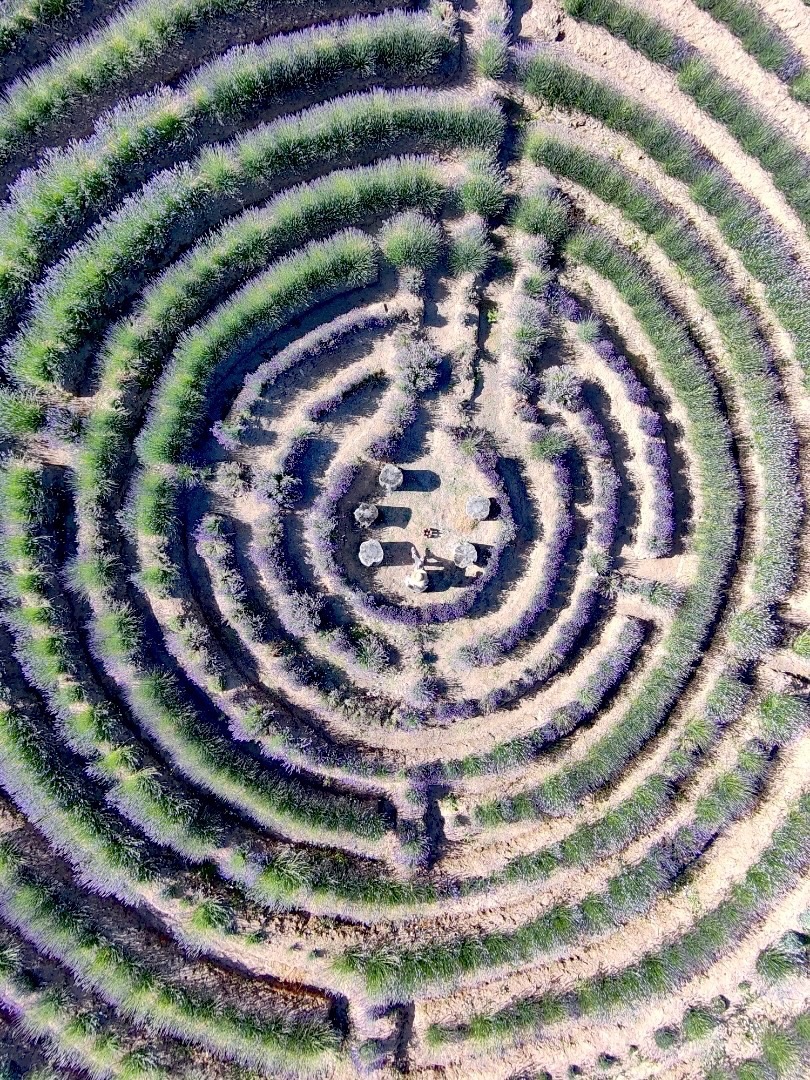
Here’s a drone’s eye view of our labyrinth on Mariquita Farm. It’s 110 feet across. You’re welcome to visit it during the U-Picks or other farm events. Keep an eye on the newsletter.
.
|
Corralitos & Berkeley Pop-Ups
I’m very happy with our 2025 season Dry Farmed Early Girl Tomato crop. The plants are happy, the fruit is ripening well and it tastes great.
A big “Thanks!” to our friends and neighbors at Corralitos’s own Jet & Rose Boutique for inviting our farm to their event this coming Saturday. Tomatoes, herbs, flowers, and other goodies. Come by the stand and visit us and the other vendors.
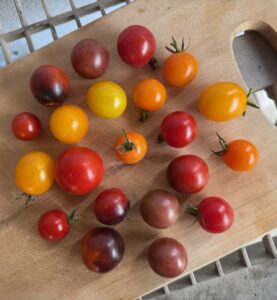
This informal cherry tomato mandala is only half a basket’s worth.
Hello, Everybody: We’ve been blessed with good weather so far this season. We did the field prep and planting work on time, the plants were cultivated and weeded well, and now our summer coastal tomato season is upon us. Fresh tomatoes and basil are a nice distraction from the infinite number of stupidities and cruelties to negotiate in this spastic, reactionary political moment. At least the sun and moon have been above it all, shining away and helping our crops.
Our first pop-ups will be a couple of “first come, first serve” affairs. We are excited to share these events with other vendors. The first pop-up will be at the Jett & Rose Boutique in Corralitos, only two miles from our farm. We will bring a rainbow of fresh tomatoes, plus basils, herbs, fruits and flowers, and elaborated products.
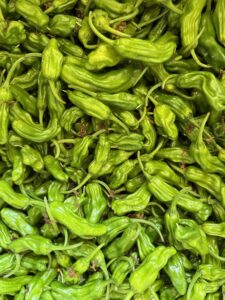
We will be picking baskets of Shisito peppers for the pop-ups.
Our second pop-up will be at The Sesame Tiny Bakery. The Bakery calls itself “A pocket sized bakery down a secret alley at 2533 Seventh Street in Berkeley.” Who doesn’t love being “in” on a secret? I’m looking forward to their pastries too. We will also be sharing the event with our friend, Chef Carlo of @linger___longer . It’s fun to be back in Berkeley and fun to work with Carlo again. He and I have worked together for many years in Santa Cruz, SF, and the East Bay! Thanks, Carlo, for being such a long time supporter of our farm.
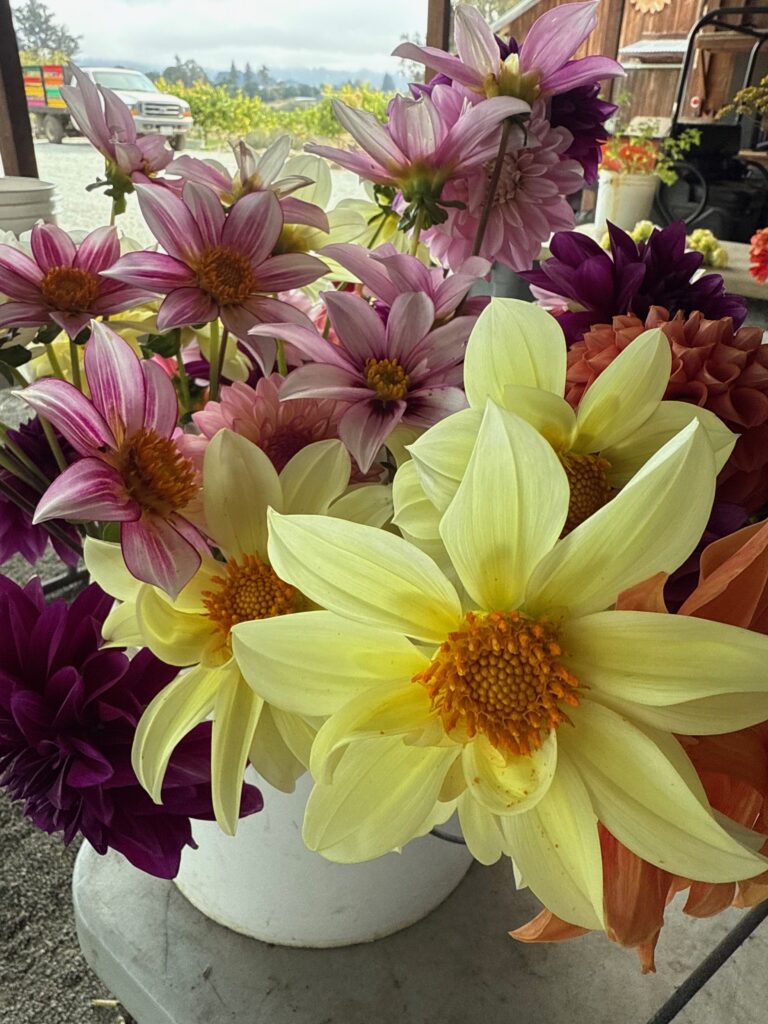
These Dahlias in the packing shed easily outshine the bright Mariquita Farm truck in the distance. Yes, we have a “Truck Farm.”
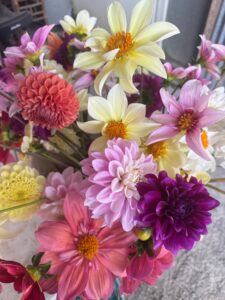
With all their diverse shapes, sizes, and colors the dahlias are so much fun. We even have a tree dahlia!
As the season progresses we plan on scheduling pop-up events in Los Gatos, Palo Alto, San Francisco, and West Berkeley. We look forward to seeing you. As our sacramental marigold crop comes into focus we will announce a series of U-Pick Marigold events. Thanks, Starr & Andy
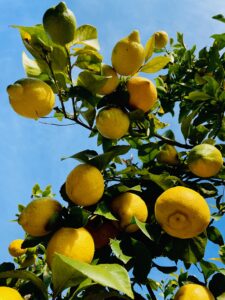
Lemon juice is essential for basil pesto, and luckily we are harvesting Lisbon Lemons right now.

Black-Eyed Susan is looking at you.
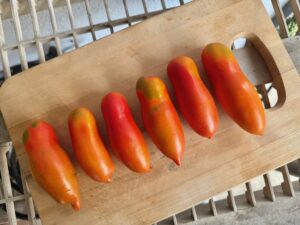
The 2025 San Marzano crop is starting to ripen. We will have a few cases to bring to our first pop-ups and after that the fields promise a big main crop this year!
A big “Thanks” to Corralitos’s Deer Creek Farm for her still and guidance and to Farm Cat Marmalade for their help distilling lavender oil & hydrosol from our 2025 crop. Farm Cat Marmalade often “pops up” with us to display their wide range of marmalades and preserves.
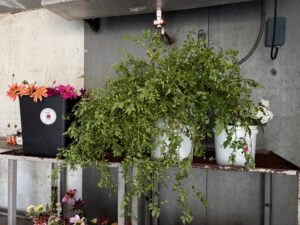
Not all the tomatoes that we grow are destined for the dinner plate; these tiny-fruited wild cherry tomatoes are harvested for their foliage and sold into the LA Flower Market thru our friends at GatherFlora LA to be used as an aromatic and fun filler in bouquets.
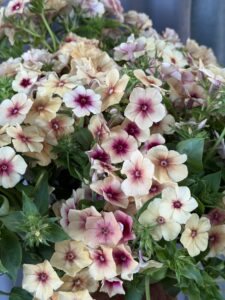
Phlox is becoming one of our favorite flowers to grow.
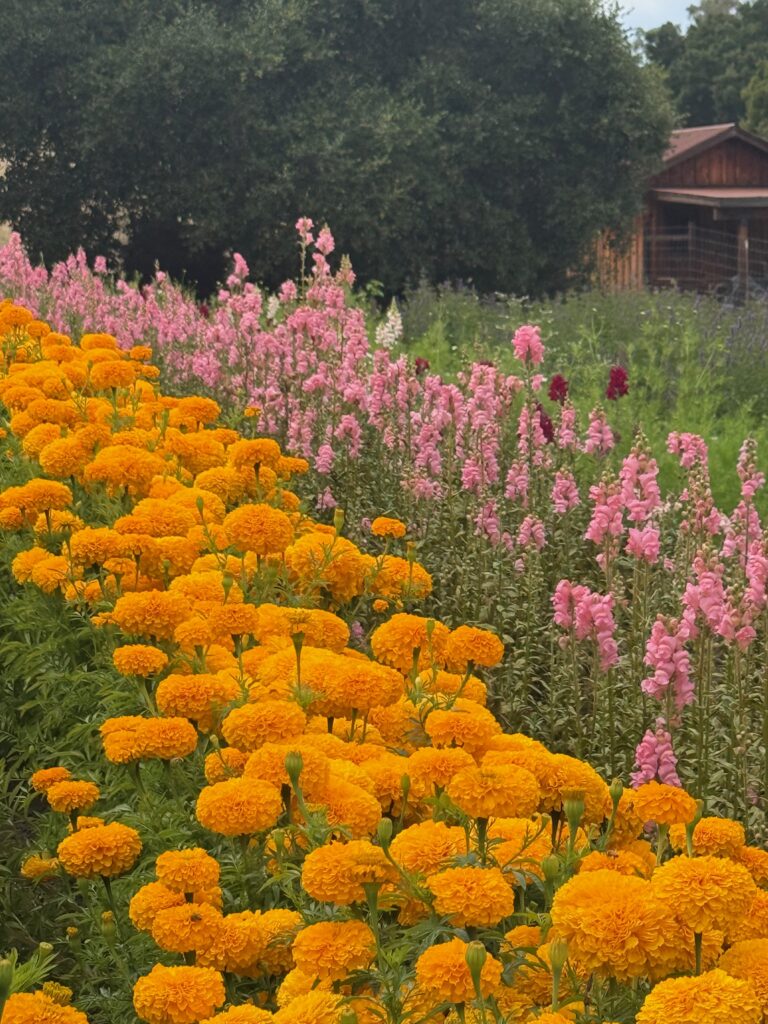
Here’s a view looking out across our first marigold row of the season. This is “Chedi Gold.” Chedi Orange & Chedi Yellow are here as well. Keep an eye out on the newsletter for details if you’re interested in coming to one of our Fall marigold U-Pick events.
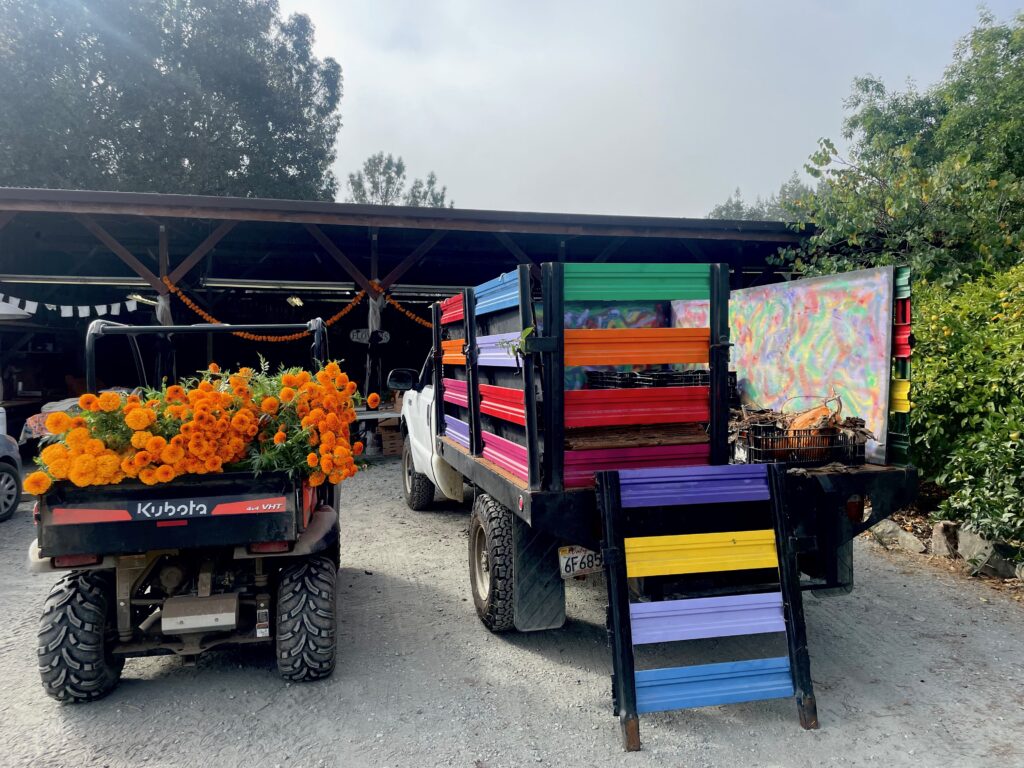
Chedi Orange sacramental marigolds coming out of the field and getting ready to go to market.
.
|
Tomato Update
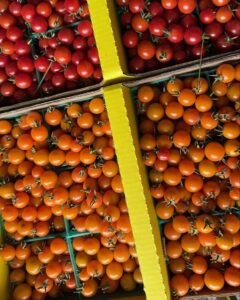
The season’s first Cherry Tomatoes
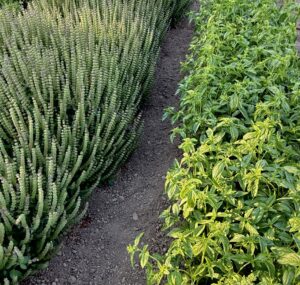
Tulsi basil from India on the left, Genovese basil on the right
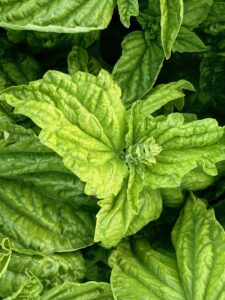
Napolitano basil, also known as “Lettuce Leaf basil”
Hi Friends: San Marzano, or “Saint Marcian” to English speakers, achieved notoriety within the Roman Empire as the first Bishop of Tortona. The historical record is blurry but Marzano was either crucified by Emperor Trajan in 117 AD or by Trajan’s successor, Hadrian, a few years later in 120 AD. Christian martyrdom earned Marzano his saintly status within the Roman Catholic Church but he achieved a wider immortality in the world of food. Tortona is near Genoa in the north of Italy. Genoa, of course, is famous in its own right because of their “Genovese” basil, said by some to be the ONLY appropriate basil for perfect pesto. Basil and tomatoes go together like cookies and milk, but the saintly, rmeaty, red, sausage-shaped sauce tomato doesn’t come from Marzano’s Bishopric but from the town of San Marzano sul Sarno in Campania, near Mt Vesuvius, in Southern Italy.Even if you’ve never tasted a ripe San Marzano tomato, you’ve likely seen an iconic image of the long, cylindrical tomato on the cans of imported tomato sauce stacked high in Italian delicatessens.

Piccolo Fino Verde basil. Piccolo means “tiny,” like the little flute. But this basil packs a huge scent!
Marzano could never have tasted his namesake tomato because Italians had to wait another 1400 years after his death for the Spanish Catholics to invade Mexico in 1519 AD and encounter all the miraculous crops that the native American farmers had developed. Even more time elapsed for these “New World” crops like tomatoes, peppers, cacao, corn, squash and beans to make their way back to Europe. Initially these “new” crops were regarded with suspicion; since none of them were mentioned in the Holy Bible it was feared that they were Satanic. It fell to any number of nameless Italian gardeners and cooks who weren’t overly concerned with the Theology of botany to convert these imported pagan crops into “Italian” food.
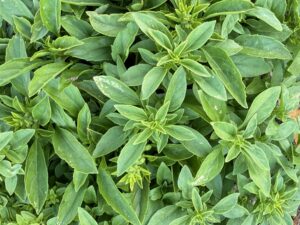
Greco a Palla basil, or Greek basil. No, the Greeks did not invent basil, but they made it their own.
Poor Marzano couldn’t have tasted authentic Genovese basil pesto either, because the basil plant was developed by SouthEast Asian farmers. Muslim spice traders would have been responsible for introducing basil into the Mediterranean and European cultures. The best pesto is an emulsion of basil leaves, lemon juice, olive oil, and pine nuts. Arab Muslims are responsible for introducing the lemon to Italy too. At least Italians can take credit for the pine nuts in their pesto which come from the native Italian Stone Pine, Pinus pinea. When we start our tomato pop-ups in August we will have a rainbow of basils on the table along with San Marzano tomatoes.
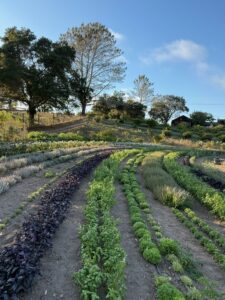
Purple basil growing next to other herbs on the farm. The pine in the background is a Torrey Pine. It would yield cones with fabulous pine nuts, but the tree squirrels get them all.
We will also have Piennolo tomatoes for sale. Piennolo tomatoes came to fame from the region around Mt. Vesuvius in Southern Italy, near Naples. Where the San Marzano tomato is big, long, and meaty, the Piennolo is small and a bit more acidic, with a more concentrated flavor. Piennolo tomatoes have gained fame because they will last a long time after harvest without spoiling. It became traditional for Neopolitan gardeners to hang the season’s last Piennolo plants from the rafters of their kitchens as winter approached, the wilting plants still laden with clusters of small, firm, green, pointed fruits. As the Piennolo’s foliage slowly dried the green, hard fruits would gradually ripen in the warmth of the kitchens so that the cooks could reach up overhead and pluck a few ripe, red tomatoes from the withered vines to flavor a salad or a sauce.
Opinions differ on what ingredients are appropriate in true basil pesto, but most folks allow lemon juice as the acid to balance the olive oil. We grow a wide range of citrus. These are Lisbon lemons.
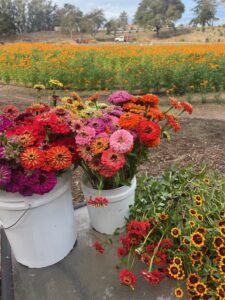
We grow a lot of cut flowers along with the fruits and herbs. Need flowers for an event or gift?
This appealing narrative of ripe tomatoes for a hearty meal on a frosty night is fun and factual but it partly obscures the truth that Piennolo tomatoes are great all season long; you don’t have to wait until the late fall to enjoy them. Piennolos are a lovely tomato for eating fresh, for saucing, and for drying. We like to cut them in half, dehydrate them and then pack them tight in little jars that we fill with olive oil. Not only do the tomatoes taste great, the olive oil that has been steeped in the tomatoes is a revelation. Naples, where Piennolos found their fame, is also the home of “Napolitano Basil,” a very large-leaved, sweet basil that is excellent for salads, garnish, and for wrapping up little bites of food a la grape leaves or fig leaves. Also- don’t sue me- Napolitano basil is appreciated by some people as a good pesto basil.
Principe Borghese tomatoes are easy to confuse with Piennolo tomatoes because they are similar in size and shape to their Neopolitan cousins but we grow them anyway. I’m confused too because, while the Principe Borghese tomato became widely produced in Southern Italy in the early 1900s for the sun-dried tomato industry, the name refers to the famous Borghese clan from the Siena region north of Rome. The Borghese family is famous for creating politicians and popes, not tomato growers. We find that sun-drying any kind of tomato is almost impossible because our regular night time marine fog rehydrates the fruit that our midday sun just dehydrated. But with an electric dehydrator in our kitchen we can make lots of “sun-dried” tomatoes. If I had to make a distinction between the Principe Borghese and Piennolo tomatoes I’d say that the Borgheses are typically a bit juicier than the Piennolo, a bit more pointed at the tip, and that their harvest starts a bit earlier.And, speaking of “early,” we will again be harvesting our dry-farmed Early Girl tomatoes. I saw the first color in our 2025 Early Girl crop today, which is what prompts today’s note to you. The plants look healthy and loaded with fruit. Dry-farm practices assure a rich flavor. It works like this:
1.Transplant sturdy little tomato plants into moist soil in early spring. For us, that means a transplant date of around April 15th, when we no longer fear frost.
2. As the fields dry out from winter rains and the moisture levels retreat into the earth the tomato plant’s roots will follow the water down into the mineral zone below the topsoil.
3. The top soil may be the richest zone for the nitrogen, phosphorus, and potassium, or the “NPK,” which are responsible for helping plants become big, green, and fluffy, the trace elements and micronutrients found in the mineral subsoil are most helpful in giving flowers their color or fruits their flavor. True, dry-farmed plants grow more slowly and the fruit is typically smaller, but they make up for it by having a richer, more complex flavor. We also dry-farm our San Marzano, Piennolo, and Principe Borghese tomatoes. We have found that dry-farming also acts to reduce disease pressure and to reduce the power bills that come from running the irrigation pumps.
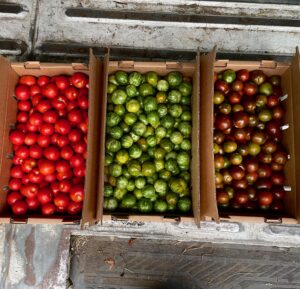
Dry farmed Early Girls on the left, Green Zebra tomatoes in the middle, and Black Prince tomatoes on the right.
We do occasionally irrigate some of our Heirloom tomato varieties, as they might have been developed in places that receive summer rains. Our 2025 crop of Heirlooms looks good at this point- a little late, perhaps, but still on track. As usual, the Purple Cherokee tomatoes will come first, followed by the red, yellow, and pink Brandywines, the Marvel Stripes, the orange Valencias, and the green Aunt Ruby’s German tomatoes.
Last, and smallest, but not least, we have a rainbow of cherry tomatoes coming your way, from the popular Sungold and Sweet 100s all the way through black, purple, and yellow varieties to the tiny, pea-sized wild cherry toms. It’s going to be a good year. Keep your eye on the newsletter for details of upcoming pop-ups and farm events.
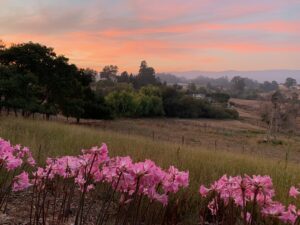
The farm is available as an event space for small weddings, elopements, team-building events, etc. These amaryllis are an event in and of themselves!
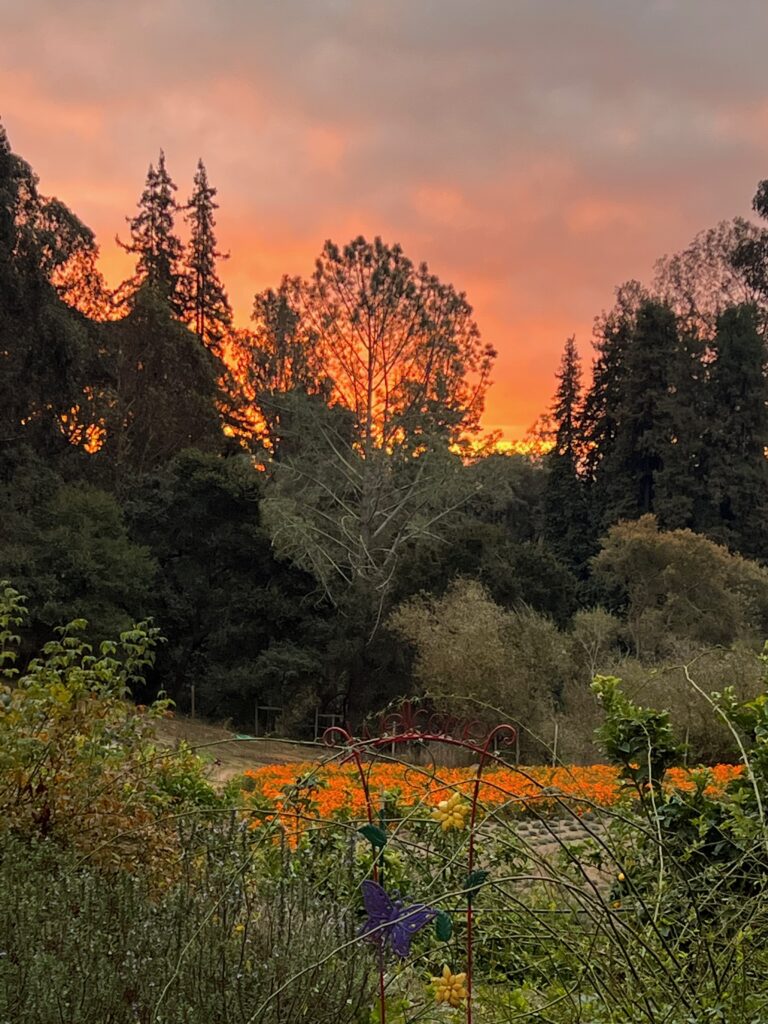
Keep an eye out for our 2025 season Marigold U-Pick events. Here the sky seems to be soaking up color from the flowers.
Also coming up at the pop-ups we will have Basilico Piccolo Fino, Purple Basil, Cinnamon Basil, Greco a Palla Basil, Thai Basil, Tulsi Basil, Oregano, Savory, Sweet Marjoram and Zaatar, or Syrian Marjoram.
.
|

 Copyright © 2023 Mariquita Farm. All Right Reserved.