

How Long Will Tomato Season Last?

Change is in the air! Starr took this lovely photo of a recent sunset seen through our gate. These clouds were from a tropical storm that snuck in from Baja. It rained, but only enough to still the dust for a minute.
This is the time of year that people start to ask me, “How long will the tomato season last?”

Look how many acorns there are underneath the oak tree! This oak clearly believes that there is going to be a lot of rain this coming winter, so it’s dumping a bumper crop of acorns on the ground in order to assure that at least one seed germinates and survives the squirrels, the deer, woodpeckers, and the weather and grow into another beautiful tree. It’s been years since I saw an acorn crop of this magnitude.
I laugh because that’s always a question I ask myself. And, if I could answer that question correctly, I’d be much better off focusing my crystal ball on a more remunerable trade, like sports betting or the stock market. I’m just as baffled as anybody else as to how long the tomato season could last. The bold outlines of October and November are drawn in black and white; every passing day brings a few less minutes of sunshine and the dawn always comes a few minutes later. True, some days in the fall it seems as though the sun burns brighter and hotter than ever, but it always retreats and, as it does, the plants slow their growth and their fruits ripen more slowly. The first rain may dry off the leaves of the tomatoes before the morning is over, but even a light rain will moisten the soil and speedup the rate of the cooling off process that has already begun. One good rain that soaks the earth in late October or early November sets the stage for the first frost. The clouds rain themselves dry and the sky clears. The moisture evaporates from the soil, driving down soil temperatures and three of four clear nights later we experience our first frost f the season. Any tomato plants that still have green foliage will be burned. The season is over.

We’re getting ready for the winter too. In this picture you can see the last of this year’s Otto File corn stalks being fed through the chipper so that they can go back to the earth. Next we will spread organic fertilizer on the ground and then plant a cover crop to protect the soil from winter rains and help enrich the land for crops to come.
But when we get the first rain or the first frost seems impossible to predict. Despite what the orange buffoon in the white house may say, climate change is real. A philosopher may tell you that the past can’t logically predict the future anyway, and my experience tells me that nature is full of surprises. Some years we’ve managed to harvest tomatoes through to Thanksgiving, and other years we’ve been shut down by the weather as early as the second week in October. The Pagan in me is reluctant to make bold predictions about the weather for fear of inciting the wrath of the gods with my greedy hubris. I know what I want, and that’s about it; I hope to be harvesting tomatoes thru November. The Mexicans I work with have a phrase that comes in useful in situations like this; “Ojala,” they’ll say, meaning ,’hopefully, or ‘may it be so,’ or “if only…'” “Ojala” comes to Spanish from the Arabic, “Inshallah,” meaning “God Willing.” So I feel confident leaving the length of the tomato season up to the whims of the divine. “But please make it thru November, Ojala!”
Another question we’ve gotten recently is, “How do I save tomato seeds?”
Now, that’s a question I feel more comfortable answering.
Take the Piennolo tomato, for example. The Piennolo tomato is an open-pollinated heirloom variety of tomato, which means that nobody owns the rights to the genetics of the plant. Heirloom genetics are our ancestors gifts from their past to our future. Heirloom crops are your inheritance: you can legally save the seeds from them to plant. Heirloom seeds will sprout true to type and you will not be violating Bayer/Monsanto , Dow/DuPont, or Syngenta’s patent rights. It’s fun to not pay a super-massive corporation for your tomato seeds and it’s not hard either.
Step 1. Slice the Piennolo tomato in half and squeeze out the seeds. No, there are not a lot of seeds. The Piennolo is a “paste tomato” and it has more flesh and fewer seeds than a cherry tomato or a Beefsteak type. We joke that you may want to buy two cases of Piennolos- one to eat and one to save the seed from.
Step 2. Put the seeds, along with the slippery, gelatinous goop that they come wrapped in into s shallow saucer and leave it someplace out of the way and out of direct sun so that it can begin to ferment naturally.
Step 3. Do not through the seedy goop our when it starts to develop mold and appear to rot. Decomposition of the goop around the tomato seeds is what you want. As the goop breaks down around the seeds, natural enzymes are released which prime the seed to germinate under the correct set of circumstances.
Step 4. When the goop seems good and rotten, then wash the decomposed stuff off of the seeds, using a very fine sieve and a gentle flow of water. When the seeds are clean, spread them out to dry on a paper towel.
Step 5. The seeds can be stored in paper envelope in a cool, dry, place free from rodents . You can even freeze them. Either way, You’ll be ready to plant Piennolo tomatoes in the spring!
Thanks for your interest and support of our farm Starr & I would like to invite you to join us in supporting a local, Santa Cruz County non-profit that will be hosting a benefit lunch on the farm. Come visit. Details below.
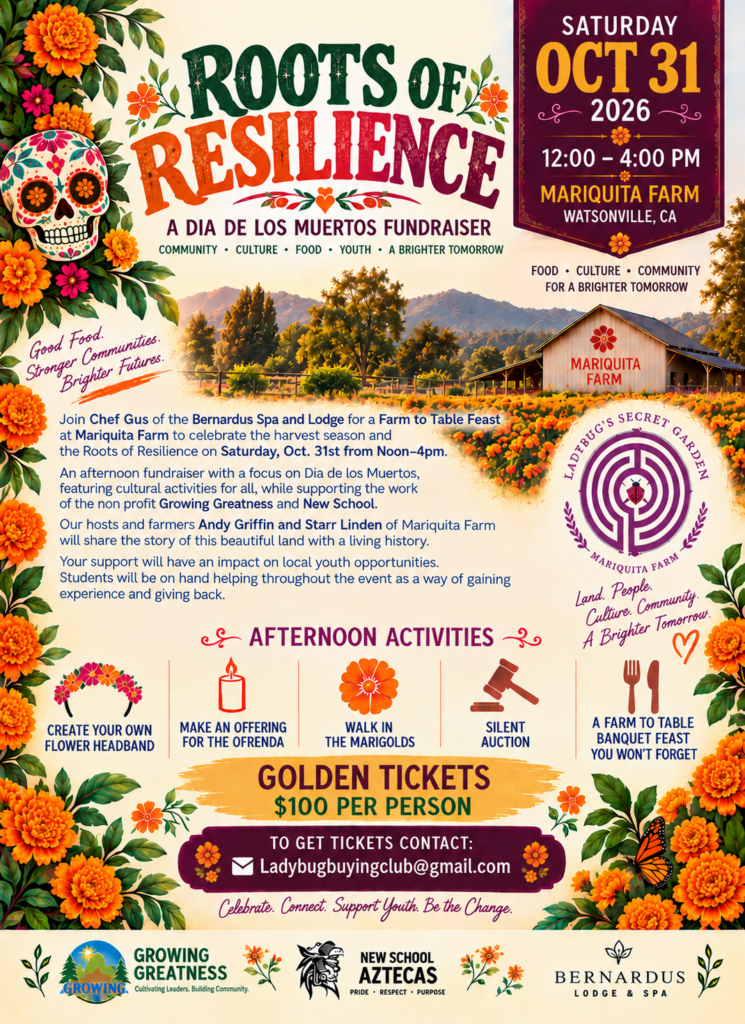
We look forward to participating in this fund-raiser for Roots Of Resilience. Chef Gus, of the Bernardus Lodge in Carmel Valley, is a big friend and supporter of the farm. Please join us. Tickets are limited so check in at the farm’s online store for availability. The weather will be perfect, Ojala!
.
.
.
|
|

 Copyright © 2023 Mariquita Farm. All Right Reserved.