

Thanksgiving Letter
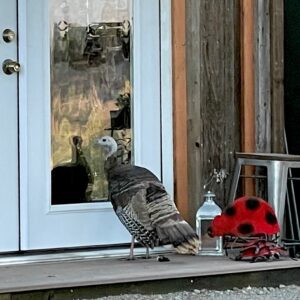
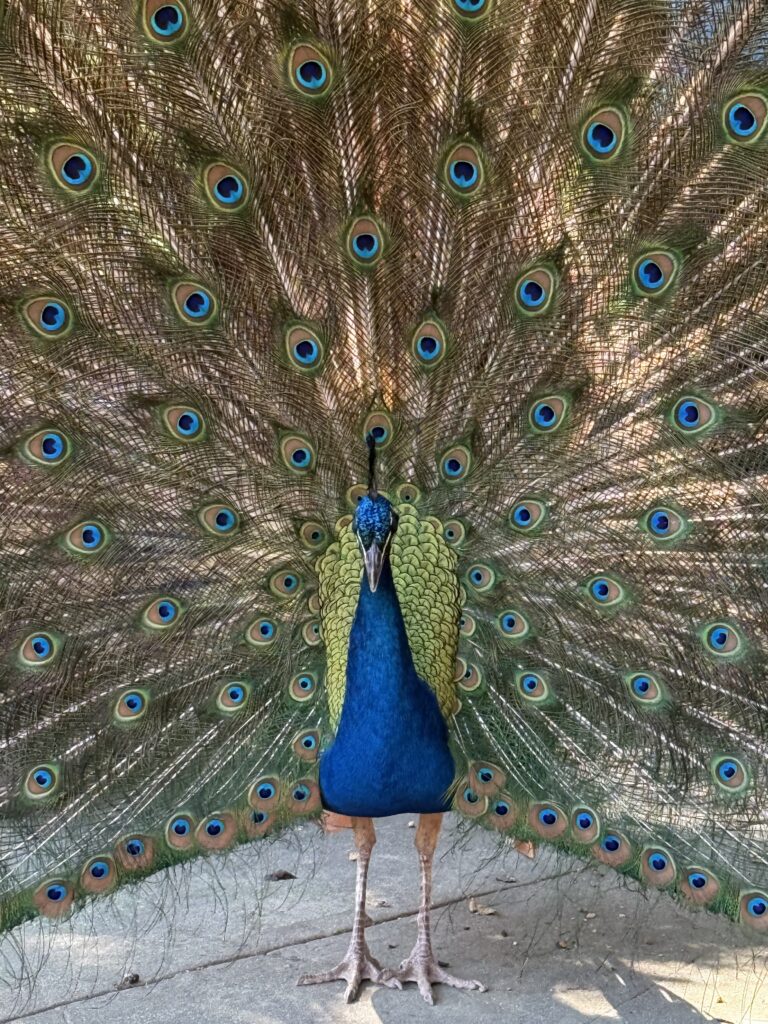
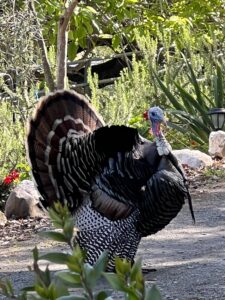
Maybe I thought that my front yard was my own, but….no, he looks at me like I’m an imposter and scolds me for my impudence. If I wanted to eat him it would be killing, not hunting. He’s safe with me, but I will throw a lemon at him if he gives me much more attitude.
No, they are not from Turkey. Turkey birds, whatever you call them- and they have many names- originally evolved here, in the so-called “Indies,” later redubbed the “New World” when it became obvious that Columbus had failed to find a shortcut across the Atlantic to India. It may have been a “new world” to the European explorers who crashed into it by mistake, but our continent was already a very “old world” by any reasonable metric. Fossilized bodies of prehistoric “Turkeys,” or “Meleagris california” to the scientists, are among the most numerous creatures to have been dug out of La Brea Tarpits in Los Angeles. Just to make their evolution a little more confusing, the wild Turkeys that we have running riot here in California today are not descended from the ancient Turkeys that once roamed the LA Basin. The Meleagris californica birds died out in California over 10,000 years ago, likely hunted to extinction by humans and other predators. Turkeys are often thought of as being exceptionally stupid birds, but they must have something going on to be thriving. They’re a prolific race of big, iridescent, and noisy birds who multiply despite the fact that they are eaten like popcorn by every sort of predator from eagles, hawks, and bobcats, down through coyotes to foxes, humans and snakes. Let’s take a closer look at these beautiful, annoying, destructive, delicious and adaptive beasts.
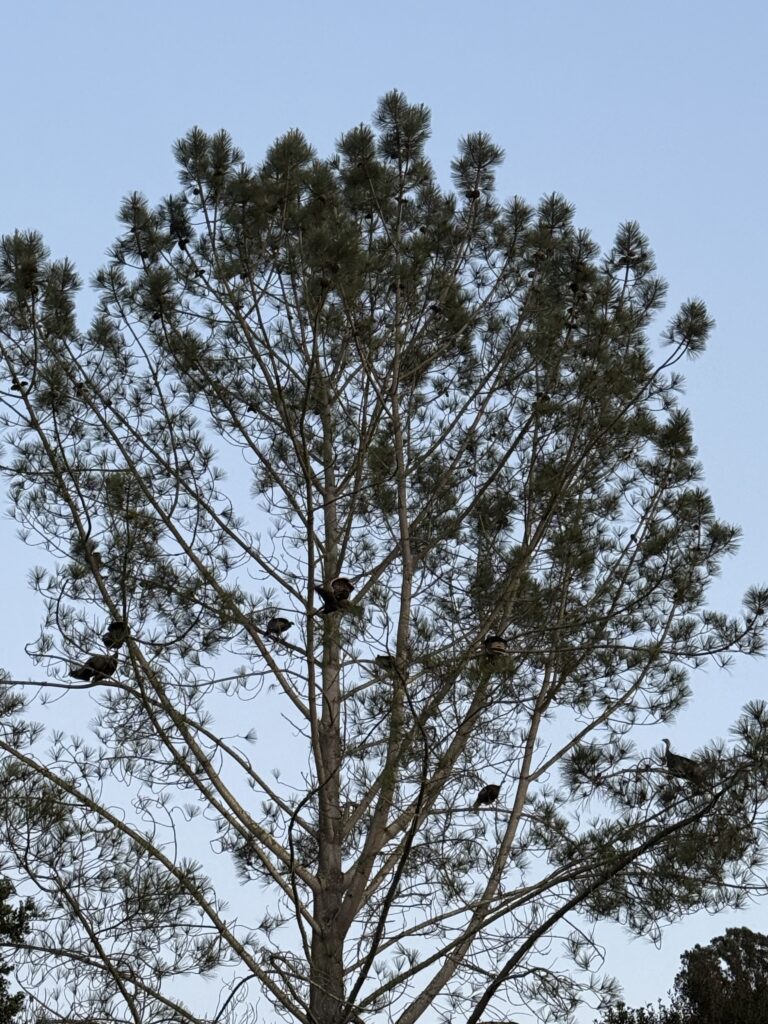
In the evening the tree fills up with wild turkeys. How many do you count?
The wild Turkeys that we put up with here in California are known to science as “Meleagris gallopavo,” and they are not native to our Golden State. At several different points in recent history Wild Turkeys were introduced into California in the hopes that they could be hunted for sport. The most recent reintroduction of wild turkeys occured in the late 1950s and those birds came from a population in Arizona. I grew up on a remote biological field station for the University Of California in Upper Carmel Valley during the ’60s and ’70s, and I recall numerous researchers complaining about the wild turkeys because they were perceived to be destructive to the native ecology. Wild turkeys eat green plants and dried seeds, but they’ll also eat many insects and even little lizards, salamanders and horny toads. We rarely saw any wild turkeys back in the 60’s though; their populations were sparse. I’m almost shocked at how many wild turkeys we have now. Somehow turkeys have figured out how to outrun their predators. And while turkeys were reintroduced to be hunted our society has changed and people do not seem nearly as interested in hunting as they were when I was a child. Back then, it seemed as though every pick-up truck had a gun rack and every living room had a Buck’s head mounted over the hearth.
When I see the contemporary success of the imported wild turkeys it makes me wonder about the future of feral Peafowl. Two of my friends, Tamara of Meliflora Farm in the Aptos Hills and Linda, who has Rancho Chupinos in Upper Carmel Valley, both tell me that the first Peacocks they had at their places arrived as tagalongs with a flock of wild turkeys. Now each property is liberally salted with these shrieking fowl. Peafowl do share certain similarities with wild turkeys; they have similar diets, they are similarly sized, they’re all capable of being really loud and obnoxious- though Peacocks are definitely worse- and they’re both beautiful animals. People here don’t have a culture of eating Peacocks, but that amnesty from humankind’s menu doesn’t extend to the other predators meal plans.
Unlike the Turkeys, the Peafowl are from the real Indies, as in India and Southeast Asia in general. Scientists call Peafowl Pavo cristatus. In Spanish the name for a Turkey is simply “Pavo,” and the Spanish name for a Peacock is “Pavo Real,” as in “Royal Turkey.” Peacocks do certainly look royal as they strut about ridiculously, adorned with all their flashy colors. In Mexican Spanish wild turkeys are called “Guajolotes,” a name which derives from their name in classical Nahuatl. It was the Ancient Mexicans that first domesticated the wild turkeys and created the prototypes for the contemporary breeds of turkeys that end up in deli sandwiches or on Thanksgiving Day tables. The guacalotl only got its English name by chance, since the first English to see these birds encountered them as treasures imported from the Ottoman Empire in Western Asia.

This selfie shows the size of a chilacayote. They are even harder headed than I am.
I tolerate the wild turkeys on our farm, and I appreciate how beautiful they are, but I’m always pleased when they leave for a while, and I’m hoping that they don’t show up someday with any feral peafowl in tow. The turkeys can be destructive. While I can’t honestly say they eat many crops, they do make a big mess in newly prepared ground by turning my carefully planted beds into dust baths. When I put out a straw mulch to protect soil from the rain, the turkeys will inevitably scratch it all up and make a big mess as they look for bugs. Plus they’re noisy. If I ever try to sleep in to 7am on a day off, the turkey flock will show up outside my window at 5 am and make a giant scandal. And the turkeys eat the cat food too, so I have to feed my kitties indoors. I’m not crazy about turkeys but they do like our place. We live at the end of the road and there’s no through traffic, so it’s quiet. Plus we don’t have any dogs. The farm has the nicely tilled soil that the turkeys like to scratch around in and the fields are ringed with tall Torrey Pine trees that they like to roost in.
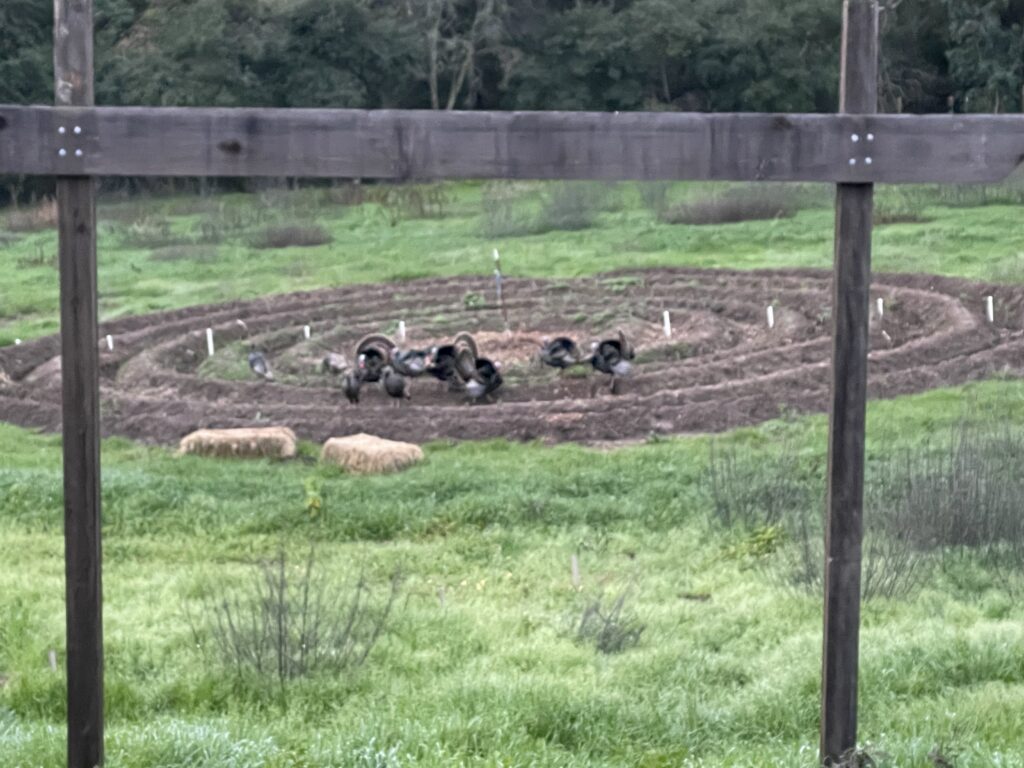
This little flock of turkeys showed up to scratch around our labyrinth as we began it construct it.
Every year it seems like we’ll start out with a big flock of Turkey hens and cocks that will dwindle as the birds get eaten. But turkeys don’t always play the victim. Starr was in the dahlia patch one afternoon when a coyote popped out of the bushes and made to rush an adult turkey that was loitering near her. The turkey wasn’t having it though, and it rose up on its legs, spread its wings, hissed and went after the coyote. The coyote reevaluated its priorities and took off as she watched.
At some point each season the turkey hens will disappear into the brush to lay their eggs and after a period of quiet they’ll reemerge followed by bobbing lines of tiny, round, fluffy, golf-ball sized chicks. Some chicks get bigger and some disappear. Sometimes the whole flock will disappear for a while, but the birds always come back. Wild turkeys may not be native, but they’ve made themselves at home.
One afternoon we had a Oaxacan family visit the farm to do a chilacayote U-Pick. Chilacayotes are giant squash family members that like large round watermelons. Like watermelons, chilacayotes have a hard shell. Unlike watermelons chilacayotes have a fibrous flesh that is white, full of seeds, and not sweet. Chilacayote might be a hard sell to a gringo crowd but they are appreciated in Southern Mexico and Central America, often being juiced to be served as a healthy drink. Grandma was out in front because she was going to show her daughter how to pick out the best chilacayote. The daughter and her husband, who was going to drag the chilacayote up the hill, were following her, and dragging along at the back were the grandson, aged 10, and the granddaughter, who was around 7 or 8. The kids were planning on whinging and being bored when, all of a sudden, a big wild turkey hopped out of the chilacayote patch and began strutting about, fanning his tail feathers, gobbling like a lunatic, and showing off his fine bronze and copper iridescent feathers.
well as recognizing its outsized attitude and its psychedelic plumage.
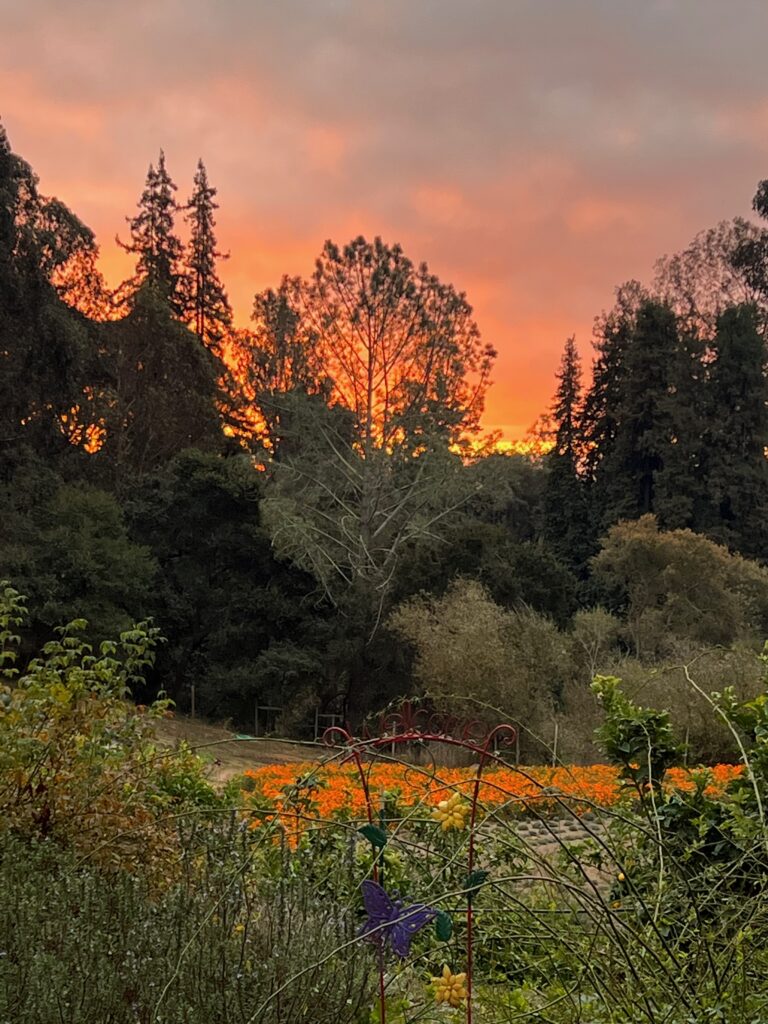
Here is the turkey flock’s favorite roosting tree at dawn. Turkeys are early risers, so they have already descended from their secure roost.
.
|

 Copyright © 2023 Mariquita Farm. All Right Reserved.