
What’s In A Name?
We grow herbs, tomatoes, citrus, and greens for you in the Pajaro Valley. “Pajaro” means “bird” in Spanish. More about the birds in a minute but, first, let me tell you a bit about the Valley.
The Pajaro River watershed starts in the hills to the south and east of San Jose. Driving down highway 101 by Morgan Hill you’ll likely never even notice when you leave the drainage of Coyote Creek, which drains to the north into the San Francisco Bay by Alviso, and enter the watershed of Llagas Creek, which drains south into the Pajaro River. There must be at least a foot of elevation between the two watersheds but, at 65 miles an hour, who can tell?
Pacheco Creek, which runs along highway 152 westwards from Pacheco Pass, is another “big” tributary of the Pajaro River. In the old days, a huge inland swamp that was home to vast flocks of waterfowl, spread out across the landscape where Pacheco Creek and Llagas Creek join forces and formed the Pajaro River. Today that area is known as “The Bolsa,” which means “The Bag” in Spanish. Mexican rancheros used to drive their cattle down from the uplands of the Diablo Range into the Bolsa’s wetlands to feed, and the surrounding hills acted as a “bag” to jug the herds up so that they didn’t wander and make them easier to manage as they fattened on the green grass.
f you’ve ever seen the Amazon, the Pajaro River is like a teardrop compared to a flood, but it’s OUR “rive,” our teardrop. The Pajaro flows south until it is joined by the San Benito “River” near San Juan Bautista, at the very tail end of the Santa Cruz Mountains. There, just after the confluence, the Pajaro turns west, and cuts through what we call the “Chittenden Gap,” which is a low point in the hills that divides the Santa Cruz Mountains from the Anzar Hills, before entering the ocean by Watsonville.
The San Benito River is typically dry since the Diablo Range that it drains is arid. During those rare years when we get any rain along the upper reaches of the San Benito River the watershed there doesn’t much vegetation out there to take the water up or hold it back, so we can experience floods here along the lower reaches of the Pajaro Valley.
Our home ranch is near the mouth of the Pajaro River, and only a few miles as the crow flies from the Pacific Ocean. Our proximity to the ocean gives us the mild, temperate climate that we need in order to grow frost sensitive crops like citrus and cut flowers. We grow our tomatoes on rented ground about 15 mile upstream along the middle reaches of the Pajaro, where the inland temperatures are warmer, yet still mild compared to the furnace of the San Joaquin Valley baking away on the other side of Pacheco Pass. It may be out of sight and out of mind, but the San Joaquin Valley defines our life. Every day, as the temperatures go up in the San Joaquin, their hot air rises, prompting an on-shore breeze of cool air off the Pacific, which blows across the lower reaches of the Pajaro Valley, through the Chittenden Gap, and over the Pacheco Pass.
When the first Spanish soldiers marched north under the command of Gaspar de Portola, out of Mexico into Alta California, they were accompanied on their expedition by a Catholic monk who chronicled their progress. The Spaniards named many of the places and features that they “discovered.” Today, we still have a few local sites that have kept an original indigenous place name that predates “discovery;” “Aptos,” our neighboring town to the west, for example, takes its name either from the Ohlone word for “The meeting of two creeks.”. Soquel, the next town over from Aptos, may take its name from the Ohlone word meaning “place of willows” or it may mean “the place of waters.”
Juan Crespi, the Catholic monk who accompanied the Portola expedition into Alta California, took his role as a priest and discoverer very seriously and he named many of our natural landmarks after saintly figures of Catholic history. So, naturally, you have the best bay in the world for ocean-going ships named after Saint Francis of Assisi, who loved animals. Llagas Creek, along the headwaters of the Pajaro, was named after “Las Llagas de nuestro Padre de San Francisco,” meaning “the wounds of Father Francisco.” Apparently Saint Francis experienced the spontaneous bodily eruption of bleeding ulcers, or stigmata, which mimicked the wounds that Jesus experienced from the nails through his body on the cross. That’s a miracle, for sure!
The Pajaro River enters the ocean in present day Santa Cruz County. “Santa Cruz,” means “Holy Cross.” The cross is not simply a design motif for jewelry; it was the torture device that the Romans nailed the Carpenter from Bethlehem to. If you flinch at blood, you should probably skip the Bible and read Winnie The Pooh or The Cat in The Hat. The “Diablo Range” means the “Devil’s Mountains,” and the name recalls the moment Spanish Padres found a shrine in the brush of the hills to the east of present day Walnut Creek that had been created to honor an un-Catholic divinity.
Spanish soldiers also awarded many place names for the lands they transversed but they were unburdened by religion and prone to fits of humor. For example, “Salsipuedes” is the name of a canyon near our farm . “Salsipuedes” means “get out if you can,” which was an apt name for a box canyon that was choked with poison oak, nettles and brambles as well as being liberally salted with Grizzly Bears, panthers, skunks, ticks, and rattlesnakes.
I’m always amused by “Atascadero,” a town down 101 south of “Saint Ardo” and “Saint Michael,” but north of “Saint Louis the Bishop.”. Ardo Smaragdus, aka San Ardo, was an author who became holy as a hagiographer, writing down (and perhaps propping up) accounts of the miracles performed by other saints. Saint Michael, aka “San Miguel,” was, technically, an archangel, not a regular human, but he was Holy. Saint Louis, of San Luis Obispo fame, fed the hungry and the homeless until he died at a young age. But “Atascadero,” a spot named by the Spanish soldiers, means “place where you get stuck.” Which brings us to “The Birds” of The Pajaro Valley, which is the place where I’m “stuck.”
“Pajaro” does mean “bird” in Spanish, but it is generally understood to mean a small or regular sized bird, like a robin or a quail or a Bluebird. When the Portola Expedition was advancing north through what would become California, the soldiers naturally followed the paths laid out by the locals that the Spaniards were “discovering.” When their procession reached the present day location of Watsonville they encountered an “Indian” village that announced itself with a dead, dried out condor stuffed with straw, mounted on a stake like a totem. The Spanish soldiers must have been vastly amused. In the Imperial Roman tradition that the Spaniards aspired to, advance parties of an army marched “under the aegis,” which is to say, “under the eagle.” The forward guard of any Roman army carried a tall pole with the form of a gilded eagle at the top. Once a territory was conquered, the staff with the eagle was stuck in the dirt, meaning that all the land around was now “under the aegis,” “under the eagle”, or “under the control” of Rome. Seeing a super-gargantuan vulture mounted on a stick at the edge of a native settlement must have read like a spoof on the Empire to the Spanish soldiers. With their genius for understatement, the Spanish soldiers named that settlement “Pajaro,” meaning “little bird” as a nod to the totem jammed into the earth and the huge carrion eating birds flying overhead.
The California Condor is coming back from a near extinction experience and their numbers are gradually increasing in the Santa Lucia Mountains south of here. (Lucia would be “Holy Lucy,” who was executed because her suitor was upset that she wanted to marry Jesus instead of him, and accused her of being a Christian. She was guilty as charged….) I once had the opportunity of seeing a California Condor floating in the sky right above the intersection of Corralitos Road and Freedom Boulevard, where we will be conducting a pop up on August 22nd. It was during the huge fires in Big Sur during Covid, and I imagine the huge bird was simply looking for a cleaner place to breathe for a moment. It was exhilarating to see such a huge “pajaro” overhead.
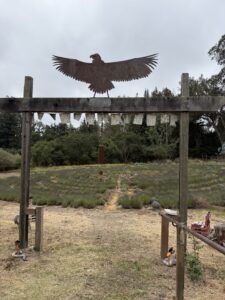
For my 67th birthday I decided to gift myself a condor sculpture which calls attention to the name of our valley. I engaged Scott, a polymath artist friend who is a metal worker, ceramicist, carpenter, graphic artist/rodeo cowboy to make me a condor who can always fly over our farm and lend us it’s carrion eating majesty. Here it is! (link) We mounted “Connie,” the Condor, at the entrance to our labyrinth like our own “aegis” as an homage to our valley and our native “bird.” My hope and ambition for this farm is always that we use this patch of soil and sun and water as an experiment in honoring all the people and creatures who have come before us and left us with this little patch of dirt and magic.
.”
.
.
.
|
|

 Copyright © 2023 Mariquita Farm. All Right Reserved.