

Ladybug Letters
A Basil Family Reunion
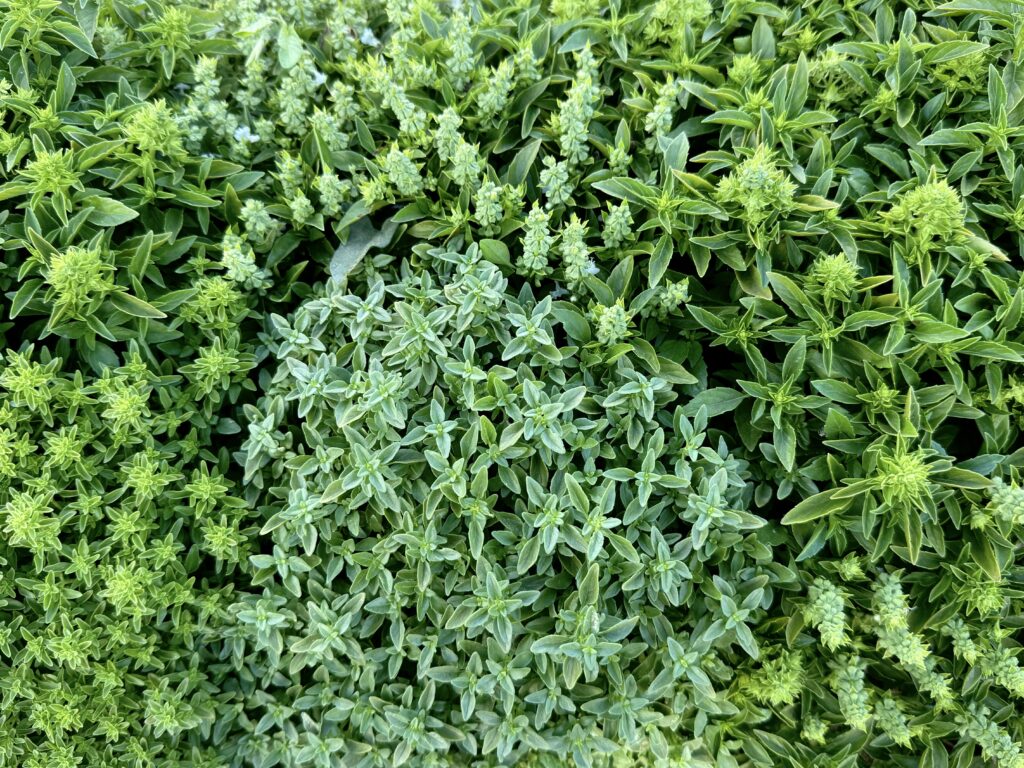
Basilico Piccolo Fino Verde is a variable plant by nature. “Piccolo Fino Verde” means “little, fine, & green,” and, as you can see, all these leaves are little, fine, and green, but there are 3 separate plants in this photo and each of them looks somewhat different from its siblings. They all smell great.
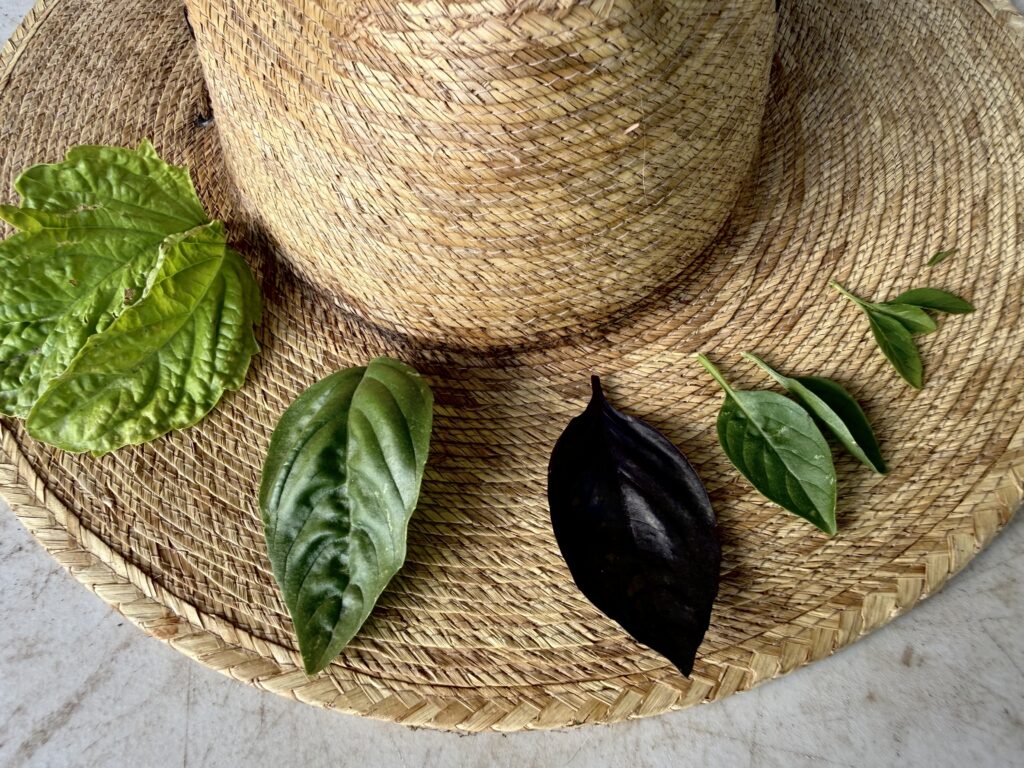
From left to right; Tuscan basil, Genovese basil, Purple basil, Greek basil, and finally 3 tiny leaves of Piccolo Fino Verde
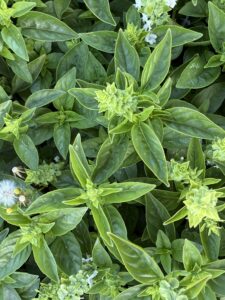
Greek basil; a smallish leaf that delivers a BIG scent. In my experience, this plant is more resistant to disease than many larger-leaved Italian basils.

A quick sweep though the tomato patch catches the first pick of a number of varietals.
Hi Folks: It looks like a Basil family reunion in the field below our house. Like any vast, rich family that lives sprawled across 6 continents, not every basil family member could make it, but we at Mariquita Farm are playing host to at least seven of their “biggest names.”
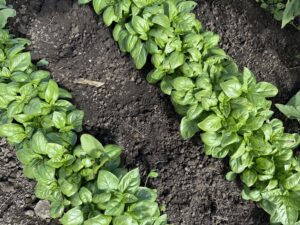
Two rows of young Genovese basil. Once the soil is warm enough the seeds will sprout with the vigor of weeds.
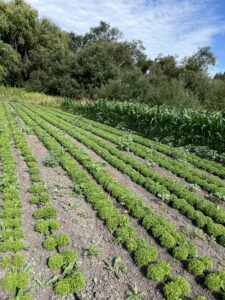
Here is one of our successions of Piccolo Fino Verde. This basil is finding favor on menus as a garnish green because it has such a sweet and spicy scent as well as a fine and filigree shape.
“Basil,” in Greek, means “King.” So-called “Holy Basil” is considered a manifestation of the Goddess Tulsi. Basils come to us with a lot of attitude. Basilico Piccolo Fino Verde has the tiniest of leaves but she arrives with one of the strongest, sweetest scents of any basil. The plant makes a tiny, tidy, fashion forward little pom-pom of a plant. There is a lot of variety in this clan with plenty of variation in leaf color, size and shape.
Greek basil – “Greco a palla”- presents a larger leaf than the Piccolo types, and it hits with much more of a clove spice than does its smaller and sweeter leafed cousin. The plant will form a compact ball, somewhat a bit taller and more erect than the Piccolo types. In my experience both the Piccolo and Greek basils are quite resistant to disease. It’s just an opinion, but Greek basil is my favorite for pesto.
Genovese basil is the market’s choice to be the most popular basil. The broader leaves make stripping the plants easier and the flavor is a rich mix of both sweet and spice. I’m a farmer, so I’m going to have a more nuanced appreciation for a plant than some consumers. Genovese basil IS GREAT, and I love it, and so do the bugs. Genovese basil also seems sensitive to airborn mildews and other fungal attacks. For a while it seemed as though we couldn’t hardly ever get a good, disease-free Genovese basil crop, so I began experimenting with other varieties, but so far, this year, things in Genoa seem great. The Purple basil that we grow is a purple Genovese type.
Tuscan basil has the largest leaf of any of our basils, with one of the mildest flavors. As a grower I have to say that it is one of the most difficult basils to grow easily because its wide leaves are easily damaged by the sun, the wind, the birds, the bugs, the snails, etc. When they’re nice the big leaves make nice wrapper leaves for hors d’oeuvres.
There are many branches of the Basil family in Thailand. This year I grew the Thai Sweet basil. Our Lemon basil is another form of Thai basil. In the past I’ve grown Thai Anise basil and Thai Cinnamon basil.
Tulsi is an Avatar of Lakshmi, consort to Vishnu, and the Tulsi basil is a manifestation of her presence. Tulsi is “Holy basil” but , as with Thai basil, there are many forms. I’m growing 2 kinds and I have been informed that they are both “Ram Tulsi” plants, not “Krishna Tulsi.” I will be bringing a few bunches of each kind to the pop-up in case you want to pop in and give the herbs a look.
Besides the basils, we’ll be coming to SF with Dry-Farmed Early Girl tomatoes, Sungold cherry tomatoes, a rainbow mix of cherry toms, Heirlooms, tomatillos, Piennolos, jalapeños, limes, lemons, and cut flowers. We are not pre-selling yet, as we’re not 100% sure on yields, but we’ll have plenty of stuff on a first come-first serve basis. We take cash, but Venmo and Zelle work too. We can’t take credit cards, I’m sorry. I hope we see you in front of Piccino at 1001 Minnesota Street, San Francisco, Sunday morning, July 26th, from 9:30 am to 12:30. Thank you, Andy & Starr.
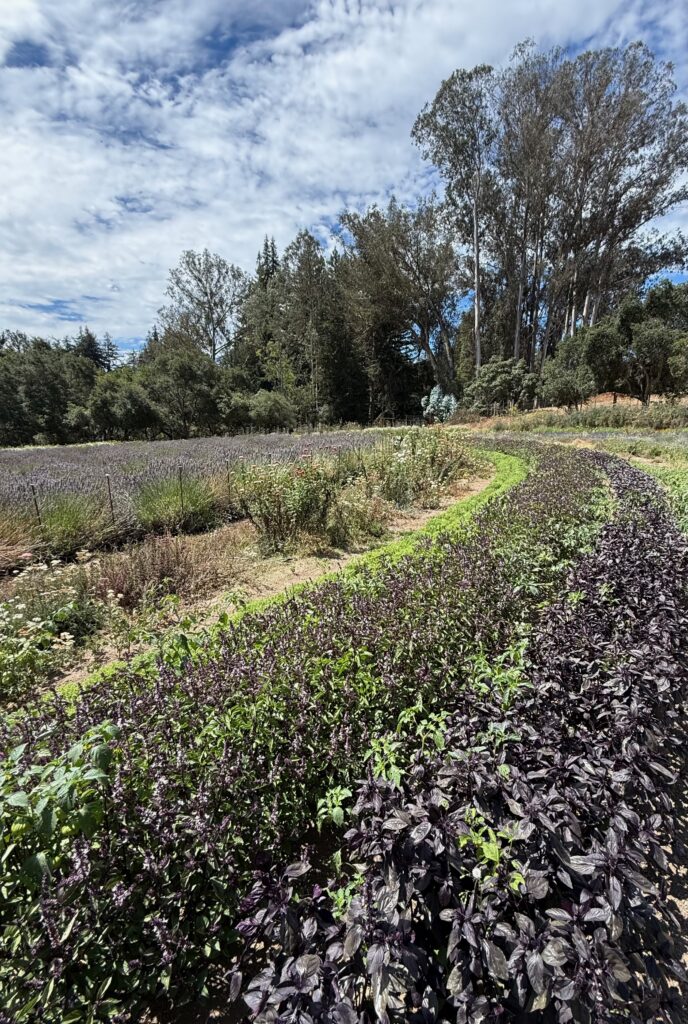
Purple Genovese basil on the right, and a tall stand of Thai sweet basil on its left.

One variety of “Holy basil,” or “Tulsi”- there are many kinds of Tulsi! The plant is very aromatic and is considered a manifestation of the Goddess Tulsi.

Our cat, Samson, in the middle of his lavender field. Lavender is an aromatic cousin to basil in the bigger mint family of herbs.
.
|
|
This Coming Sunday’s Pop-Up Menu
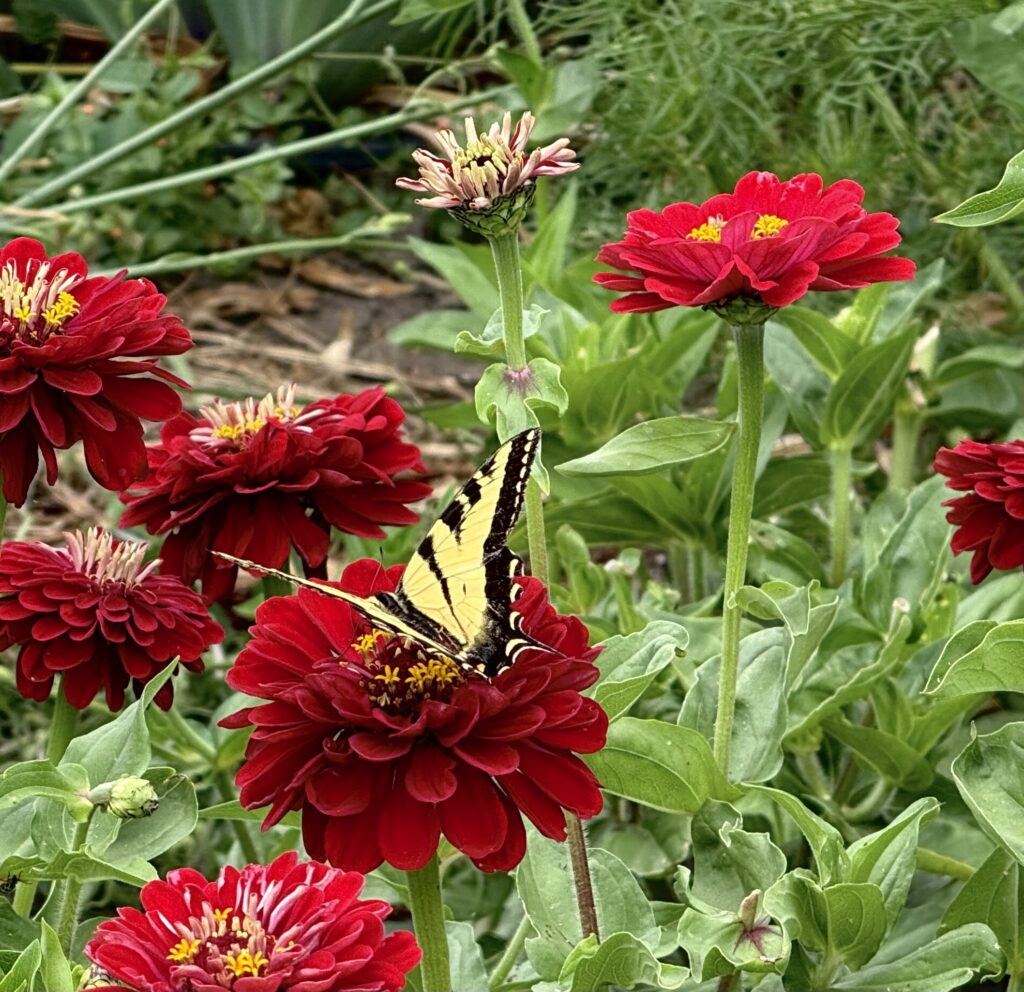
There are so many fewer butterflies flitting about the world than I remember as a child, so it’s fun to see them enjoying the flower gardens on the farm.
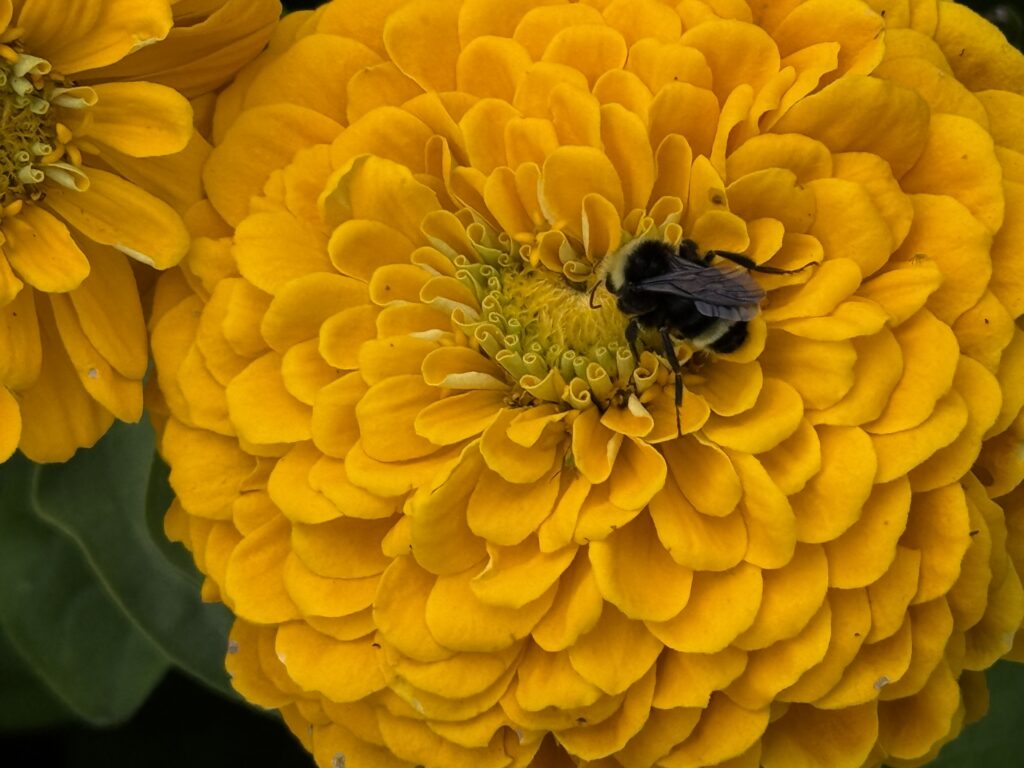
The farm swarms with bees, but they’re too busy to notice us. My favorites are the Bumble Bees. This one is diving into a yellow zinnia.
Hi Folks: We’re looking forward to seeing you at our first pop-up of the 2026 summer season this coming Sunday in Dogpatch across the street from Piccino Restaurant @ 1001 Minnesota Street , SF, from 9:30 am to 12:30 in the afternoon. We will be showing up with our friends from Farm Cat Marmalade too. As I write this note to you I’m not quite sure of the amount of tomatoes that we’ll be able to harvest so we will present our initial harvest on a first come, first serve basis, but I imagine we’ll come with plenty of Dry-Farmed Early Girls and Sungold Cherry Tomatoes, and possibly our first heirlooms and Piennolos too! We will be offering the tomatoes “mix and match” in pint baskets and by 10 & 20 pound cases as well. And I know we’ll have plenty of tomatillos. Also on the menu are fragrant bags of Genovese, Greek, Tuscan, and Thai basils, as well as Basilico Piccolo Fino Verde, some Tulsi, and some Purple Basil as well. Our Austrailian Finger Limes are getting ready to pick, and I’ll also harvest Persian limes, Meyer Lemons, Lisbon lemons, Assadas Citron (Etrog) and Buddha’s Hand citrons. We’ve been growing an interesting cooking green for our local Oaxacan community called “Alache,” so I’ll bring some of that for any curious cooks who want to do a deep dive into the foodways of Southern Mexico. Our cut flower program is doing well this year, so we’ll prepare a feast for the eyes too. When you walk down 22nd Street and turn onto Minnesota you will not miss seeing our market stall because the colors are going to pop!
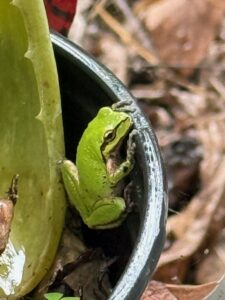
Frogs are under a lot of pressure from habitat loss so it’s comforting to see them every day on the farm. Starr surprised this one when she moved a potted plant, but the frog settled back down again in the Aloe bush once the drama passed to await a tasty mosquito. Frogs are so much better for the environment than chemical pesticides.
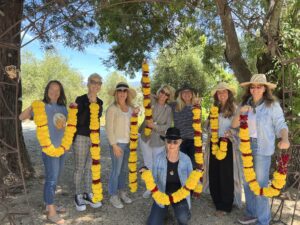
Everybody made flower garlands at our previous “5 Senses” workshop that focused on the sense of smell.
Flowers and bouquets will be the focus of our 5th and final “Five Senses” workshops. We’re billing this August 8th tour of the flower gardens and bouquet building workshop as “Seeing,” but flowers are all about “smelling” too, and some of them are about tasting. Besides a tour of the flower gardens, a walk in the Lavender Labyrinth and a bouquet workshop our friend and Collaborator, Wild Beauty Cosmetics, from Soquel, will be on hand to give mini-facials that focus on the eyes. You can sign up for this workshop on the “Events” page of this web page. Thanks, Starr & Andy
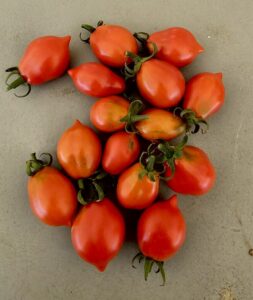
This photo of last year’s Piennolo crop has me looking forward to this year’s fruit.
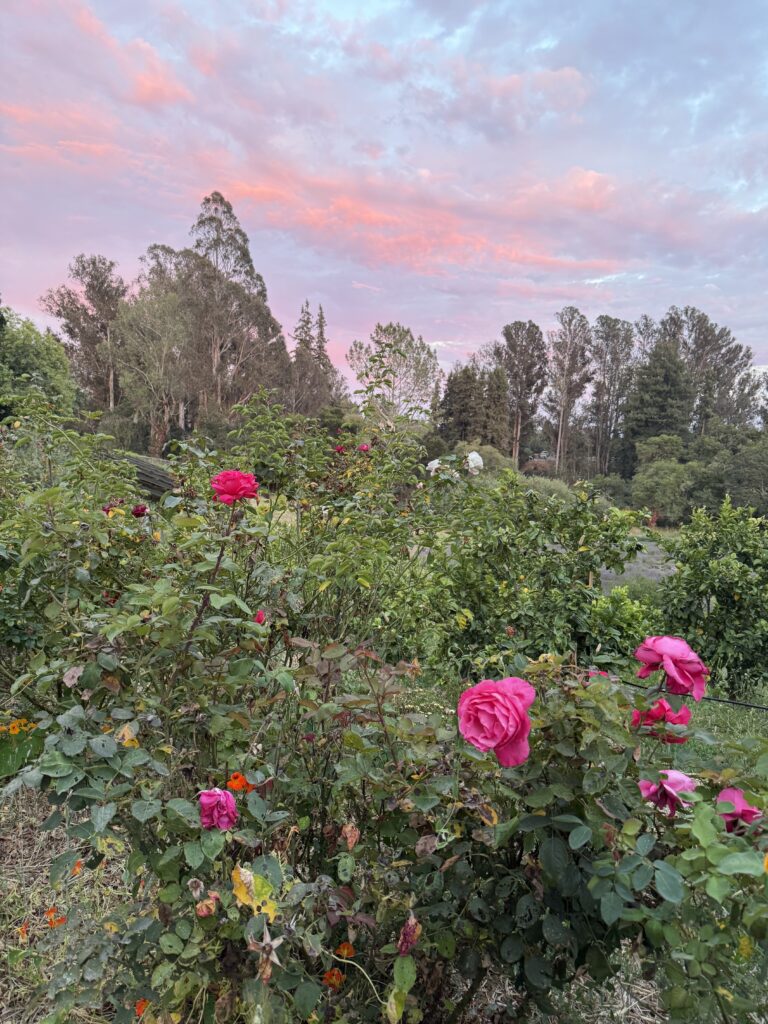
The roses were leaking some color into the sky the other day, or is it the other way around?

Our cat, Samson, putting the Ellagance Purple Lavender in context. Starr will have some of her lavender products available in the farm store.
.
|
|
Knock On Wood

Our head cat, Samson, reviewing the work we did planting out a rainbow of different basil varieties.

Hi Folks: I’m happy to say that the 2026 season tomato crop is looking good. Knock on wood. We expect the first harvests to take place in the first week of July. All told, we have several successive waves of each kind of tomato planted out in the field now so we’re hoping to be in production from early July through late October.

The tomato crop is looking great! These are the Dry Farmed Early Girls
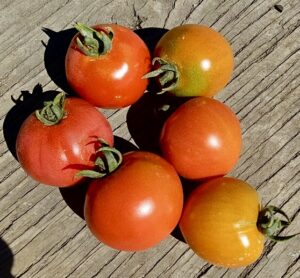
Here’s the first handful of 2026 tomatoes. A big field only yielded these 6 fruits but a big crop is coming.
One of the first hurdles for a successful crop to clear is always the winter greenhouse stage of production. We always aim to get the first tomato seeds sowed into the transplant trays in early February. February can be a hard time of year for the birds, so if they can figure out a way to get into the warm greenhouse they may peck the seeds right out of the little cells in the trays where they’ve been sown before they even germinate and later on they can eat the tiny plants. The same goes for field mice. But this year none of those disasters befell us. Plus, the neighbor’s old, scruffy cat found the greenhouse to be a warm and inviting environment to relax in and he kept a watchful eye on production when he wasn’t snoozing.
Greenhouses are warm and humid, which encourages rapid plant growth but that same damp heat can foster mildews and other fungal problems. From day to night fungus can wipe out a crop in an enclosed space, like a greenhouse. We used to book our transplants with a large organic greenhouse operation, figuring that they could do a better job than us, and we’d pick up the plants all ready to go. We figured that the expense was worth the security of knowing that trained professionals were overseeing our crop when it was at its most vulnerable stage. But even the pros have problems and one year they lost- not just our crop, but thousands of trays of other farms’ tomato transplants in an outbreak of blight. We had some trays planted in our own greenhouse and didn’t have a problem, so now I figure I’ll live with the worry and count on dumb luck and an old cat to guide our tender transplants through their first months of life.
This photo of last year’s Piennolo crop has me looking forward to this year’s fruit.
You’ll recall that this past March was unseasonably warm. While warm winter temps can create havoc for farms that grow crops that have a chill requirement like cherries which need 800 to 1200 hours below 40 degrees Fahrenheit during dormancy for an adequate bloom to set, tomatoes are a tropical plant by nature and they resent being cold. Our neighbors who grow cherries have problems this year with the bloom set, but our tomatoes grew fast and healthy in the greenhouse. The warmer winter also helped us prepare the fields well. We got rain when we needed it this year and we got dry spells when we needed them. Dumb luck again, but dumb luck is better than no luck, and we got the cover crop worked under and spread compost on the fields six weeks earlier than usual.
We used to figure that April 15th was the frost-free date here on the Central Coast. By “We” I mean the farmers in the area who, by necessity, pay close attention to frost patterns. I can remember planting tomatoes out on April 15th back in the 1990s, only to have a damaging frost on the night of April 17th, so the “frost free date” was only a practical guideline, not a law of nature. But this year the fields were ready early, the tomatoes were ready to plant early, so we gambled that our luck would hold and we got the plants in the ground in late March. Our luck held. I’m not a gambler, which is to say I don’t go to Vegas and play the slots, and I don’t even buy lottery cards, but I have no right to criticize gamblers on moral grounds since so much of farming boils down to luck and every planting is a gamble. Maybe after all the risks I take farming I simply have no appetite for more risk when I’m on vacation.
So our plants were set out early and then a series of gentle rains helped nurture the little seedlings as they established their footing in their new home. The summer weeds all sprouted just when the soil temperature rose to the point that they were waiting for, just like they always do, but we were ready with our tractors. True, the war against Iran and the subsequent rise in diesel fuel prices is making farming more costly than ever, but you’re feeling that pain too. We bought the $7 dollar a gallon diesel for our tractors and got the cultivation done on time. With dry-farmed tomatoes cultivation is really key. We bank on the water in the soil to sustain our crop through production, and cultivation helps that happen. It’s not just that removing the weeds keeps them from drinking up the water our tomatoes will need. As soil dries out under the sun and wind the mechanics of evaporation create little capillary-like structure in the soil. Cultivating the soil surface shatters those capillaries where they meet the air and acts to help retain residual moisture in the soil. This is called a “dust mulch.”
If March was warmer than usual then April and May were often cooler than typical, but the tomatoes did well anyway and they created big canopies of greens. The plants flowered well. Because we farm in that region we call “The Bolsa,” east of Gilroy and north of San Juan, near where Pacheco Creek meets the Pajaro River, we can count on a strong breeze every afternoon as warm air rising in the San Joaquin Valley pulls in cool marine air over the Pacheco Pass. Tomatoes are wind pollinated, so we’ve got that angle covered. The tomato plants in the first of our three successive plantings are loaded with green fruit. The Cherry Tomatoes and Early Girls will come first, followed by the Heirloom varieties, then the San Marzanos and finally the Piennolo.
There’s still plenty of time for complications and drama but like the gambler on a lucky streak I know it will all work out. Yes, carton costs are way up. Yes, the availability of labor is way down. And yes, the weather forecast is calling for a Godzilla El Nino effect, with whatever that entails, but I feel like we’re on a lucky streak too and I look forward to sharing a great crop with you this summer and fall. Can you hear me knocking?
Meanwhile, back on the ranch….We’ve got the last two of our “Five Senses Workshops” that will be happening on the Farm. Saturday, July 11th, our workshop will be about our sense of smell – our “sense of scents,” if you will, focusing on lavender and other aromatic herbs. Have you ever smelled Huacatay? Nepitella? Lovage?
Then on Saturday, August 8th, our last workshop that focuses on seeing. It’ll be a beautiful day and Starr will be making bouquets with people from the flowers we grow. Also, she informs me that there will be “mini facials” offered. Lastly, now that I can see our harvest taking shape I’ll be reaching out to our past pop-up hosts to see if we can “pop up” again to offer this year’s harvest of tomatoes, herbs, flowers, citrus, and other veggies. Keep an eye on the newsletter and we hope to see you soon. Thanks, Andy & Starr.
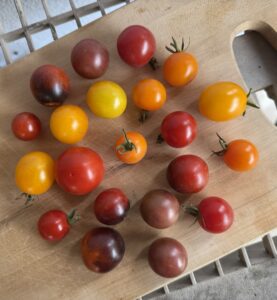
A rainbow of cherry tomatoes
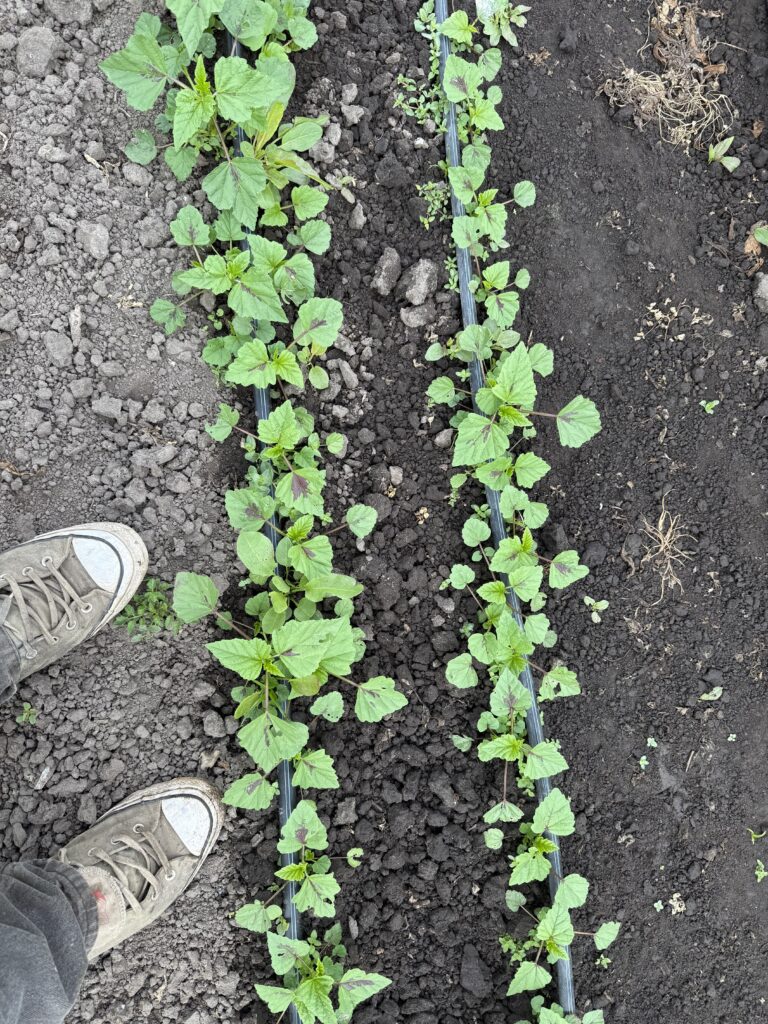
This is a fun experiment; here’s a foot-selfie (for scale( to show you a Mexican pot herb or “quelite” called Alache that we are growing for the local Oaxacan shoppers. It’s used to thicken soups and stews and acts the way that okra does to gumbo. Both okra and alache are in the Malvaceae.
.
|
|
Mariquita Farm Update/Five Senses Series

The sky above the farm really looked like this- for three minutes- earlier this spring. It’s important to realize that things can be “heavenly” even in the midst of all of the world’s problems.
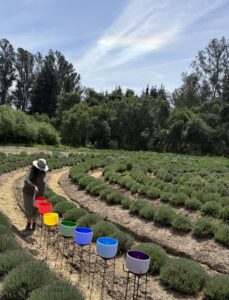
Hearing: Here’s Starr arranging her sound bowls in the labyrinth and trying out the stands to make sure the bowls are stable for her first of the 5 Senses workshops she’ll be hosting with Amber Michele on May 16th.

Here’s our growing crop of Otto File polenta corn at the end of April. Due to the convenient vagaries of the weather we have never been so far ahead with all of our farm work as we are this year. The tomato crop is already in the ground and we’re working our way towards having a whole spectrum of veggies this year. Pop-ups will be coming soon.
Hi Folks: Starr & I are excited to announce the farm’s “5 Senses” workshops that we’ll be hosting over the spring and summer; “Hearing, Tasting, Touching, Smelling, and Seeing” in our beautiful gardens. We’re thinking of it as an opportunity to turn away from the craziness of the world for a moment and return to a sense of oneself in a beautiful world. Starr has assembled a posse of friendly and skilledpractitioners to make the workshops welcoming and positive. The details are all on our website @ https://www.mariquita.com/features/5-senses-series-coming-home-to-self-bundle-of-all-5-workshops/ We hope you’ll join us for one or all of the events.

Where does “media crisis” fit in your action plan?
But you know me…. It’s spring and I’m in the middle of planting, so I’m often caught up in the drama of day to day issues like weeding, watering, tractors and fertilizer. Especially fertilizer. You’ll recall that Timothy McVeigh blew up the Murrah Federal Building in Oklahoma City back in 1995 using a bomb made from a mix of ammonium nitrate fertilizer and diesel fuel. His attack was the single most nauseating act of domestic terrorism since the Army’s massacre of the Lakota people at Wounded Knee….unless you count the 1921 Tulsa Race massacre….or the mass internment of Japanese American citizens in concentration camps during the Second World War. And the tab is still open and counting for ICE agents shooting people who peacefully protest their leadership, their mission or their tactics. For “One nation, under God, with liberty and justice for all,” we sure have some stuff to work out. But if we can’t or won’t learn from our past experiences in South Dakota, Oklahoma, California, and Michigan at least McVeigh’s example reminds us that conventional fertilizers can be highly explosive, and that fertilizer factories are especially vulnerable to accidents, disasters, or mischief. Which is why, when I visited my local fertilizer company earlier this spring, the “Crisis Action Plan” they had posted on the wall in their office caught my eye.
I took the liberty of removing the company’s name from the photo because I like and respect the people who work there, I need their products- or at least some of them- and I have no wish to cause any drama for them. But look! The information pages for various crises that can befall a fertilizer company have not been arranged from top to bottom alphabetically but instead according to a more existential logic. “Evacuation” comes first, obviously, because if you are working at a place that can violently explode if prompted by an electric spark, a cigarette butt, an earthquake, a lightning strike, a workplace-related live shooting incident, etc. then you’re not going to want to be flipping through a lot of pages before you run. And I love how, right after “Evacuation” comes “Media Crisis,” well ahead of “Natural Disaster,” “Medical Emergency,” “Spill and Release,” “Fire.” Priorities, priorities!” We live in a post-factual world where media agents both real and artificial are deployed to put a cyclonic spin on “information” so that we’re all awhirl and don’t know what to think. Meanwhile, the world is blowing up, or at least our President is threatening to blow up “a whole civilization.” Which takes us to the Strait of Hormuz, that narrow stretch of sea which serves as a conduit for a spectacular amount of chemical fertilizer and fuel to flow out from the oil fields to their markets in the wider world. Hormuz is a place where fertilizer and fuel can be mixed together with missles to explosive effect! McVeigh was a poor Gulf War veteran who became embittered with the government while Donald Trump is a rich draft dodger and President who sends people like Timothy McVeigh off to die in places like the Persian Gulf, but that’s where their similarities end. So why was I buying fertilizer in a building that could blow up?

Tasting: Kelly Marie at her shop, ARTNZEN. Kelly will be guiding the Tea ceremony and workshop on infusions on June 6th.

Smelling: Here are some lavender oils from the farm’s lavender labyrinth.
I
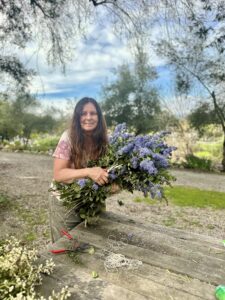
Seeing: Here’s Starr coming out of the cutting garden with an armload of wild lilac. Bouquet making will be the focus of this workshop, but it will smell great too.
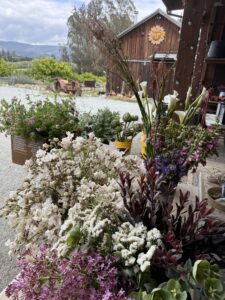
Part of a morning’s haul of cut flowers
Conventional chemical fertilizers are elaborated from petroleum and its byproducts, and especially from natural gas, which is why there is so much fertilizer being produced around the oil fields of the Persian Gulf. Fertilizer companies are just like most other companies; they want to make money and they’ll change their business practices to keep up with the times and maintain or expand their market share. All across Central California there have been farms transitioning from chemical farming into more sustainable farming practices for years now, and the big ag companies have noticed and are adapting. Many conventional fertilizer companies are hedging their bets on the future and now sell organic fertilizers that have been manufactured from composts, manures, kelps, minerals, fish, and other biological sources. I was down at my neighborhood fertilizer plant picking up a ton of 8-5-1 “TRUE” brand pelletized compost to spread in my fields ahead of planting to supplement the added natural inputs from my cover crops. If “TRUE” sounds like a cynical name for a fertilizer brand then think for a minute about the branding for fake president’s “TRUTH SOCIAL” platform; at least TRUE brand fertilizer doesn’t pretend to be more than conveniently packaged bullshit. Anyway, here’s a “pro tip” for my fertilizer supplier; if you think that the presence of the press is a crisis then you ought not post any material that is sensitive where “the Press” could see it because in this day and age any clown with a phone and a social media account- like me- can post their version of alternative facts. Lucky me, I don’t use chemical fertilizer so I’m not experiencing the cost surge with those products, but I can’t pretend that I’m “pure.” I use plenty of diesel and those prices are through the roof. It’s a weird world out there right now….and a good time to take a step back from time to time and reflect on how much beauty there is to enjoy seeing, smelling, hearing, touching and tasting.
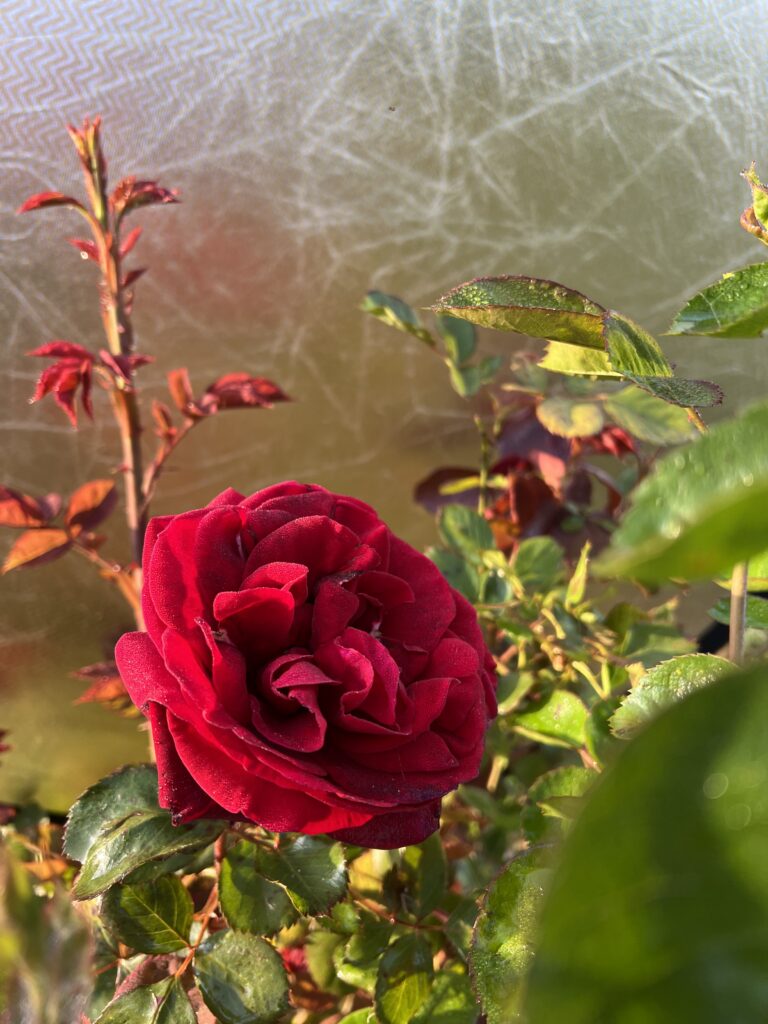
We’ve planted over 250 different rose bushes on the farm
.
|
I Helped Them Buy The Building
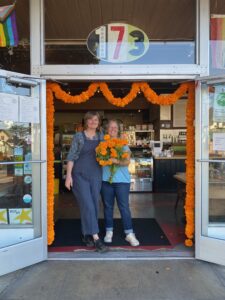
Jordan, the Happy Girl, on the left, with a happy customer on the right. Our marigolds frame the doorway.
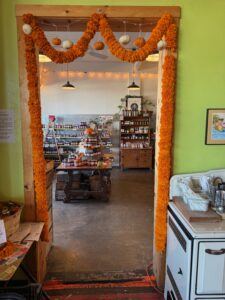
Looking from the main shop and dining area through the garland doorway to the grocery section. Happy Girl likes to deck the hall with garlands of marigold in honor of Dia de Los Muertos and Diwali
Hi Folks: I met Jordan Champagne in the late 1990s when she and her husband, Todd, literally pitched their tent along the edge of a field I was farming near Aromas. Today, I am happy to lend my support to Jordan and the team at Happy Girl Kitchen as they make a serious effort to purchase the building in Pacific Grove that houses their restaurant and cannery. There are a lot of sad stories out there about the dashed hopes of idealistic kids, the lost years of misspent youth, and the brutal realities of bad luck, but this is not one of them. Let me tell you Happy Girl Kitchen’s “Happy” story from my perspective, and let’s see if together we can help them write another happy chapter.

Jordan with one of her cows. The cows provide milk and cream for the cafe. They have a tiny but very professional dairy in upper Carmel Valley

Todd & Jordan’s Son, Rye, at Mariquita Farm, hauling a harvest of marigolds up the hill to their van to take back to the cafe.
I had been a founding partner of Happy Boy Farm, and when I left that partnership to start Mariquita Farm with my late wife, Julia, she and I chose to focus our efforts on building a “CSA program.” “CSA” is just a fancy acronym for “Community Supported Agriculture.” The idea wasn’t new, but it was exciting to us. We’d learned that in Japan there was a movement among frustrated consumers who wanted more choices of organically grown food available in their stores so that they didn’t have to rely on conventionally grown produce imported from abroad. Instead of merely complaining about how big corporations rule the world, some Japanese consumers chose to band together and support their remaining local farms by stepping in where big banks fear to lend. The people joined together with their neighbors to pay the few remaining small-scale local farmers in their communities to grow the traditional, heirloom vegetables in the natural way that they wanted – Community Supported Agriculture! Of course, the truth is that all farms are supported by some community or other; it could be a “community” of bankers, lobbyists, petrochemical companies, major chain retailers, and the politicians that do the bidding of their corporate sponsors, or it could be a community of you and I and our friends who want to preserve a local food system that works for our local interests. As we grew our little CSA farm Jordan was our first delivery driver. She was passionate about building community around food, she was excited to work with organic farms, and she had a valid driver’s license. As a former employer I KNOW how hard she works.
Meanwhile, over at Happy Boy Farms, Jordan worked with my former partner and managed his growing farmers market operation. When she noticed how much food waste seems inevitable on farms she thought to take advantage of all the cull produce and unsold veggies by preserving and canning the produce as pickles and sauces. So she and Todd learned how to do all that. And they learned about the permitting and the legal ramifications of preserving and selling food. Soon the jars of preserved foods were available to sell at Happy Boy Farm’s market stalls and a separate entity emerged- Happy Girl Kitchen. It was nice to see Jordan’s idea develop and take off. When she and Todd were able to successfully spin the Happy Boy kitchen effort off as their own company, Happy Girl Kitchen, I was happy to be able to turn to them and have them can the tomatoes that I grew, or make marmalades from the citrus I was growing.

The Mariquita Farm cats, Casha & Tassa, arriving as kittens from the Happy Girl Dairy in Cachagua. “Casha” is short for “Cachagua” and “Tassa” is short for “Tassajara.” I too grew up in that neighborhood. These two are my homies!
Besides running a CSA program, Julia and I sold produce in San Francisco’s Ferry Plaza Farmers Market. When Happy Girl Kitchen got their own stall there, so we were “neighbors” again and we would each pitch our tents near to each other. It was fun to watch their progress. Eventually, as our children got older, it was difficult to always be busy on a Saturday morning, so after 18 years in the farmers market we dropped out to create a more amenable family schedule. In the meantime Todd and Jordan had started a family. I wasn’t surprised when, years later, they too eventually chose to drop out of regular attendance at the farmers market to better manage their family life. I was happy to learn that they had opted to move away from a life on the road serving farmers markets to open up a little cannery and cafe in the nearby town of Pacific Grove. I was worried a bit about the challenge they’d face running a restaurant as well as managing a cannery, but they did it! That was 15 years ago now< And they’ve done it well. Happy Girl Kitchen has become a hub for farms all around our area. Not only have they preserved produce for a wide range of our local growers, they have taught classes, organized events, served as a venue, and cooked a million great meals. I’m so proud of them and it’s fun to have a “I knew them when” story.
Besides operating a Community Supported AG program for many years and working in farmers markets I’ve served the restaurant trade, especially in San Francisco and Berkeley. In fact, the first vegetable farm I ever worked on back in 1980 was a garden that was in the service of Berkeley’s Chez Panisse and at this point in my life the ups and downs of the restaurant industry are in my DNA. With over 45 years in the service of kitchens I’ve learned a thing or two.
I can think back on so many warm, inviting restaurants with great food that I worked with over the years and that are no longer with us. I know that running a restaurant is a hard and demanding task. I have respect for any restaurant that can survive the initial period of being the exciting new place in town and mature into being a timeless destination. It’s not enough to serve good food in a warm and inviting environment. It’s not always even enough to be a really WELL RUN place with happy, dedicated employees, dishing out thoughtful service along with the great food! What I observe is that it’s the restaurants that can do all of that and who OWN THEIR BUILDINGS that thrive over the long haul.
Happy Girl Kitchen has survived the ups and downs of the economy because they do a good job, they assiduously court and support local growers in the service of their community and their customers, and they work hard. I trust them.
As a farmer I want places like Happy Girl Kitchen in the neighborhood to buy the herbs, veggies, fruits and flowers that I grow.As a food producer with too much to do already I depend on canneries like Happy Girl Kitchen because I need a licensed, permitted facility with a skilled staff to preserve the tomatoes I grow or make marmalade from the citrus I’ve produced.
As a consumer and resident of the Monterey Bay Area I enjoy restaurants like Happy Girl Kitchen. When I find myself on the Monterey Peninsula and I want a great sandwich or a savory hot soup, or a cup aromatic chai, HGK is always inviting, dependable and satisfying and I always direct all my friends who are checking out the Monterey Bay Aquarium to drop in there after visiting the otters and octopi.
And as a hopeful person I need places like Happy Girl Kitchen to thrive; their success validates my own dreams about the healing effects of warm, positive, flavorful community spirit. Join me, and let’s all say, “We helped them buy the building!”
Links Below


.
|
Hey; look what’s in season!
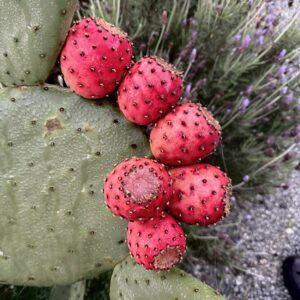
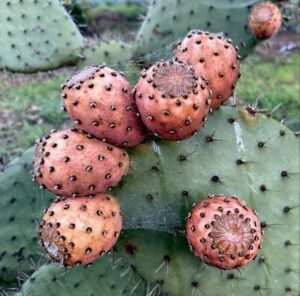
The flesh of these tunas is a bright, tangerine orange. I knew it was time to harvest because I saw the birds moving in.
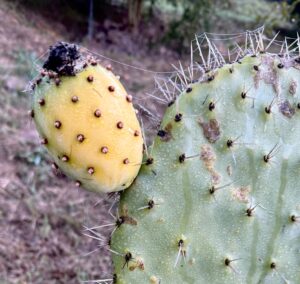
The white tunas are the biggest, and may be the sweetest, but they also have the fiercest spines.
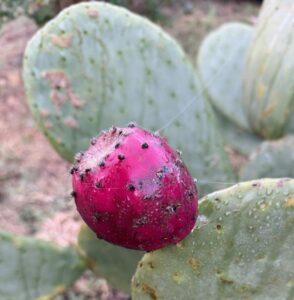
 Hi Folks: When I was in my late 20s I had an opportunity to travel to Bolivia. Having never been there before I had no expectations, so I decided to expect the unexpected. I didn’t have to wait long for satisfaction.
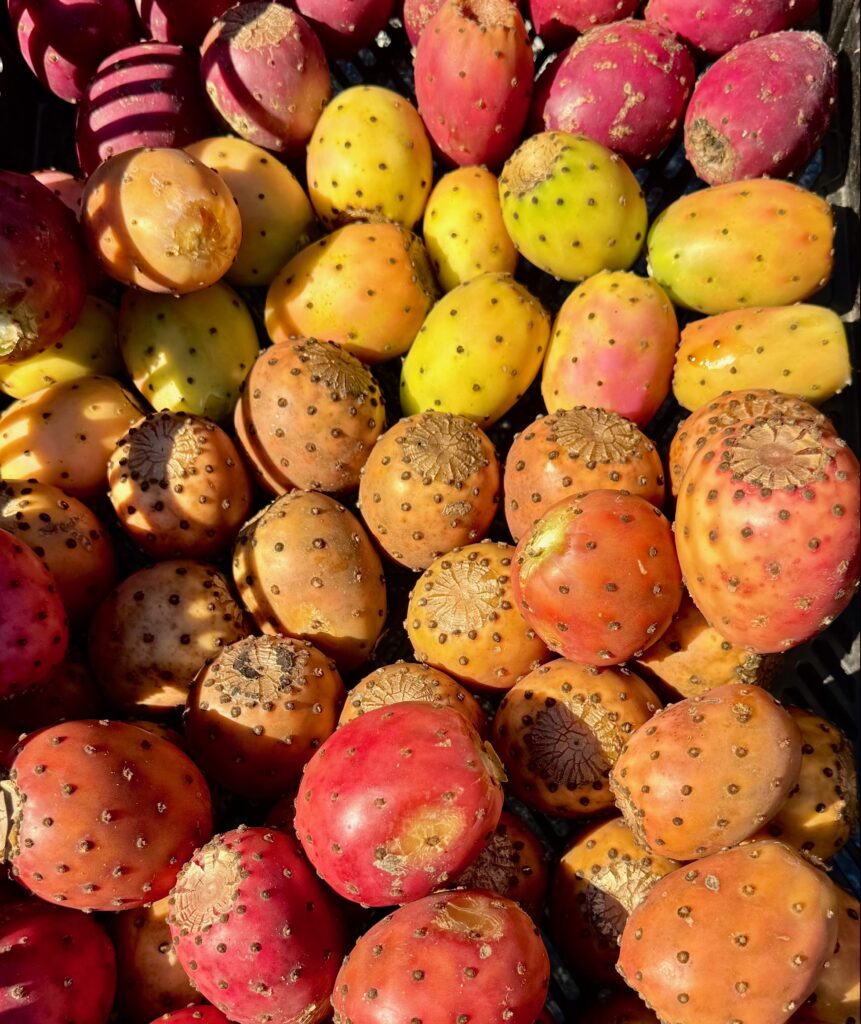
The plane flight from Callao in Peru landed in La Paz around midnight. I’d been in the air or stewing in an airport waiting room for a couple of days so I had all kinds of jet lag and I was too tired to sleep well. I decided to walk around the downtown financial district and look for a cup of coffee. The eastern sky was just beginning to welcome the dawn. There still wasn’t any traffic to speak of, so when a series of small Japanese pickup trucks began rolling down the boulevards they were hard to miss. I was interested to see each of them stop at a different street corner. In each case the drivers dropped off an Afro-Bolivian woman dressed in colorful Aymara clothing topped off with the traditional Bowler hat. Then the driver would help his passenger unfold a large blanket and spread it out over the sidewalk. The two of them would then unload the pickup truck’s cargo of prickly pear cactus fruits and make a big pile in the middle of the blanket. There were purple cactus fruits, red ones, orange ones, yellow ones, and even some that were so pale as to be described as “blanca,” or white. Once his passenger was situated on her stool next to the cactus fruits the driver would zip off into the growing stream of traffic and the woman would begin to call attention to her wares. “Tasty cactus fruits,” she would sing out. “Mine are the sweetest! A rainbow of flavor! Mine are the freshest! So nutritious!”
I was familiar with the red or purple prickly pears, or “tunas.” We have them here in California and they were a favorite fresh fruit snack with the Mexicans I worked with on farms but I hadn’t realized that tunas came in so many colors. I approached a vendor and pointed to an orange prickly pear. She speared the fruit with a wooden popsicle stick, deftly peeled it with a small paring knife and handed it to me. I’d watched her earlier customers walk off eating their fruit on the stick and spitting the seeds into the gutter so I did the same. I stopped at the next vendor and bought a yellow cactus fruit. A block later I bought a pink cactus fruit. By the time I got to my hotel I was out of change, but I’d eaten my way through a rainbow. In my private life, when I’m not busy being a farmer, I enjoy studying and growing cacti. Any vacation I can take inevitably ends up with me snuggling up to a cactus. I’d traveled to Bolivia to visit the vast, arid, southeast of the country which hosts some of the most spectacular stands of cacti in the world. I took it as a good omen that my first moments in Bolivia would be so cactus-centric.
When we think “desert” we think “cactus.” When I finally did get to the deserts of southern Bolivia I saw plenty of species of cacti in habitat, including some of the Opuntia varieties of cactus which yield prickly pear fruits. But the fruits I saw displayed on the street corners of La Paz were more “dessert” than “desert.” Over the millennia the Native Americans from Nebraska to Tierra Del Fuego had selected the best tasting, best yielding cactus varieties from the wild plants they encountered. They improved the crops that they chose to cultivate to the point where modern, garden variety cacti ought be considered as hardy, drought-tolerant, fruit trees more than any sort of desert plant.
Once I was back in California, I was inspired to plant some prickly pear cactus in my yard. For a long time I only had the red fruited form that is so common here, but a few years ago at a friend’s holiday party I was introduced to a fellow who was a member of the local chapter of the Rare Fruit Growers Association. He, in turn, passed my number on to a friend of his who had traveled widely across Mexico collecting every garden variety of prickly pear he could find. I was invited to visit his orchard in Morgan Hill and he gifted me one cactus pad each of 14 different kinds of prickly pear cactus.
All you have to do to propagate a prickly pear cactus plant is lay a pad on the ground. Cactus pads are not big, thick leaves, even though that is what they look like, but rather the succulent stems of the plant. Any leaves that a cactus plant will have are tiny, almost unnoticeably so, and they fall off the pad as the spines develop. The cactus leaves, and later the spines, grow out of a bud structure on the stem called the “areola.” Every areola is a bud capable of producing a root, a leaf, a flower, or a new branch. If you lay the cactus pad on the ground and wait, sooner or later it will take root and start to grow. new stems. I “planted” the 14 pads of cactus I received several years ago and now my new plants are mature enough to begin giving me my first harvests.
One of the nice things about having so many different varieties of cactus is that they don’t all mature at the same time; different varieties have different seasons when they ripen. Over time, as all the varieties mature, I’ll have fruit more often. Also. cactus plants flower on the older pads, so next year, with much bigger plants to pick from, I can expect much more fruit, but it’s fun to be able to offer some now. This morning, I ate several “tunas” for breakfast and I enjoyed my memory of the Black women in their colorful outfits hawking their colorful fruit with their colorful speech as much as I enjoyed the sweet fruit. And what do prickly pears taste like? “Tropical,” I’d say, “But not too sweet.” Starr said the yellow one she had for breakfast tasted a bit like melon. Each variety has its own nuances of flavor. Tunas are like Pokemon; ya gotta “catch ’em all.”
CAVEAT EMPTOR; Cactus fruits, Fiche d’India, Tunas, Prickly Pears, Indian Figs, whatever you want to call them, THEY ALL have spines; tiny, hair-like spines called glochids, which can be irritating if you get them on you. When I harvest the crop I wear glasses and gloves. I brush the tiny spines off each fruit with a brush before I make the cut and harvest the fruit. Once I’m back in the packing shed I wipe each fruit down with a damp rag. But there could always be a spine or two left over, despite my best efforts and intentions. They’re worth it. Thanks.
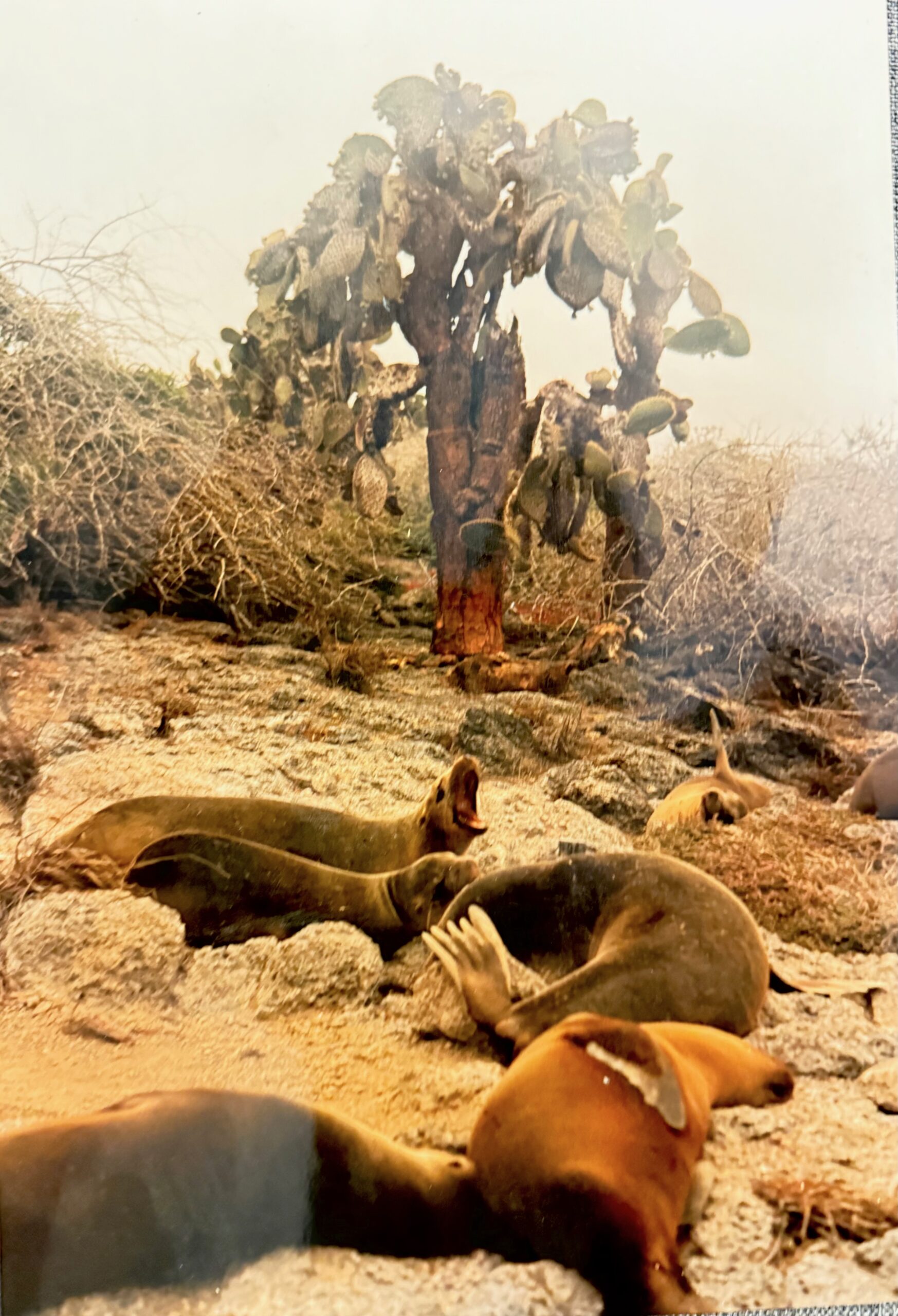
Here’s a wild prickly pear species, Opuntia galapageia, in habitat. I was standing at the water’s edge to capture this shot of the sea lions and the cactus tree in the same frame. The sea lion with his mouth open is complaining about having to say “Cheese.” As the “tunas” were not in season at the time of my visit I wasn’t able to try them. I’m sure they taste good; the huge Galapagos tortoises have the patience to wait until the fruit falls, and then they slowly eat it, relishing every moment.

Here’s our front yard “Christmas Tree;” an Opuntia ficus-indica that I planted the day I moved to the farm 38 years ago. We wish you a merry holiday season and a happy New Year.
.
|
Under a Volcano/Canner’s Special in SF and Beyond
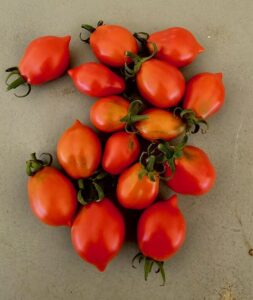
Dry-Farmed Piennolo tomatoes are so good. They taste great and if you don’t use them all at once they hang out in splendid shape for a long time. They make great dried tomatoes but they’re excellent fresh too, and I love them in sauces.
Hi Folks: This coming Saturday, September 27th, we will be in Dogpatch, from 10am -1pm, in front of Piccino Restaurant, 1001 Minnesota Street, San Francisco. We are offering our Dry-Farm Early Girl Tomatoes at a special “Canners Special Price,” of $200 for 100# orders. Or you can get single 20# cases for $50. We are also offering our Dry Farmed Piennolo Tomatoes for $30 per 12 pound case. Piennolo tomatoes are an excellent saucing tomatoes. (More on Pienonolo in an essay below.) We are sold out on our San Marzano tomatoes at present. If you want to take advantage of the Canner’s Special just drop us an email at mariquitachef@gmail.com. We’ll confirm the order and you can pay when you pick up. As always, we appreciate cash, but we accept Venmo at pick ups too. If we DON”T confirm the order it means that for some reason we haven’t gotten it. We’ve learned to scroll through our spam files because some addresses get dumped there by the filters. If we get an order but fear we can’t can’t fulfill it we will advise you. It’s best to make a pre-order if you’re counting on having your tomatoes. We do plan on having extra tomatoes for casual sale available at the pop-up on a first come, first serve basis as well.
We may offer our Canners’ Special prices for Early Girls, Piennolo and San Marzano tomatoes at future pop-ups – or not…. Once we get into October the weather gets dicey and I don’t want to make promises now that I may not be able to fulfill later. A lot of people have asked me, “How long will the tomato season last? All I can say is “the answer as to ‘weather’ or not we will have tomatoes in October is up in the air.” If I could accurately predict weather patterns my talents could be put to better use in the betting parlors of Las Vegas than in the fields of Central California. At present, the fields look good with plenty of green fruit to ripen in the days to come.
That said, on Sunday, October 5th, we plan to be be back in Palo Alto. On Saturday, October 11th, it’s back to Berkeley @ Willow’s house on 9th, and on Sunday, October 11th, we’ll be in our own home city of Corralitos. Besides our tomatoes we plan to harvest red & gold sweet & hot peppers, ornamental gourds, edible and ornamental pumpkins, cucuzzi greens and a rainbow of fresh flowers! Keep an eye on the newsletter concerning availability and pricing on the different crops. Below is a rave about the Piennolo tomato.
UNDER THE VOLCANO
It’s just a small tomato but its title is as long and majestic as any Italian aristocrat could wish for; ” Il Pomodorino del Piennolo del Vesuvio.” And, for many Italian cooks, the “Piennolo” tomato reigns “over the kitchen” with a reputation as great as Vesuvius, the volcano it takes its surname from. Mt. Vesuvius is thought of as one of the world’s most dangerous volcanoes because several million people live in its shadow. While Vesuvius is infamous for having particularly violent eruptions, all that lava and ash the mountain blasts into the air does give the surrounding region a top soil that is highly mineralized. Good color in flowers and fine flavor in fruits has as much or more to do with trace elements and micronutrients as it does with the more well-known nutrients like nitrogen, potassium, or phosphorus. What the citizens of Southern Italy lose in security by living in the thrall of a violent and unpredictable volcano they make up by having delicious tomatoes for their meals..
At Mariquita Farm we don’t have a volcano looming over us to flavor our tomatoes with danger but we do dry-farm our crops. Under a dry-farm regimen, the tomato crop is not irrigated. Instead, the baby tomato plants are transplanted into moist soil in the spring and, as the water table gradually retreats, the roots follow the moisture down, down, down, out of the top soil and into the mineral earth underneath where the tomato plants can mine those trace elements that help create great flavor. The sheer quantity of water that an irrigated tomato plant takes up can make the fruit especially juicy, but that can also mean a “watery” flavor. Dry-farming practices help give a fruit a denser texture and a more concentrated flavor. In Italy, il pomodorini del piennolo del Vesuvio are often thought of as a premier tomato for sun-drying, so dry-farming the crop makes sense; if you’re going to struggle later on to take the water out of a fruit, why put too much water in in the first place?
“Piennolo” means “hanging,” and the Piennolo tomato is famous for being a tomato that the peasant can pull up by the roots towards the end of the season and hang from the ceiling in the kitchen, green fruit and all. When rain and frost come in the late fall and the tomato plants in the field turn brown, fall over, and rot, back in the kitchen the Piennolo tomatoes are “hanging out.” The green fruits of the Piennolo slowly color up and all the cook has to do is reach up and pluck them. Tales abound of how the thrifty Italian peasant can enjoy flavorful tomatoes in their cosy kitchens even as the snows swirl in the wind outside. I’ve never been to Italy so I can’t report back on any contemorary authenticity to these stories but, as a farmer, I can say that the piennolo’s fruits hang on the plant in the field well and they last for a long time in the basket even after we’ve harvested them. I enjoy them in salads and in sauces. Starr dehydrates Piennolos and then packs them in olive oil. Wow! is word for that olive oil that’s left when the tomatoes are gone from the jar, and the tomatoes are great too.
As quintessentially “Italian” as il pomodorino del Piennolo del Vesuvio may be, let’s not forget that ALL tomatoes started out in Mexico, and it wasn’t until Columbus collided with America that the Italians discovered the tomato. As the tomato wasn’t mentioned in the Bible- American crops apparently being excluded from the Garden of Eden- the Italians had no native word for it. The first tomatoes they saw must have been a round and yellow cultivar, because they took to calling the “new” fruit a “pomodoro,” which means “golden apple.” “Pomodorino” means “Little Golden Apple,” The Piennolo may be a small fruited variety of tomato, but it packs big flavor fresh, dried, or in sauces.
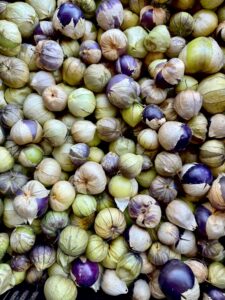
Tomatillo de Milpa
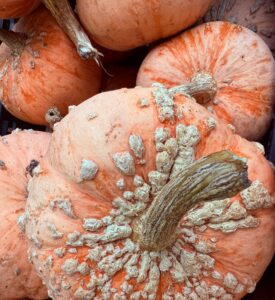
Galeaux d’Eysines, a sweet, heirloom, French cooking pumpkin that can serve as an ornament until it’s made
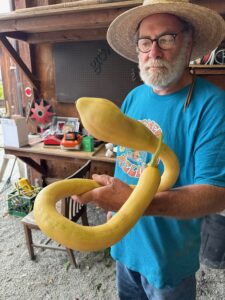
Here I’m posing with an heirloom Italian Butternut squash cousin called “Tromba d’Albenga”
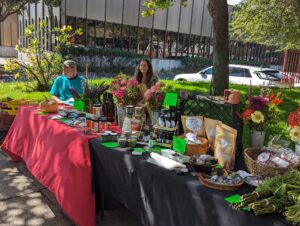
Here’s looking out across our pop-up in Dogpatch. A super pleasant scene. Thanks, SF.
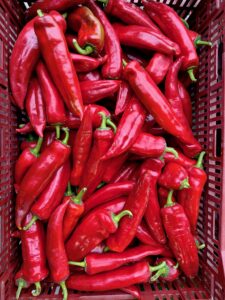
Red Anaheim peppers mix the sweet with the heat.
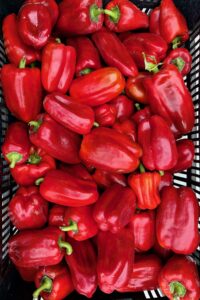
Red Bell peppers
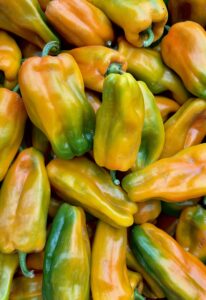
Sweet Golden Bull Horn peppers aka “Corno di Toro”
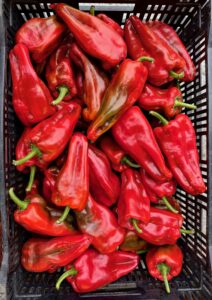
Red Bull Horn Peppers; all sweet, no heat
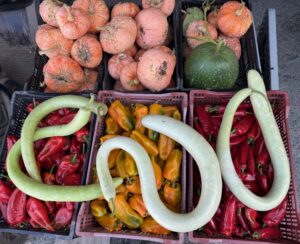
The cucuzzi gourds will naturally curl if they are not grown on a trellis to hang down from.
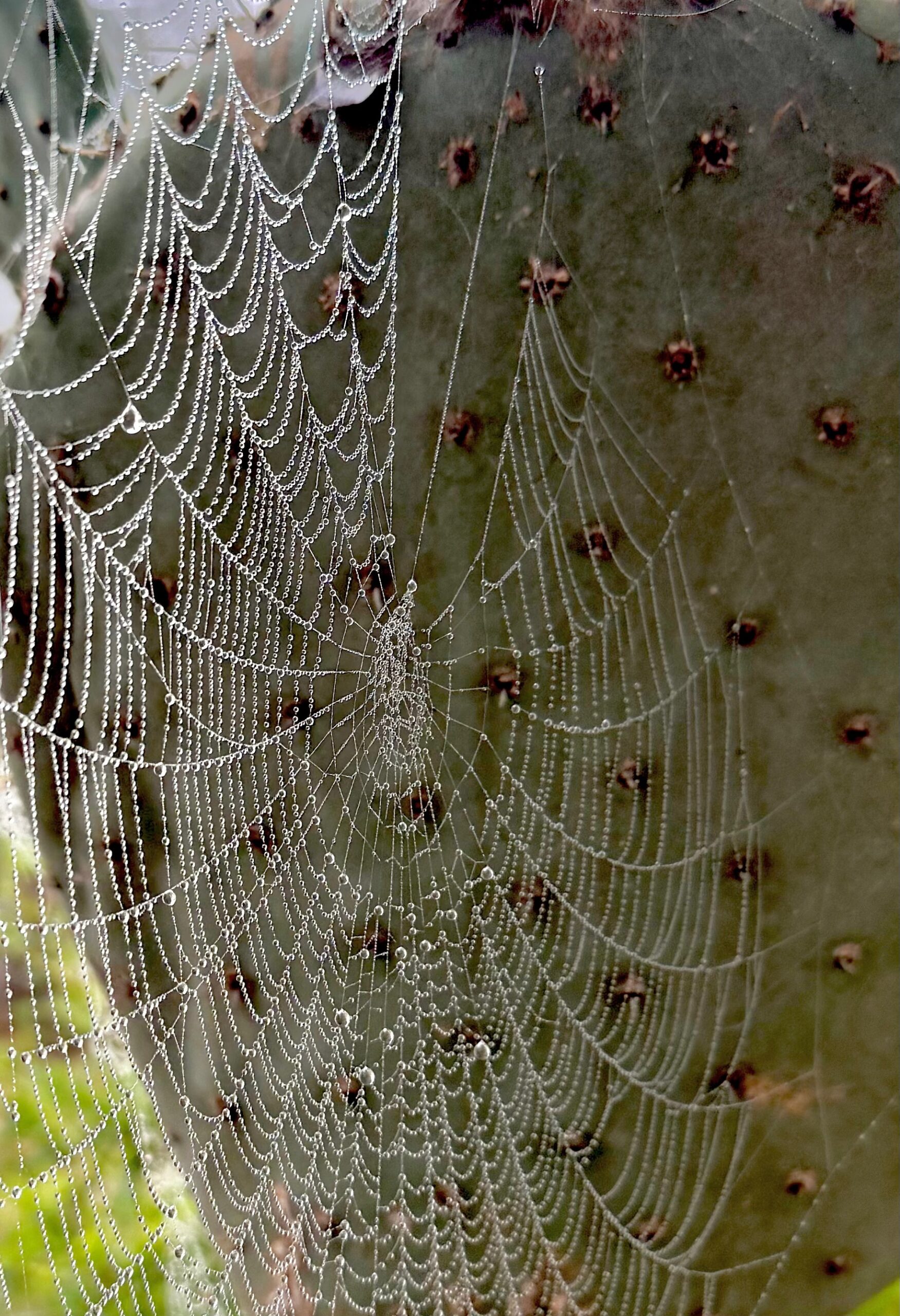
Who needs diamonds when you have fog an a spiderweb?
.
|
Sunday In Berkeley
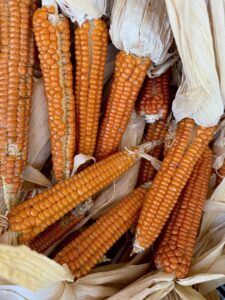
“Otto File” polenta corn, an Italian heirloom that my friend, Annabelle, originally gifted me the seeds of. Thanks, Annabelle.
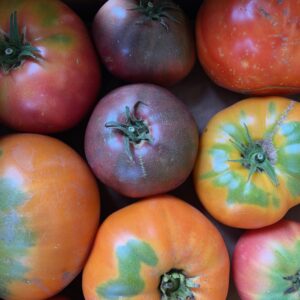
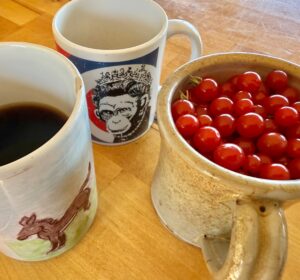
We grow these tiny “wild” tomatoes for the LA Flower market. The little tomatoes taste great, but it would take all day to fill a basket. We harvest the entire plant and ship it south to be used as a graceful and fragrant foliage green in large bouquets.
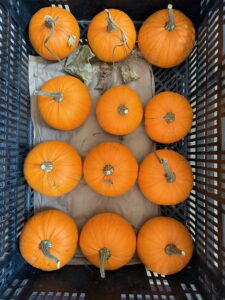
Baby Bear Pumpkins are in. They are real pie pumpkins and veritable ornamental edibles.
Dry-Farmed Piennolo tomatoes are so good. They taste great and if you don’t use them all at once they hang out in splendid shape for a long time. They make great dried tomatoes but they’re excellent fresh too, and I love them in sauces.
Hi Folks: Business first! We will be in Berkeley this coming Sunday with dry-farmed Early Girl tomatoes as well as dry-farmed Piennolos, San Marzanos, Cherry tomatoes and heirlooms. Red & Gold sweet & hot peppers are in season now, as are fresh Shishitos. We’ve got ornamental gourds, edible and ornamental pumpkins, cucuzzi greens and a rainbow of fresh flowers! If you already know what you want to get just drop us an email to mariquitachef@gmail.com. We’ll confirm the order and you can pay when you pick up. As always, we appreciate cash, but we accept Venmo at pick ups too. We will be popping up on Sunday, September 21st, in West Berkeley on 9th Street at Willow’s House between Virgina and Cedar Streets, from 9-11. This is a day later than previously announced but we needed to make the change to work some kinks out of life and get some homework done. Thanks, Willow, Thanks, Willow, for generously sharing your space and your enthusiasm for preserving heirloom vegetables and traditional foodways.
For those of you who don’t know Sunday’s pop-up hostess, Willow has long been active in the East Bay Slow Food Convivium. If you want to learn about the efforts the Slow Food Movement is making to preserve, promote and popularize the open pollinated crops that our ancestors have left for us you might want to check into Slow Food. Here’s a link to their “Ark of Taste.” https://slowfoodusa.org/ark-of-taste/
We will be bringing a number of heirloom crops to Sunday’s West Berkeley pop-up, including Tromba d’Albenga squash, Chilacayotes, Otto File corn, Galeaux d’Eysines pumpkins, Tennerumi di Cucuzzi, Tusta peppers, and tomatillo de Milpa. None of these crops are produced by the big growers here in California or sold in any regular supermarket but they all make sense in the context of a little farm like ours serving a public like you. I learned about each crop and how to grow it from a different person, so besides taking delight in their varied colors, shapes and flavors, every harvest reminds me of a friend I’ve made. Here’s my “origin story” for one of these crops, the Tomatillo de Milpa:
“We live in a Paradise, Andres,” Ramiro said. “But there’s something missing.”
“Oh yeah?” I responded. “What would that be?”
It was 1992 or 1993. The date doesn’t matter much now since it seems like another lifetime before marriage, kids, or the trials, triumphs or tribulations of being a small business owner. Ramiro and I both worked on an organic farm together, and I shared my home with him and his family. The two of us were sitting around a campfire in the yard, waiting for the coals to develop that we’d be cooking over. No hurry, no worry. It was early evening on a quiet Sunday. The women were in the house hanging out, the children were playing in the dirt behind us with their dolls and toy trucks and the cat was keeping an eye on them. There were no flies or mosquitos to annoy anyone, a little ribbon of smoke rose straight into the skies and not into the eyes and a tasty dinner was about to take shape around the fire. Maybe it wasn’t paradise but it beat sitting around on a cloud with Jimmy Swaggart, Pat Robertson and Jerry Falwell while the angelic hosts twanged out “Onward Christian Soldiers” on their harps for ETERNITY.
“Look around you.” Ramiro made a grand gesture. “We’ve got all the space we could want, with a garden, a pear tree, two persimmon trees and a lemon tree. There are goats in the corral, tunas on the nopales, plenty of firewood in the shed and there’s water in the well! But….”
“But what?”
“There are no tomatillos in the milpa!”
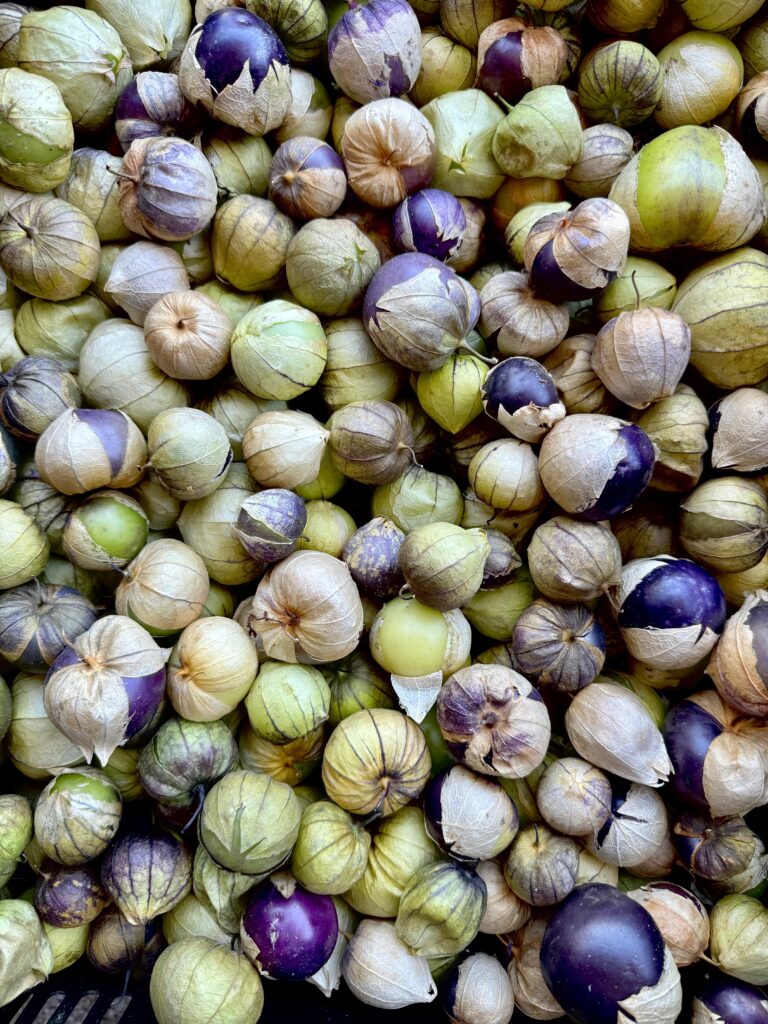
Tomatillo de Milpa
Galeaux d’Eysines, a sweet, heirloom, French cooking pumpkin that can serve as an ornament until it’s made into dinner.
Here I’m posing with an heirloom Italian Butternut squash cousin called “Tromba d’Albenga”
I knew what a milpa was. The traditional Pre-Columbian Mexican farming style was based around a Holy Trinity; corn, squash, and beans. The logic of the milpa is as follows; the corn stalks grow tall and provide the beans with a sturdy cane to climb up for support. The squashes grow out horizontally and their broad leaves choke out the weeds. Taken together, the corn, squash and beans work together to create a balanced diet for the farmer. Also, the beans work to capture atmospheric nitrogen and convert it into a soluble form that plants can take up as natural fertilizer. It’s almost magic. And when you consider that two of the worst pests in corn, the corn earworm and the corn fungus were both traditionally “controlled” by being appreciated as delicacies and consumed with alacrity, the milpa reveals itself as a remarkably sustainable food system. But of course there are weeds….
“We can get tomatillos in the market,” I said.
“Sure,” Ramiro replied. “But you have to pay for them. Besides, the best tomatillos with the most authentic flavor are the milperos. Luckily, my sister is arriving tomorrow and I asked her to bring me some tomatillos de milpa from home.”
By “home” Ramilro meant a ranch in the hills outside of La Barca, Jalisco, not far from Lake Chapala. His sister did, indeed, bring a handful of small, purple tomatillos from their milpa back home. Ramiro and I had a project together, unrelated to the farm where we both worked. In the field below the house we planted a patch of garbanzos and we sold huge bundles of the fresh plants heavy with fat, full little bean pods out of the back of my pick-up in the streets of Pajaro. Ramiro scattered the purple tomatillos along the edges of the garbanzo field and when we worked the ground up the following spring the tomatillos all sprouted. Ramiro and I worked together at Frogland Farm, and then at Riverside Farm. By the time I started Mariquita Farm Ramiro had returned to La Barca where he bought his own ranch and began raising dairy goats. That was almost thirty years ago now, but Ramiro’s tomatillos are still with me. They germinate like clockwork every spring, and they’ve spread to every corner of the ground that I cultivate.
I could get mad and say that Ramiro was a vector spreading a noxious weed, but it’s not like that at all. The tomatillo de milpa really is a good tasting crop and it is beautiful. They are so decorative that we have actually been harvesting big, tall tomatillo de milpa plants and selling them into the LA Flower Market where they are appreciated for their airy grace and durability as a “cut flower.” And we sell the colorful tomatillo fruits to people who want to make a flavorful salsa verde. (Note; if you want to make salsa verde the way Ramiro does you will roast the tomatillos around the fire until they’re soft enough to mash into sauce in a molcajete. It’s nice to add some roasted onion too, with a little roasted jalapeno pepper, a pinch of salt and a squeeze of lemon.
Here’s looking out across our pop-up in Dogpatch. A super pleasant scene. Thanks, SF.
Back to business; On Saturday September 27th, we plan to be back in San Francisco’s Dogpatch, from 9-12, in front of Piccino Restaurant. Then, on Sunday, October 5th, we’ll be back in Palo Alto. On Saturday, October 11th, it’s back to Berkeley and on Sunday, October 11th, we’ll be in our own home city of Corralitos.
Past these dates I don’t want to tempt fate by offending the weather gods with my hubris. People ask me, “How long will the tomato season last?” Truly, if I could honestly and correctly answer that question my talents would be better employed at a weather bureau. Generally speaking, September is a great month for tomatoes and October can be great but it’s hard to predict how the season will progress. It’s worth noting that we produce a lot more than tomatoes and when we can do a pop-up that showcases our other crops and products we look forward to doing so. Also, as our sacramental marigold crop comes into focus we will announce a series of U-Pick Marigold events. Keep an eye on the newsletter for announcements as all dates are tentative by nature. (That’s a pun, LOL, because Mother Nature ALWAYS calls the shots.)Thanks, Starr & Andy
Red Anaheim peppers mix the sweet with the heat.
Red Bell peppers
Sweet Golden Bull Horn peppers aka “Corno di Toro”
Red Bull Horn Peppers; all sweet, no heat

Starr is drying these sunflower plants for florists to use in their larger dried arrangements.
The cucuzzi gourds will naturally curl if they are not grown on a trellis to hang down from.
Who needs diamonds when you have fog an a spiderweb?
.
|
Fall Colors/You backed a winner!
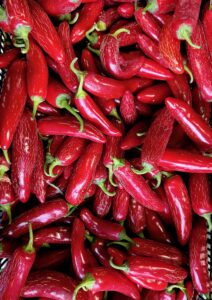
The jalapeno pepper crop is turning red; perfect for sriracha, chipotle, or for jazzing up a salsa. They make a great jelly too.
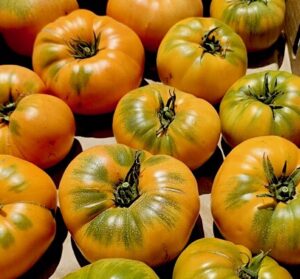
Amana Orange Heirloom tomatoes are starting up this weekend. Other colors, shapes, flavors, and sizes are ripening too.
Piennolo tomatoes getting ready for a ride through the dehydrator. We can’t sundry these the way they do in Italy because no matter how much sun we have inj the day to dehydrate we always have fog in the night to rehydrate. But the dehydrator works perfectly.
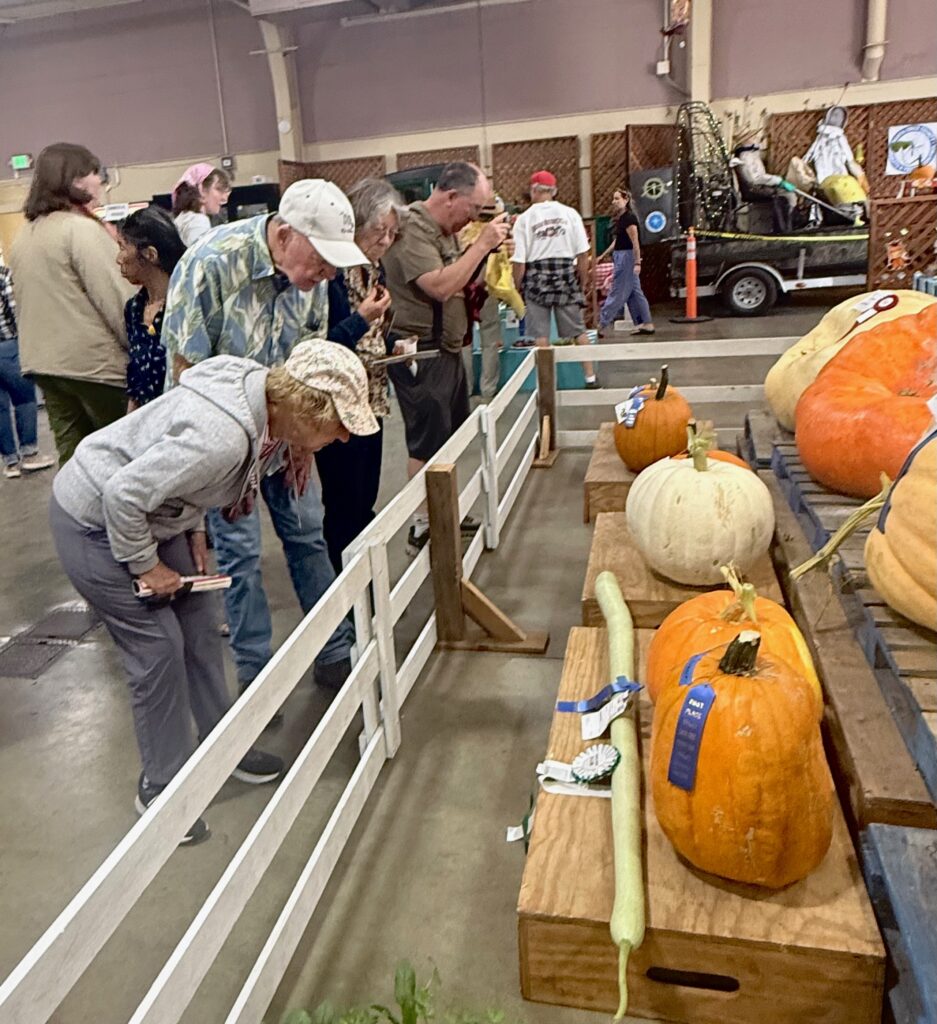
The citizens of Santa Cruz County were blown away by our prize winning cucuzza gourd. It not only won 1st place, it also won best of class.
Baby Bear Pumpkins are in. They are real pie pumpkins and veritable ornamental edibles.
Dry-Farmed Piennolo tomatoes are so good. They taste great and if you don’t use them all at once they hang out in splendid shape for a long time. They make great dried tomatoes but they’re excellent fresh too, and I love them in sauces.
Hi Folks: Fall colors are here! The fields are full and the harvest is happening seven days a week now. We’ve got Dry-farmed tomatoes of all sorts plus sweet & hot peppers, ornamental gourds, pumpkins and flowers! On Saturday, September 13th, from 9 to 11, we will be popping up at The Pumpkin House in Santa Cruz, 827 California Street, off Walnut and directly across from the High School. Then, on Sunday, September 14th, from 10 to 1 we will be in San Francisco at Piccino in the Dogpatch, 1001 Minnesota Street. If you already know what you want to get just drop us an email to mariquitachef@gmail.com and we’ll confirm the order. As always, we appreciate cash, but we accept Venmo at pick ups too. Thanks.
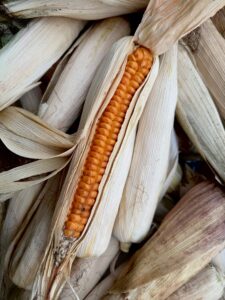
Otto File corn is an heirloom Italian corn that is considered to be the best variety for polenta. I will be bringing whole ears of it in case anybody wants to enjoy it as a seasonal ornamental before grinding it up for polenta.
Galeaux d’Eysines, a sweet, heirloom, French cooking pumpkin that can serve as an ornament until it’s made into dinner.
Here I’m posing with an heirloom Italian Butternut squash cousin called “Tromba de Albenga.”
Sunday, September 21st, will find our mobile farmstand in West Berkeley on 9th Street at Willow’s House between Virgina and Cedar Streets, from 9-11. This is a day later than previously announced but we needed to make the change to work some kinks out of life and get some home work done. Thanks, Willow, for generously sharing your space.
On Saturday September 27th, we plan to be back in San Francisco’s Dogpatch, from 9-12, in front of Piccino Restaurant. Then, on Sunday, October 5th, we’ll be back in Palo Alto. On Saturday, October 11th, it’s back to Berkeley and on Sunday, October 11th, we’ll be in our own home city of Corralitos.
Past these dates I don’t want to tempt fate by offending the weather gods with my hubris. People ask me, “How long will the tomato season last?” Truly, if I could honestly and correctly answer that question my talents would be better employed at a weather bureau. Generally speaking, September is a great month for tomatoes and October can be great but it’s hard to predict how the season will progress. It’s worth noting that we produce a lot more than tomatoes and when we can do a pop-up that showcases our other crops and products we look forward to doing so. Also, as our sacramental marigold crop comes into focus we will announce a series of U-Pick Marigold events. Keep an eye on the newsletter for announcements as all dates are tentative by nature. (That’s a pun, LOL, because Mother Nature ALWAYS calls the shots.)Thanks, Starr & Andy
Red Anaheim peppers mix the sweet with the heat.
Red Bell peppers
Sweet Golden Bull Horn peppers aka “Corno di Toro”
Red Bull Horn Peppers; all sweet, no heat
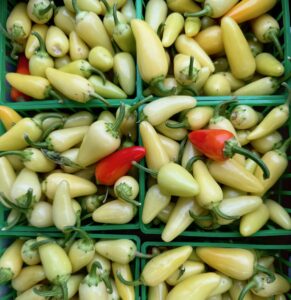
Tusta, a Oaxacan pepper with an attitude
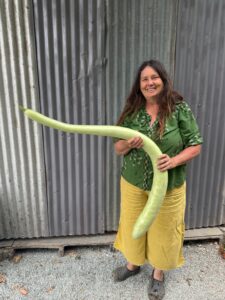
Starr shows off one of our Cuccuzi
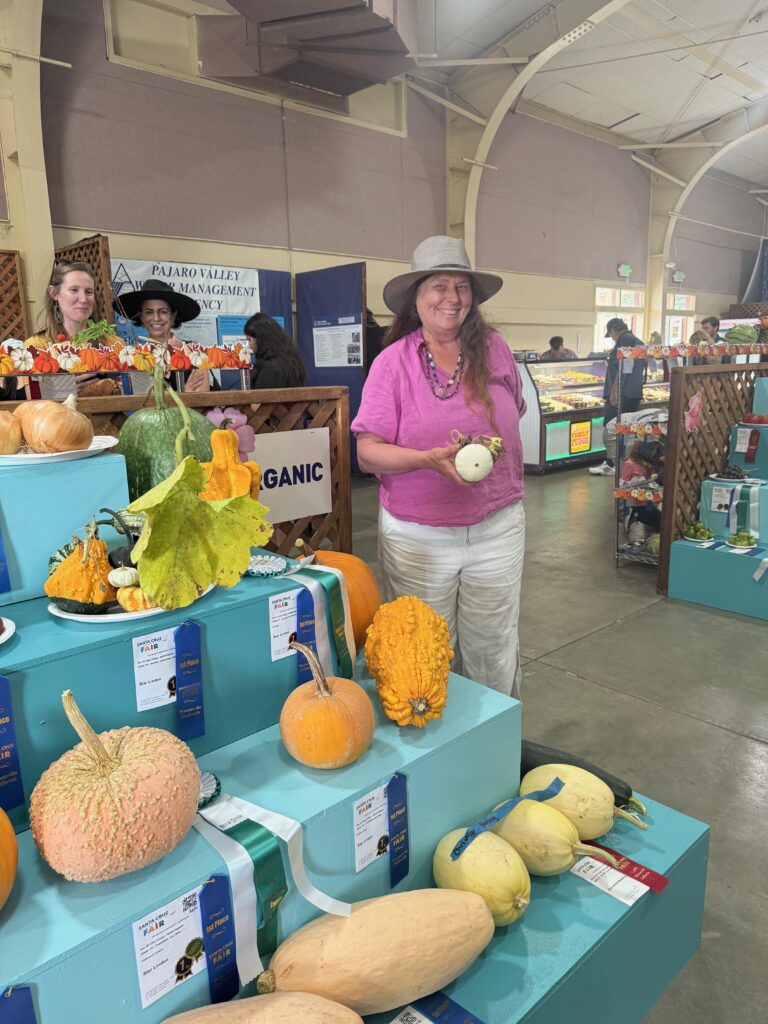
Starr at the Santa Cruz County Fair. She took first for the White pumpkin, as well as for a pie pumpkin called “Winter Luxury,” and also a selection of gourds. It was a big day for Mariquita Farm.
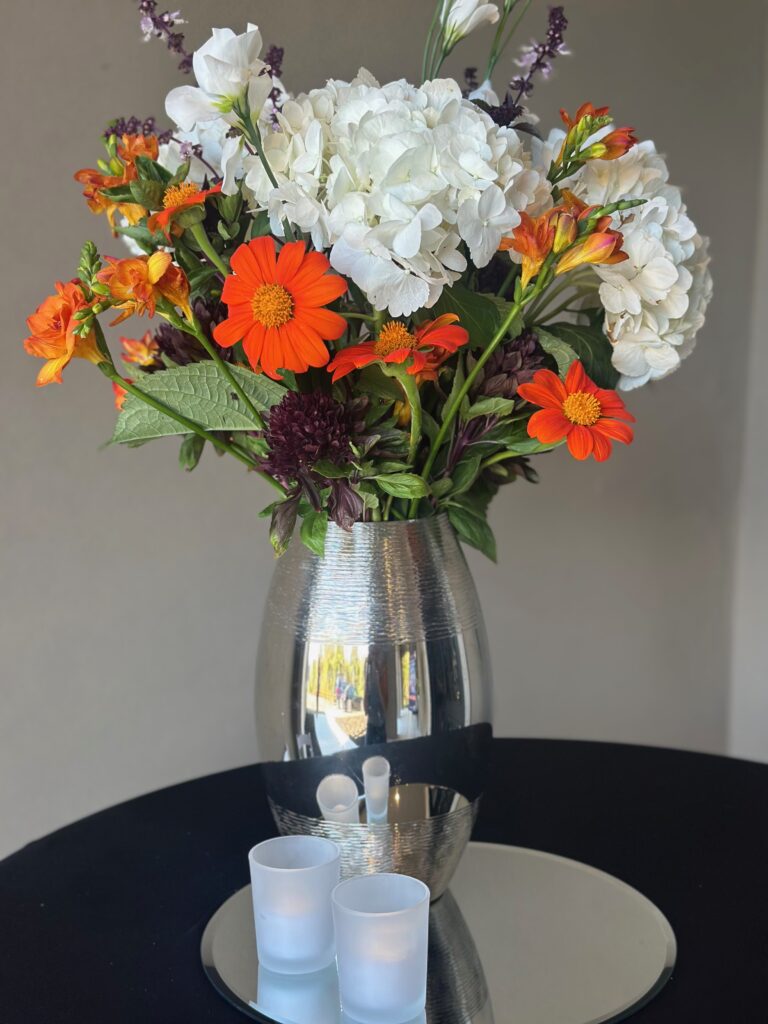
Our flowers had a night out on the town at a party in Santa Cruz. We do flowers for events.
.
|
Santa Cruz/San Francisco
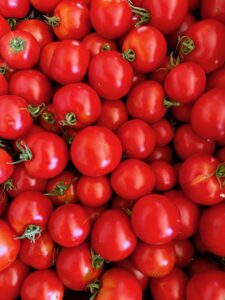
The dry-farmed Early Girl tomatoes are coming on strong and they taste great. We will be offering them by the 20# crate for $50 or by the pint basket for $3 apiece. We will be bringing around 20 cases, for sure, and maybe more.
Amana Orange Heirloom tomatoes are starting up this weekend. Other colors, shapes, flavors, and sizes are ripening too.
Piennolo tomatoes getting ready for a ride through the dehydrator. We can’t sundry these the way they do in Italy because no matter how much sun we have inj the day to dehydrate we always have fog in the night to rehydrate. But the dehydrator works perfectly.
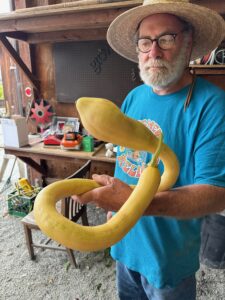
This curvy cousin of the Butternut squash tastes great and looks cool. It’s an Italian Heirloom called Tromba de Albenga.
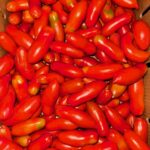
San Marzano tomatoes are starting. We figure on picking around 20 x 20# cases to bring to Piccino. We’re asking $60/case..
Dry-Farmed Piennolo tomatoes are so good. They taste great and if you don’t use them all at once they hang out in splendid shape for a long time. They make great dried tomatoes but they’re excellent fresh too, and I love them in sauces.
Hi Folks: The fields are full and the harvest is happening seven days a week now. We’ve got Dry-farmed tomatoes of all sorts plus sweet & hot peppers, ornamental gourds, pumpkins and flowers! On Saturday, September 13th, from 9 to 11, we will be popping up at The Pumpkin House in Santa Cruz, 827 California Street, off Walnut and directly across from the High School. Then, on Sunday, September 14th, from 10 to 1 we will be in San Francisco at Piccino in the Dogpatch, 1001 Minnesota Street. If you already know what you want to get just drop us an email to mariquitachef@gmail.com and we’ll confirm the order. As always, we appreciate cash, but we accept Venmo at pick ups too. Thanks.

We grow cut flowers for sale at our pop-ups, and for events. Here’s a bouquet of our flowers that was arranged by an event coordinator for a party last week.
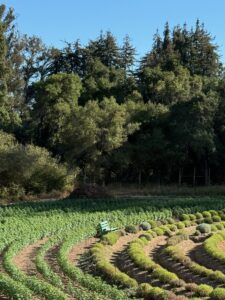
He’re the marigold patch as it is this morning. You can’t see them from this vantage point but pretty soon all the unopened flower buds will start to pop and the field will light up.
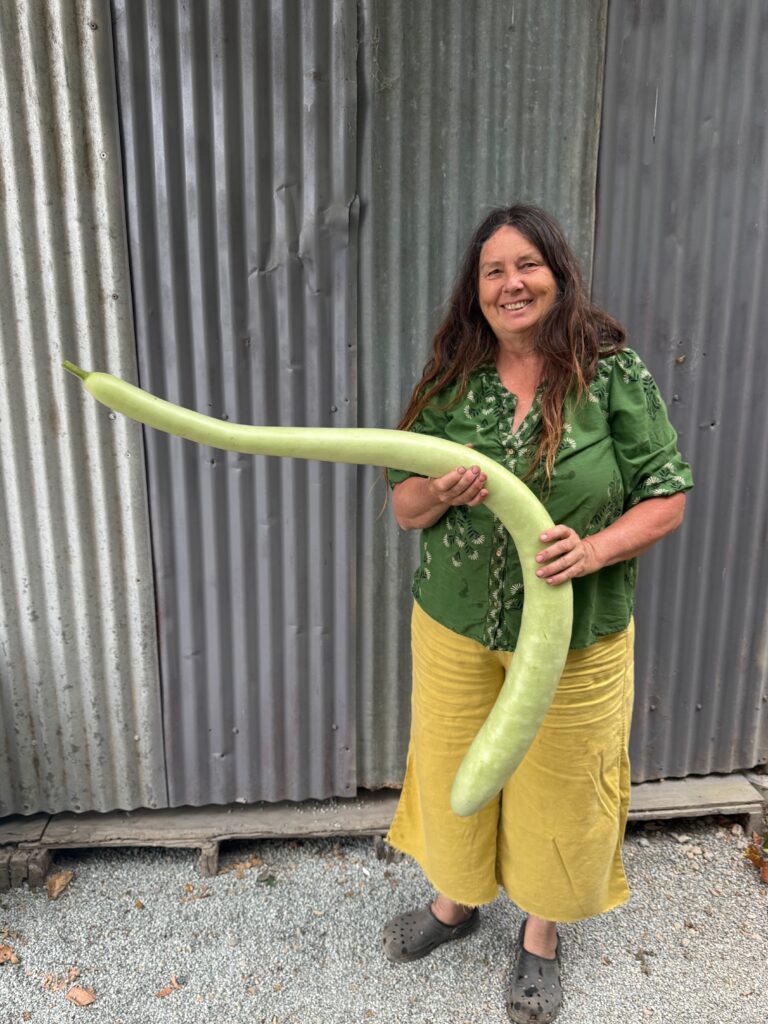
Starr is modeling an enormous cucuzza. We’ll be bringing some to our pop-ups. Let us know in advance if you want some. Thx A
Saturday, September 20th, will find our mobile farmstand in West Berkeley on 9th Street at Willow’s House between Virgina and Cedar Streets, from 9-11. Thanks, Willow.
On Saturday September 27th, we plan to be in San Francisco’s Dogpatch, from 9-12. On Sunday, October 5th, we’ll be back in Palo Alto. On Saturday, October 11th, it’s back to Berkeley and on Sunday, October 11th, we’ll be in our own home city of Corralitos.
Past these dates I don’t want to tempt fate by offending the weather gods with my hubris. People ask me, “How long will the tomato season last?” Truly, if I could honestly and correctly answer that question my talents would be better employed at a weather bureau. Generally speaking, September is a great month for tomatoes and October can be great but it’s hard to predict how the season will progress. It’s worth noting that we produce a lot more than tomatoes and when we can do a pop-up that showcases our other crops and products we look forward to doing so. Also, as our sacramental marigold crop comes into focus we will announce a series of U-Pick Marigold events. Keep an eye on the newsletter for announcements as all dates are tentative by nature. (That’s a pun, LOL, because Mother Nature ALWAYS calls the shots.)Thanks, Starr & Andy
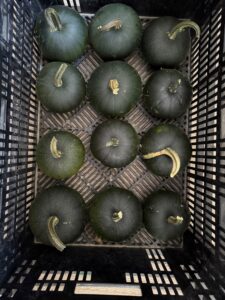
This is a small “black” pumpkin called Black Bear. I did some squash & gourd trials this year for fun.
This is an old favorite; “Baby Bear.”
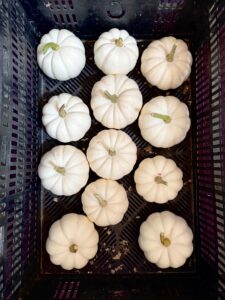
These little, white pumpkins are called “Casperita.” They do well here. I’m waiting for the plant scientists to cross one of these with a lightning bug to produce pumpkins that glow in the dark. Whoops, I shouldn’t have said that; someone will probably try…
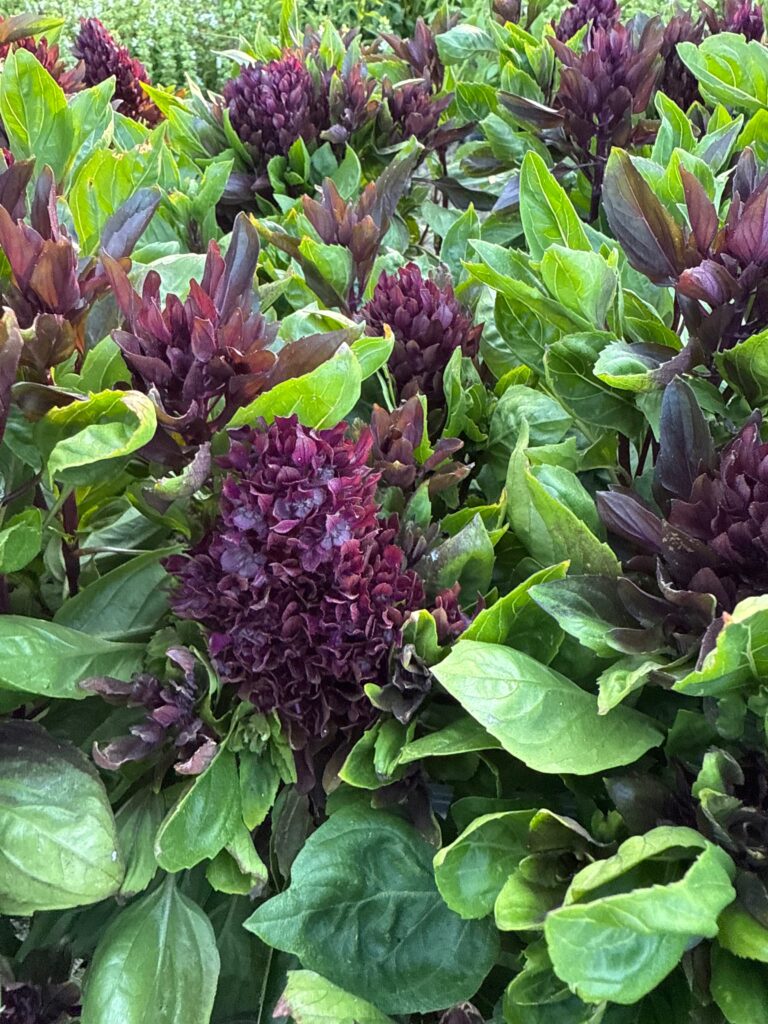
We enjoy trying new crops. This is a trial of an unusual basil called “Cardinal” that looks cool and smells great!
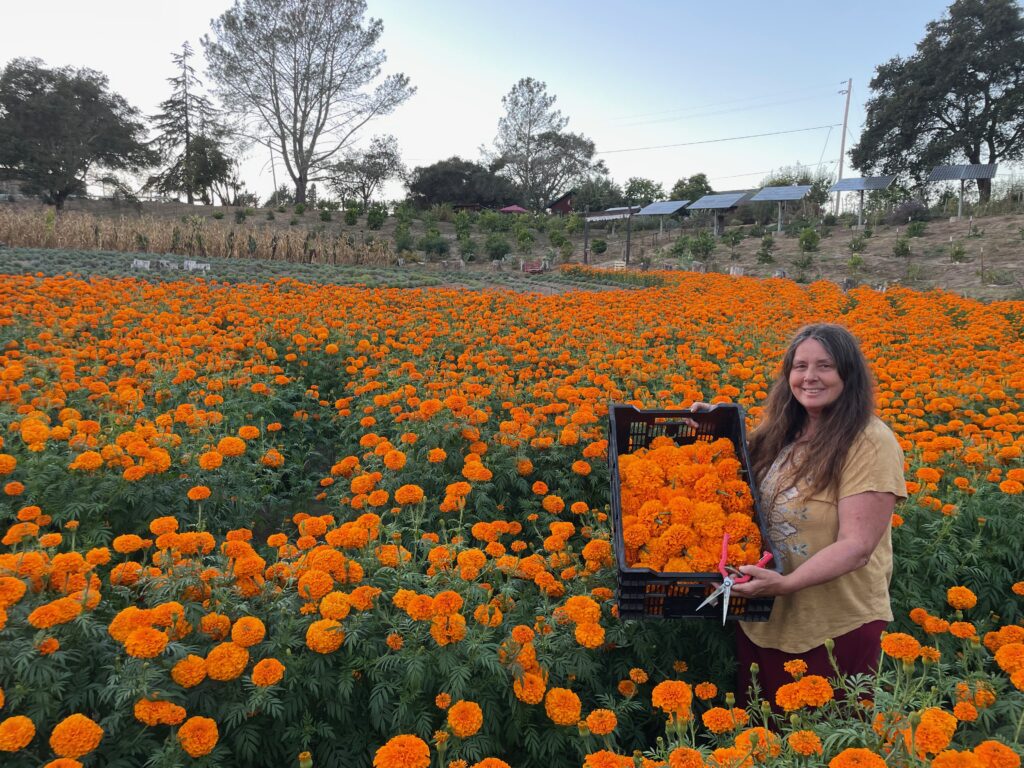
Here’s Starr picking sacramental marigolds for garlands that will decorate a Diwali shrine. We ship marigold flowers by FedEx in boxes of 100 blooms.
.
|

 Copyright © 2023 Mariquita Farm. All Right Reserved.